
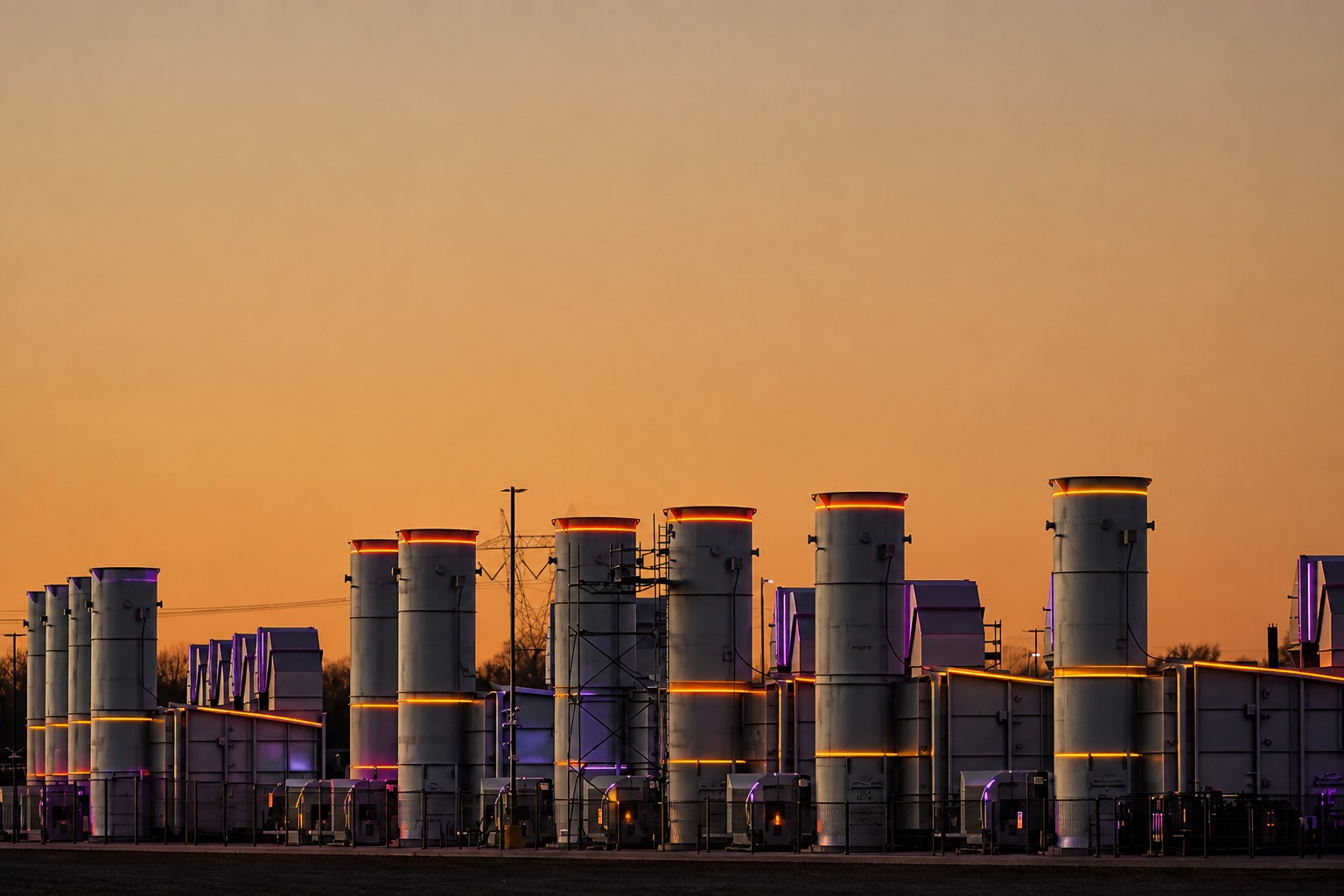
Why developers are building power plants
One prominent early example is xAI’s campus in Memphis. In 2024, it was already using dozens of gas turbines, some without permits. The project drew regulatory scrutiny and is still tied up in legal proceedings. At the time, this approach was unusual. Now, building dedicated power sources for data centers has become more common.
Connecting a large industrial facility to the grid starts with an application to the local utility or regional operator. Specialists then spend years studying what changes are needed to supply the facility with electricity while maintaining grid reliability. That may mean laying transmission lines or installing more powerful transformers; developers may be required to cover some of the costs.
The wait and expense are pushing companies toward on-site generation. Building a power plant usually costs more than connecting to the grid, but in the race to bring data centers online, companies are willing to pay for speed. Musfika Mishi, an energy analyst at BloombergNEF, says the ability to get electricity sooner is now the strongest reason developers are building generation on-site.
These power plants are called “behind-the-meter” because they sit on the customer’s side and supply a facility directly, without a conventional grid connection. But that does not always mean complete independence. Some data centers may use gas generators as a temporary solution and keep them in reserve once they connect to the grid. Brendan Pierpont, director of electricity at the Energy Innovation think tank, puts the waiting period at roughly five to seven years.
Gas plants may stay online for years
Even when developers describe on-site generation as a temporary measure, investment in fossil-fuel infrastructure can encourage operators to keep using it. Mishi warns of the risk of “lock-in”: gas-fired power plants may operate longer than originally planned.
Fossil fuels still account for a significant share of US electricity generation, but nuclear power and renewables together provide around 40% of the country’s electricity. Connecting to the grid is therefore generally associated with lower emissions than supplying a data center solely from its own gas-fired power plant. The picture varies by country. In India, for example, where the number of data centers is expected to grow over the next decade, the grid currently relies mainly on high-emitting coal plants.
Utilities are also planning to build more gas-fired power plants to meet rising electricity demand. Equipment manufacturers cannot keep up, affecting the choices developers make when building their own plants.
Large gas-fired power plants typically use combined-cycle turbines: they capture heat and generate additional electricity. This is more efficient than simple-cycle plants, which are usually cheaper to build. But Mishi says only a few of the planned power plants for data centers will use combined-cycle turbines. Their emissions are therefore likely to be higher than those of other gas-fired power plants.
Potential emissions and effects on bills
BloombergNEF tracks gas-generation projects associated with data centers around the world. Planned capacity totals 181 GW, with 90% of it in the US.
BloombergNEF estimates that if all the planned US gas-fired power plants serving data centers are built, they could produce annual emissions equivalent to 345 million metric tons of carbon dioxide by 2035. That is 152 million tons more than if those data centers drew electricity from the US grid. The difference exceeds the Netherlands’ combined annual emissions.
Data centers switching to their own generation will not necessarily protect other consumers from higher bills. Matthias Fripp, director of global policy research at Energy Innovation, says additional demand for gas could push up its price. This would affect roughly 60% of US households, which use gas for heating and cooking, and could also raise electricity prices.
The scale of construction remains uncertain. According to Cleanview, 4.9 GW of gas projects associated with data centers are operating, while 15.8 GW are under construction. Not all announced plants will necessarily be built.
What could replace some of the gas
The climate impact of on-site gas generation can be reduced by combining it with renewables or energy storage. These sources can cut the amount of time gas plants operate, although building several kinds of power supply at once makes project economics more complicated. BloombergNEF’s Mishi says this is one option.
Fripp says additional demand could also be met with renewables. In a recent study, his team concluded that renewables paired with storage can reliably meet growing electricity demand at a lower cost than fossil fuels.
Dataist's take: On-site gas plants solve developers’ need for speed, but shift some of the costs to emissions and energy consumers. How serious the consequences will be depends on how many projects are actually built, how long they operate, and whether they are supplemented by renewables and energy storage.
Daily AI news
Every day we pick what actually matters in AI and explain it plainly — no hype, no filler. Subscribe if you want to follow where the industry is going.
Only what matters — every day
Follow on X