
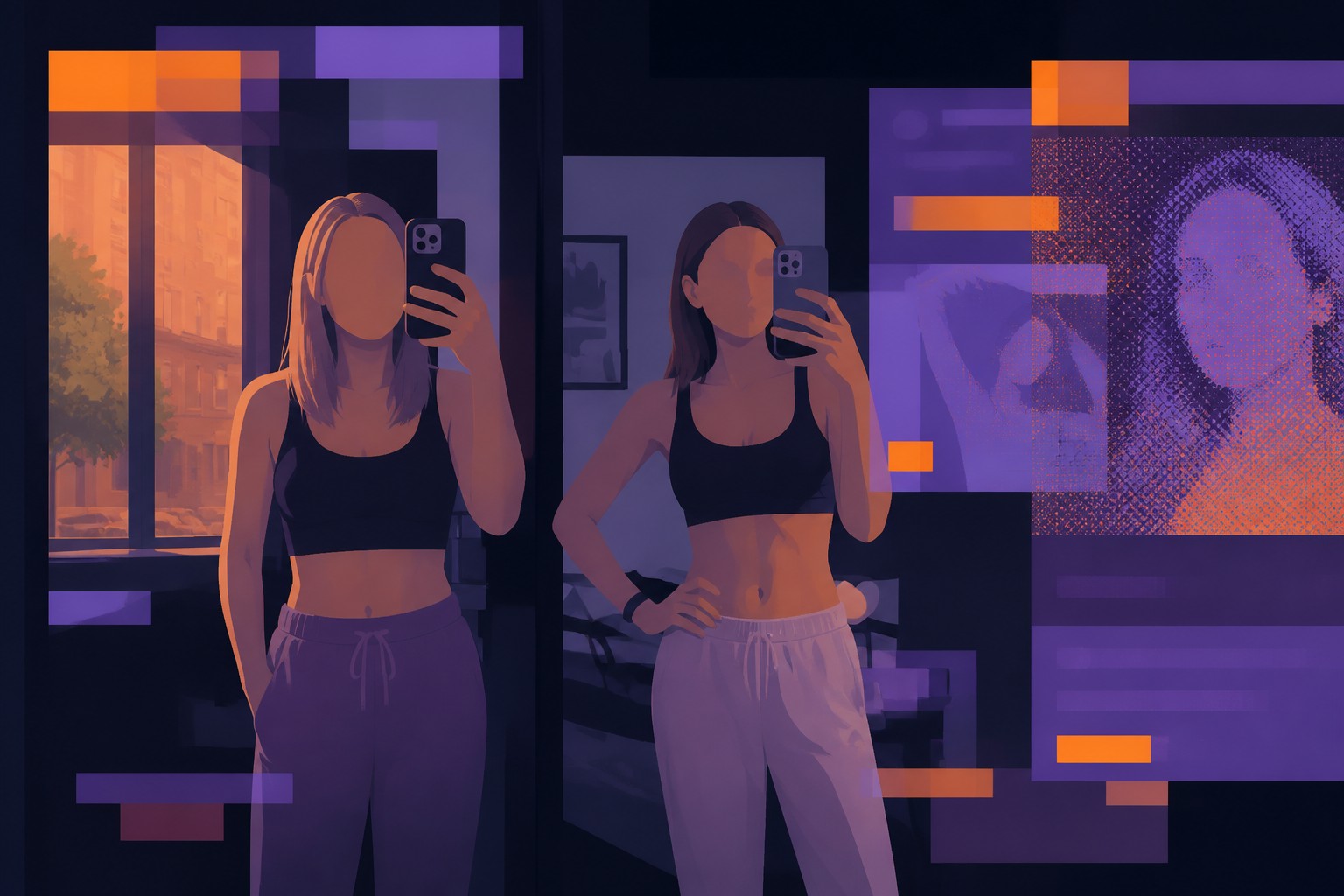
An AI-generated likeness of the influencer Schumann has been used to sell cosmetics for Meroda Cosmetics and blood testing for a company called Superpower, in campaigns she never agreed to. The first one, for a brand called Gala, was built from a selfie she had posted to Instagram years earlier; her own followers spotted it and started asking about the partnership, because the endorsement did not fit her personal brand. Surfshark's research team estimates that consumers worldwide could lose as much as $3.7 billion to deepfake fraud in 2026, about half of it through impersonation on social platforms. For creators the exposure is a different kind of problem: the forged asset is the only thing they sell.
Schumann described the experience as a violation of her personal boundaries. The videos and images looked almost exactly like her, she said, but presented an inverted version of her. In one Instagram post, an AI version of her with darker hair applied foundation for Meroda. On TikTok, generated images of her appeared in advertising for Superpower.
Gala and Meroda did not respond to requests for comment. Superpower chief executive Max Marchione said the TikTok post was not a genuine advertisement but came from a scammer the company later reported. Fraud existed before, he said, but AI has made the problem considerably worse.
The mechanics are not complicated. Generative AI has made text, code and media cheap to produce, and it has accelerated the production of deepfakes — synthetic photos and videos that can be nearly indistinguishable from reality. Influencers are unusually easy to forge, because hours of video and thousands of images of them are already public and available as training material. Alice Marwick, director of research at the Data & Society Research Institute and the author of recent work on the spread of AI impersonation scams, says that material can be loaded into a model to produce a convincing fake.
Fake promotional material has already been made with Taylor Swift, Oprah Winfrey, Kim Kardashian, Gwyneth Paltrow and Tom Hanks. But the pattern runs well below that tier. The beauty influencer Arielle Lorre was used in a deepfake for a skincare brand. The fashion creator Jessie Caparella found altered images of herself on Pinterest that sent users to affiliate clothing links. Fake videos of the OnlyFans creator Elaina St. James were used to extract money from fans through fraudulent accounts.
The sharpest case is not a scammer at all. Molly Tranchin, who has more than 500,000 Instagram followers as FashionVeggie, recently sued the underwear brand Eby. According to the suit, she contracted to make three marketing videos for a fee, with the brand entitled to request one round of "reasonable edits." In the clips she delivered, she posed modestly covering her breasts with her hands. Instead of those videos, the suit alleges, Eby published a deepfake of Tranchin in a different pose in which her breasts and nipples were visible through one of the company's sheer bras. Tranchin later withdrew the suit for lack of jurisdiction and plans to refile in another court, according to filings made last month. An Eby representative, Clara Spar, said the company cannot comment on pending litigation but will answer the claims in court.
There is also a legitimate market pulling in the same direction. According to research from the marketing consultancy Digital Applied, AI-generated, or virtual, influencers accounted for $1.37 billion in 2026 — about 4% of all brand spending. Virtual influencers may lack the authenticity of real people, but they are cheaper, available at any hour and almost unlimited in how they can be customized. Advertising has blurred the line between real and artificial for decades with retouching and computer graphics; what changed is that brands can now build content almost from scratch at minimal production cost. For some companies that has meant moving to deepfakes.
Marwick says AI has made impersonation far easier and far more convincing, so the schemes can now run at much greater scale, and that each new frontier model makes the fakes better.
Against that, what a creator actually has is a report button. When Schumann found the ads, she and her manager immediately complained to Meta, and many of her followers reported the posts too. Meta removed the GLP-1 drug advertisement only after weeks of persistent pressure. The cosmetics ad is still circulating on Instagram despite her repeated attempts to get it taken down.
Meta and TikTok both explicitly prohibit using AI or digital manipulation to impersonate a person. Their personalization systems work against that rule in practice. Meta lets advertisers segment audiences very precisely, which allows fraudsters to run fake ads quietly, open new accounts after old ones are banned and expand reach quickly. In response to complaints about large-scale fraud, Meta introduced stricter advertiser verification rules this year, along with a detection tool aimed at celeb-bait, the impersonation of famous people. Experts consider this insufficient and doubt Meta has enough incentive to clean up its own advertising ecosystem. The company did not respond to several requests for comment.
The incentive question has a number attached to it. A Reuters investigation in 2025 found that Meta earned about $16 billion in 2024 from advertising for scam offers and prohibited goods, roughly 10% of its revenue. The same investigation cited an internal presentation by Meta's safety team estimating that the company's platforms were connected to a third of all successful scams in the United States.
The asymmetry here is the whole story, and it is not really about detection. Producing a convincing fake ad takes minutes and costs close to nothing. Removing one takes weeks of a creator's time, a manager, coordinated follower reports, and often does not work at all. No technical fix proposed so far changes that ratio, because the party bearing the removal cost is the only party with no leverage over the platform.
Notably absent from the industry's response is any obligation on the people with money. Meta's two new tools are aimed at scammers and celebrity impersonation. Neither addresses the Eby allegation, where the entity accused of publishing a synthetic version of a woman's body is her own counterparty — a brand that signed a contract, paid a fee, received three videos and, according to her suit, shipped a fourth it made itself. That is not fraud arriving from outside the creator economy. That is the creator economy's buyer side deciding the talent was an input rather than a partner.
Schumann is now deciding whether to hire a lawyer against deepfakes that keep appearing. Hiring one costs money and time, she says; not fighting risks the reputation that is her income, so the creator loses either way. Influencer marketing rests on a single premise — a real person vouches for something, and followers extend that trust to the brand. The cheapest way to obtain that endorsement is now to manufacture it, and the person being impersonated pays for the cleanup.