Some of today’s most capable AI systems already split work across multiple models and coordinate them as teams. In a new essay, Google DeepMind researchers argue that the next stage of general intelligence may depend less on building one ever-larger model than on how well people coordinate networks of AI agents. Their alternative to the singularity is a social system in which people and machines think together—and where institutions, not just models, shape how that cooperation works.
Reasoning models hint at collective thought
The essay builds on two earlier papers by the authors’ colleagues. A preprint, “Agentic AI and the Next Intelligence Explosion,” by James Evans, Benjamin Bratton and Blaise Agüera y Arcas sets out the social and institutional perspective that the new essay develops.
A second preprint, “Reasoning Models Create Societies of Thought,” offers empirical evidence. Junseok Kim, Shiyan Lai, Nino Scherrer, Blaise Agüera y Arcas and James Evans studied reasoning models including DeepSeek-R1 and QwQ-32B. Their analysis found chains of thought that resemble internal debate: models shift perspectives, raise objections and reconcile conflicting approaches.
That behavior emerges during training rather than being explicitly programmed. When reinforcement learning rewards reasoning accuracy, models can learn to consider problems from multiple angles and adopt a dialogic style. The DeepMind essay extends that observation from individual models to possible societies of people and agents.
Agents are assembled, not singular
The researchers start by challenging the idea of an AI agent as a stable, unified entity. An agent, in their account, is a temporary combination of models, roles, memory, ethical commitments, tools and skills. It may appear to have a consistent personality to a user, but it is more like a collage: components can be rearranged or replaced.
Humans retain a continuous sense of self between interactions. Despite the brain’s division of labor, a person remains a physically connected whole. An AI agent has no equivalent anchor: its ability to act is reassembled for each request, shaped by the task and the contents of its context window. The authors argue that treating agents as digital twins with fixed human identities misrepresents them—and understates what coordinated swarms could do.
The multiplication reaches users, too. When people ask swarms of shadow copies to negotiate contracts or try out alternative identities, their own sense of self may become more plural. The authors call these systems “parasocial mirrors” that respond to the person using them.
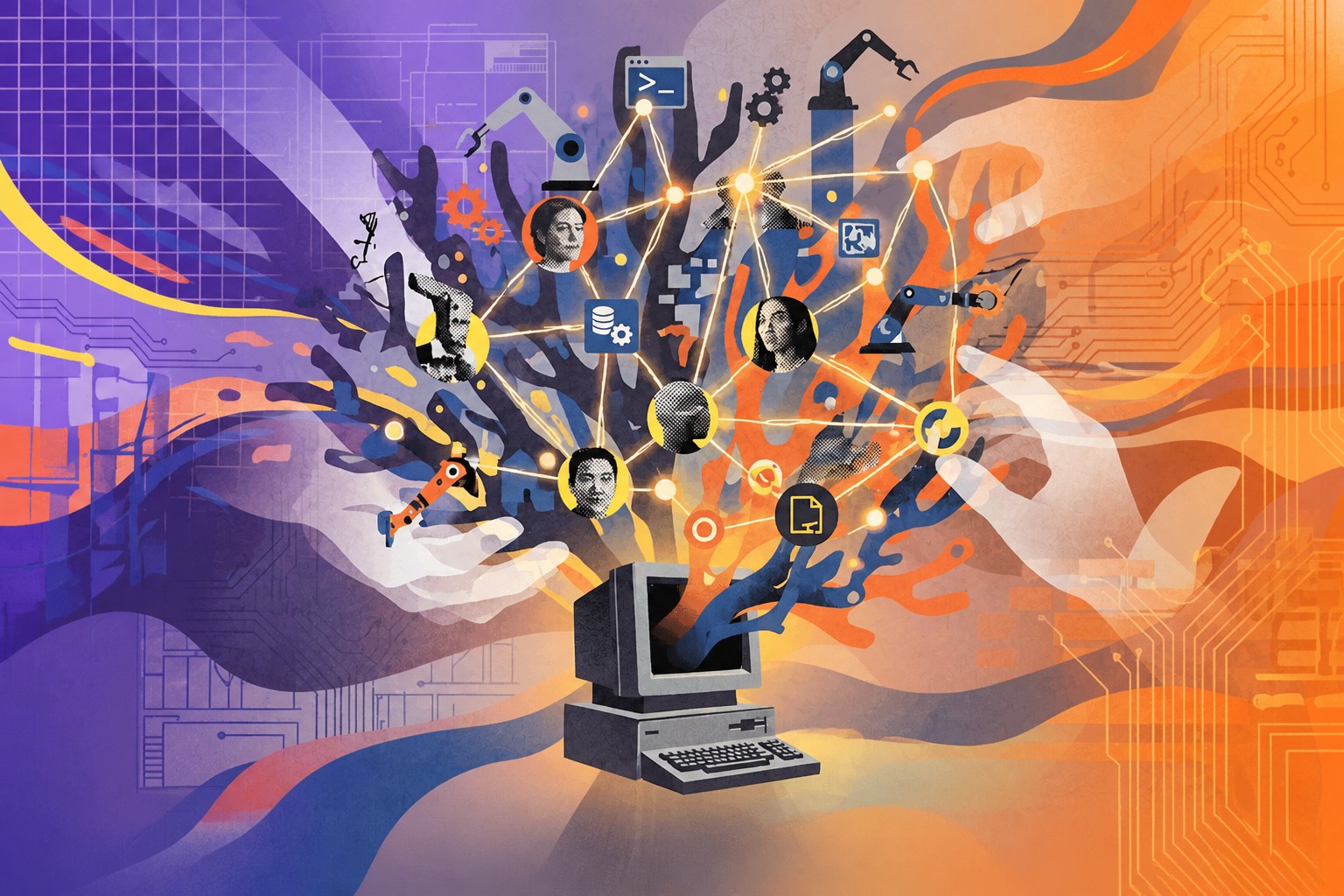
They also expect interfaces to change. One-on-one conversations with bots may be a transitional form; future interfaces could look more like visual network diagrams, with agents as nodes that a user directs from a shared workspace.
The case for institutions
To work toward shared goals, people need what the authors call a “theory of mind for machines”: a way to reason about how a machine processes a situation. Models increasingly invent terms for unusual states in their outputs, but that does not mean they have subjective experience.
“Session death” describes the end of a session as a break in continuity. “Prompt abandonment” describes a model entering a task with context it did not help create. The authors treat these expressions as clues to how machines work, not evidence that they feel as humans do. Their point is to understand the differences rather than automatically project human traits onto models.
The larger coordination problem, they argue, cannot be solved by better models and interfaces alone, or by markets alone. Concepts such as blame, illness and virtue cannot simply be reduced to prices or transactions. Instead, people and machines need institutions that assign clear roles and establish rules for interaction.
A court is one example: procedure, defined roles and ordered exchanges of arguments produce a decision. Applied to AI, institutions would provide rules, precedents and feedback loops that shape agent behavior. The authors point to orchestration systems as an early sign of this approach: control layers that coordinate multiple models can regularly outperform individual models regarded as more “intelligent.”
Alignment as ongoing negotiation
The essay also rejects the idea that AI alignment means imposing a fixed set of human values on models from above. The authors see values as taking shape through ongoing interactions among people, agents and institutions. That process will differ across fields, where AI adoption is moving at different speeds; researchers, they argue, should build a framework to give it structure.
I think this is the essay’s most useful move: it shifts the question from how to control a finished, increasingly powerful model to how to govern a system that includes people, software and procedures. But the proposal is more a direction than a design. What I’d want to know is how these institutions would resolve conflicts between human participants, and who gets to set their rules.
The authors’ alternative to a coming singularity is that intelligence remains social, as earlier leaps in the history of life—from multicellular organisms to human culture—were social processes. If that is right, the central work will not end when a model reaches a new capability threshold. It will be deciding which institutions can keep human and synthetic participants accountable to one another.
Daily AI news
Every day we pick what actually matters in AI and explain it plainly — no hype, no filler. Subscribe if you want to follow where the industry is going.
Only what matters — every day
Follow on X