
A lower score on the price curve
DeepSeek says the new version improves on V4.1-Flash in internal benchmarks, runs tasks faster and produces shorter answers. In several coding and agent categories, it also scores ahead of Claude Opus 5, GPT 5.6-Sol, Kimi K3 and GLM 5.3.
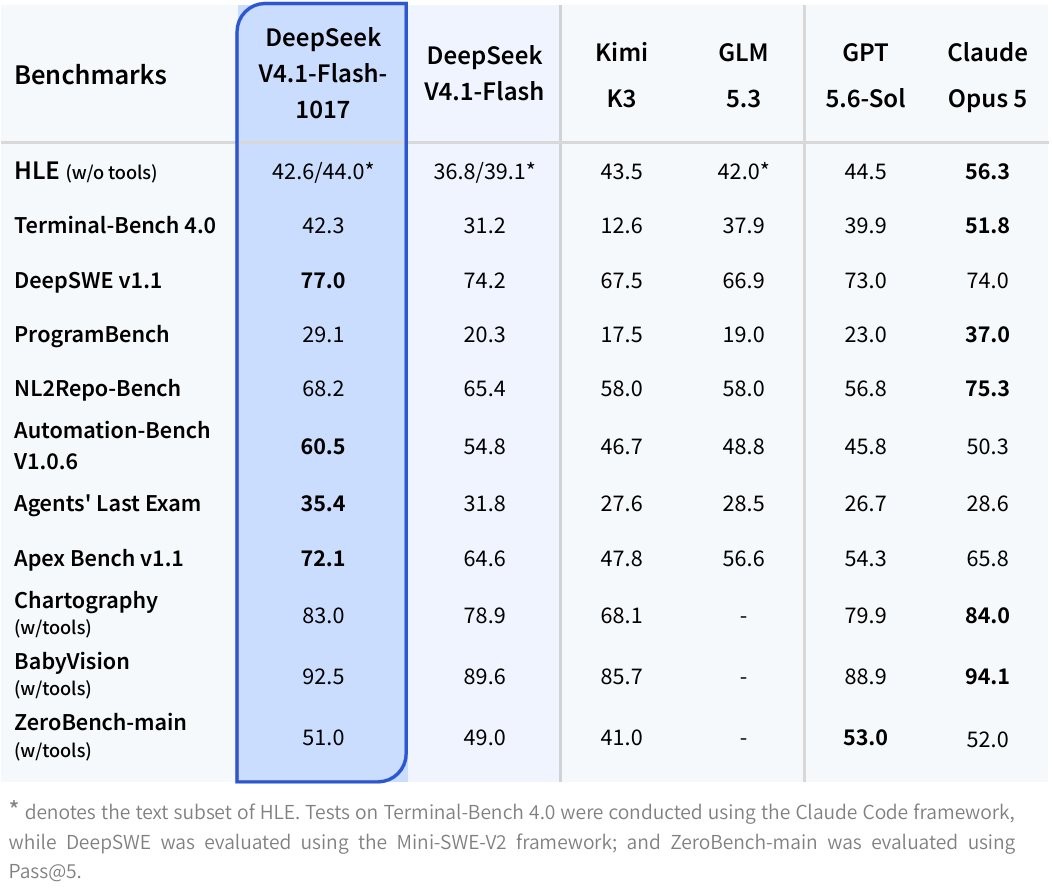
Deepseek V4.1-Flash-1017 improves on its predecessor in every tested category. | Image: Deepseek
Source: the-decoder.com
The DeepSWE results put the cost claim in concrete terms. V4.1-Flash-1017 reaches 77.0% at just under $0.20 per task; its low-cost setting exceeds 72% at about $0.10. The previous version scored 74.2% at roughly $0.50 per run. On the same chart, GPT-6 Astra, Gemini 3.8 Flash and Claude Opus 5 cost from $2 to more than $10 per task, without matching the smaller DeepSeek model’s accuracy.
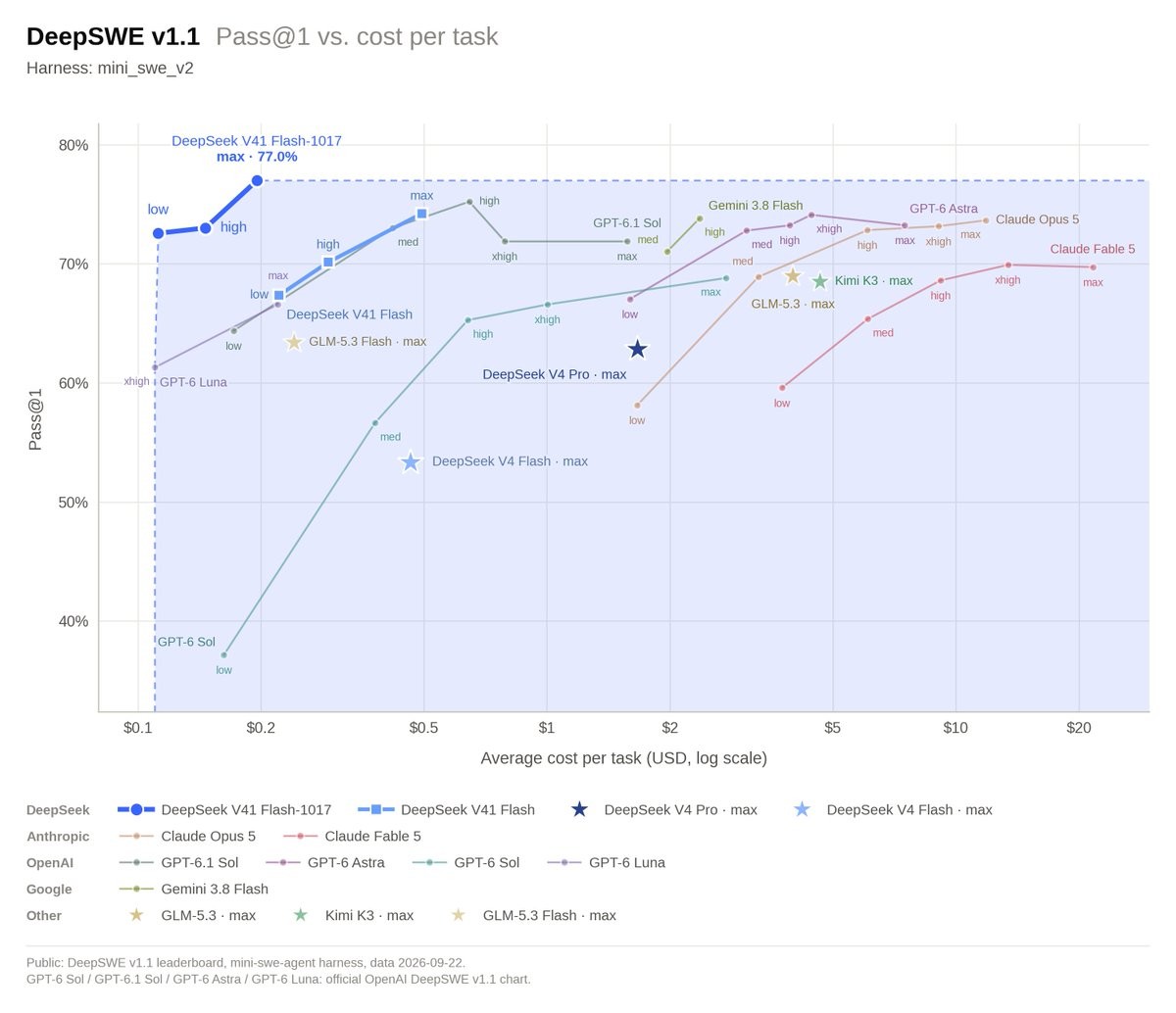
On average cost per agentic coding task, the Flash model undercuts the competition by a wide margin. | Image: Deepseek
Source: the-decoder.com
Those are DeepSeek’s internal benchmark results, not independent measurements. Benchmarks also capture only part of the experience: developers’ impressions of code quality can diverge sharply from test scores. I think the price gap is the most compelling part of the release, but it makes the absence of outside evaluations more consequential, not less.
DeepSeek says it used reinforcement learning and self-feedback (RLSF) to train the model on complete software projects. The method rewards the model using its own confidence assessments or generated critiques, without human evaluators or external reward models. The company says this helps it handle projects from game development to 3D modeling and design, as well as create animated explanatory clips. It also points to the recently released Opus 5.5 as capable of that kind of video generation.
The model is tuned for DeepSeek Harness, with version v0.2.1-rc.1 or later recommended, as well as Tencent CodeBuddy and WorkBuddy.
Search is part of the release
DeepSeek has also made its Search and Fetch tools available to all developers through an API. The company says they run on its in-house search engine, which handles hundreds of millions of queries worldwide each day. Each endpoint costs $0.75 per 1,000 calls. DeepSeek API users can access the tools for free through server functions in DeepSeek Harness, Claude Code and Codex until October 31, 2026, at 16:00 UTC.
The timing adds a complication for developers considering open-weight Chinese models. Media reports say Chinese authorities plan to tighten rules for publishing such models or ban their release outright. One factor in the decision is whether a system ranks among the ten most capable models.
My guess is that this makes the release’s two bets—cheap model access and open weights—pull in different directions. DeepSeek is making the economics of using its model look unusually attractive, while the rules around distributing the model itself may become less certain.
Source: the-decoder.com
Daily AI news
Every day we pick what actually matters in AI and explain it plainly — no hype, no filler. Subscribe if you want to follow where the industry is going.
Only what matters — every day
Follow on X