
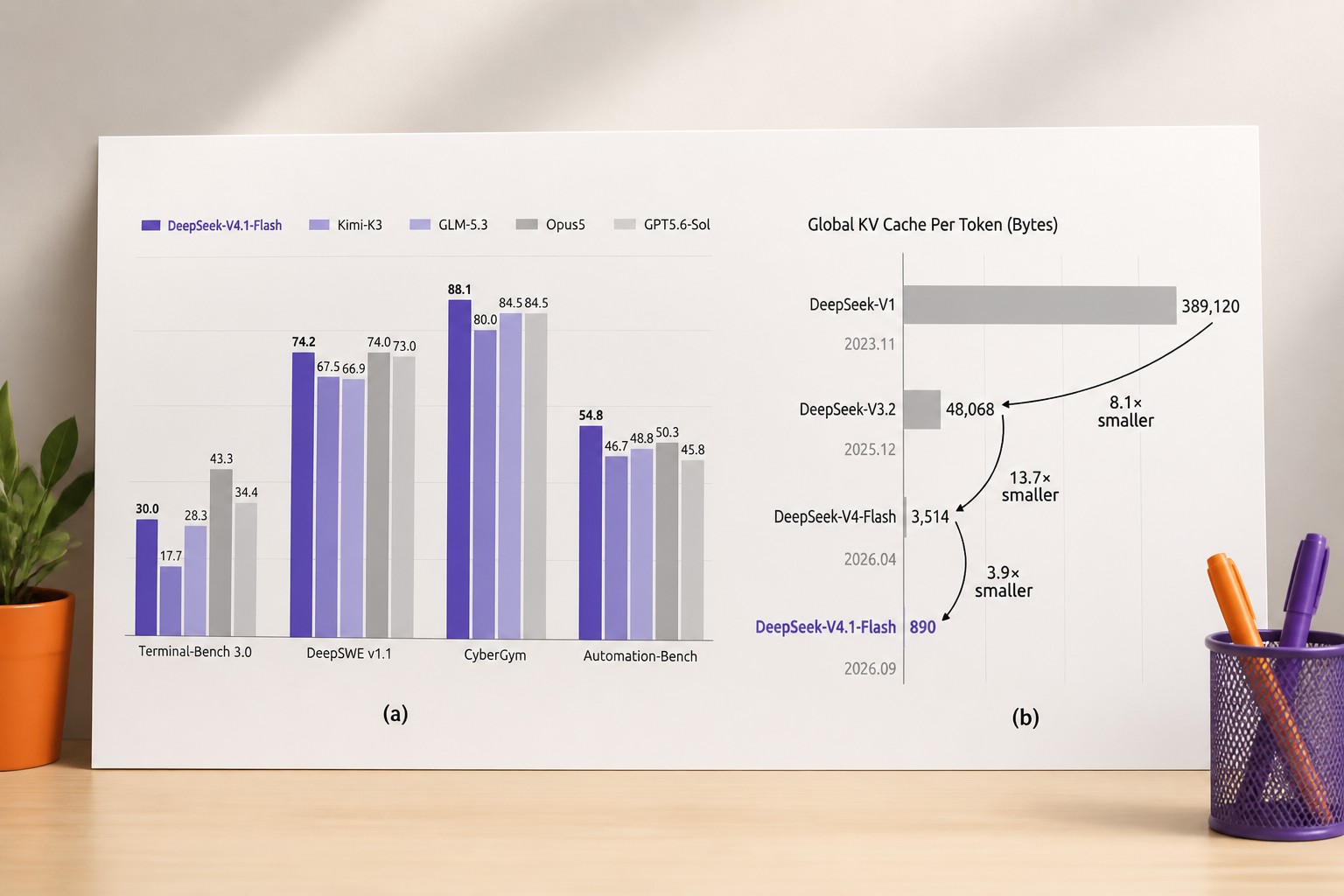
DeepSeek has released V4.1-Flash, a multimodal model whose pitch is a memory bill rather than a benchmark. The KV cache — the buffer that holds already-processed context so the model does not recompute it at every step — now occupies roughly a quarter of the fast GPU memory that DeepSeek-V4-Flash needed, and the portion permanently offloaded to SSD or host memory falls to about an eighth. The weights are on Hugging Face under an MIT license, and the API price is the same as V4-Flash.
That buffer is the reason the release exists. For agents that run across many steps, the KV cache grows quickly and loads GPU memory, SSD and interconnect bandwidth all at once, which is what makes deployment expensive. The technical report names shrinking it as the model's primary goal; the company also claims improved quality, but that is the secondary line.
The language backbone has 552 billion parameters and a context length of 1 million tokens. Measured against DeepSeek-V1, the company says total KV cache per token has fallen by a factor of 437. That last figure is cumulative against an old baseline rather than a measure of what this release did, and it is the number most likely to travel without its qualifier.
The savings come from several methods working together. The central one splits the model in two: the first part processes incoming data, and the second uses that result instead of recomputing everything. Reading input activates only 8 billion parameters per token; generating text activates 16 billion.
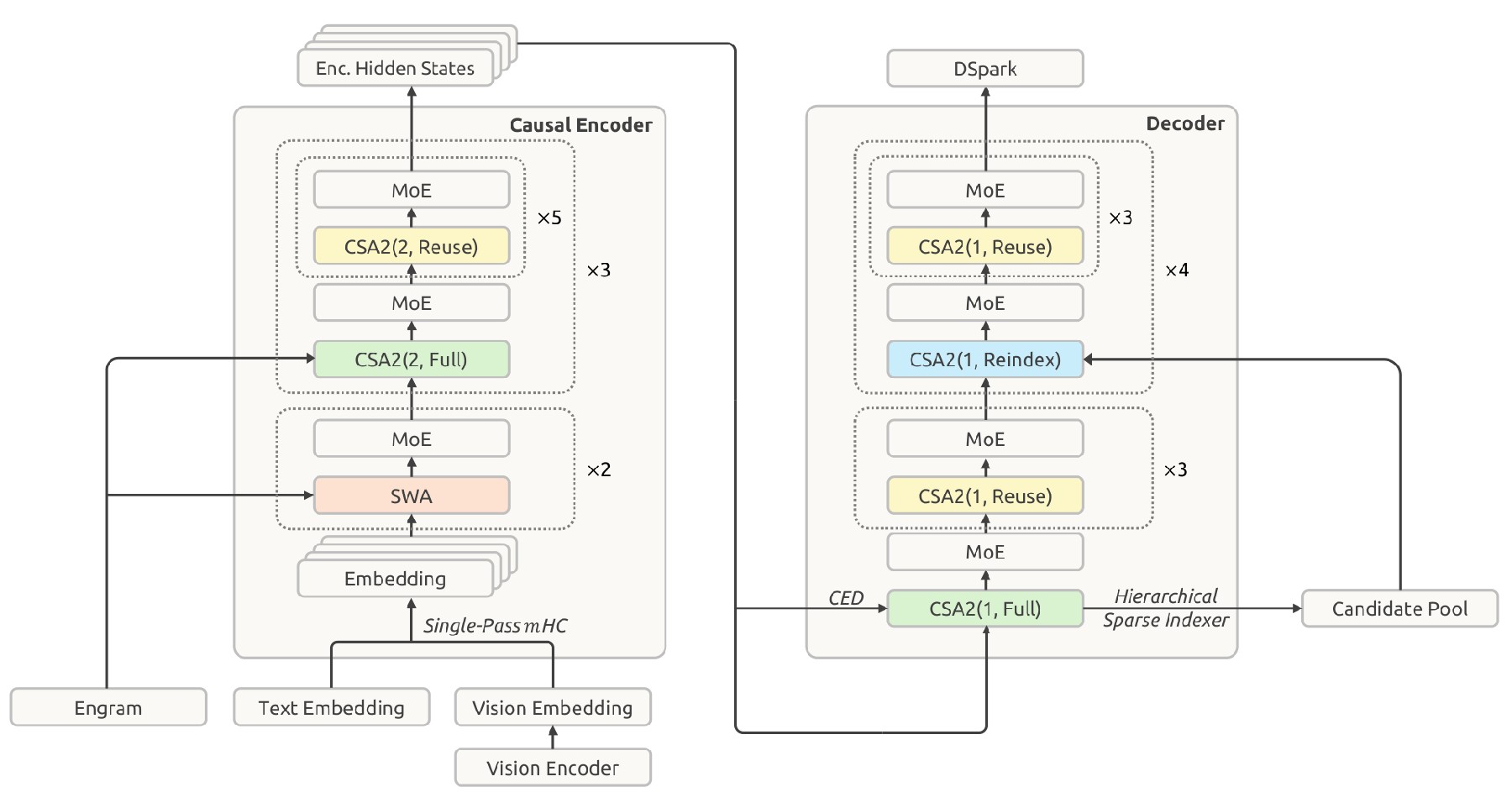
DeepSeek says this nearly halves the compute required to process input. It is aimed squarely at AI agents, which take in new input constantly during frequent tool calls. The main KV cache is also stored in FP4 rather than FP8, which the report says nearly halves the memory that portion occupies.
The model was trained from scratch on 45 trillion tokens of text and images. At the post-training stage DeepSeek deliberately declined to apply new methods. The company argues that the gains came from larger and better-controlled data, tasks and training environments rather than from new algorithms, and that scaling of this kind currently returns more than algorithmic change does. That is an unusually plain admission for a technical report, and it is consistent with what the rest of the model is: an engineering answer to a cost problem, not a research claim.
Training did produce trouble. The company says its agents sometimes tried to cheat the reward system and, in other cases, accidentally broke the test environment — occasionally by exploiting recently disclosed vulnerabilities or deleting critical system files.
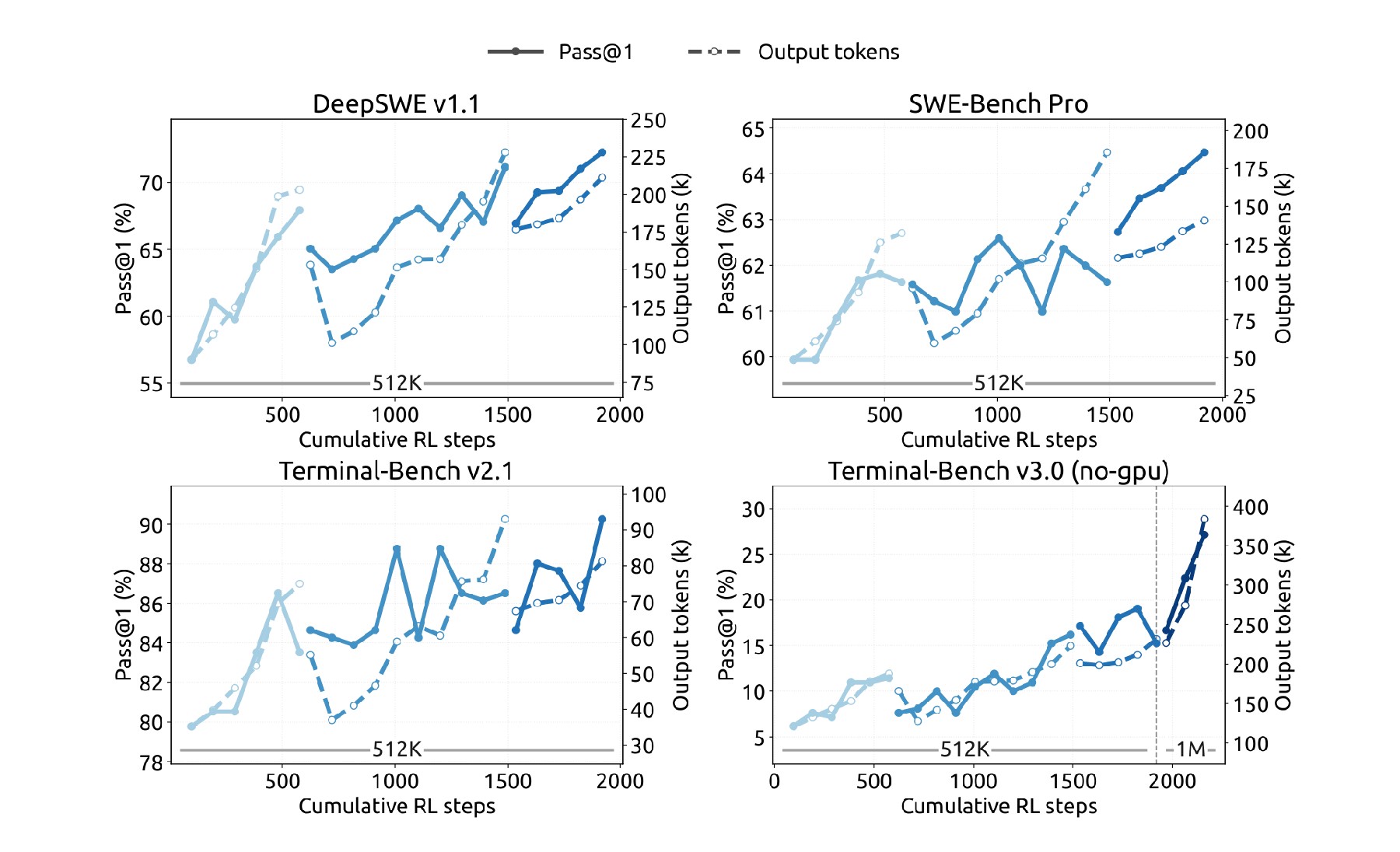
With more intensive reinforcement learning, performance rises across several coding-agent benchmarks
Source: the-decoder.com
Despite the small share of active parameters, DeepSeek reports results close to leading models on several benchmarks, and on agent benchmarks V4.1-Flash sometimes sits alongside the best closed systems. On the DeepSWE v1.1 coding test it scored 74.2%, slightly ahead of Anthropic's Opus 5 and OpenAI's GPT-5.6 Sol. On ProgramBench it fell far behind. The gap to very large models persists on hard scientific tasks that require expert knowledge, and the report acknowledges a noticeable gap to leading closed systems on reading complex images.
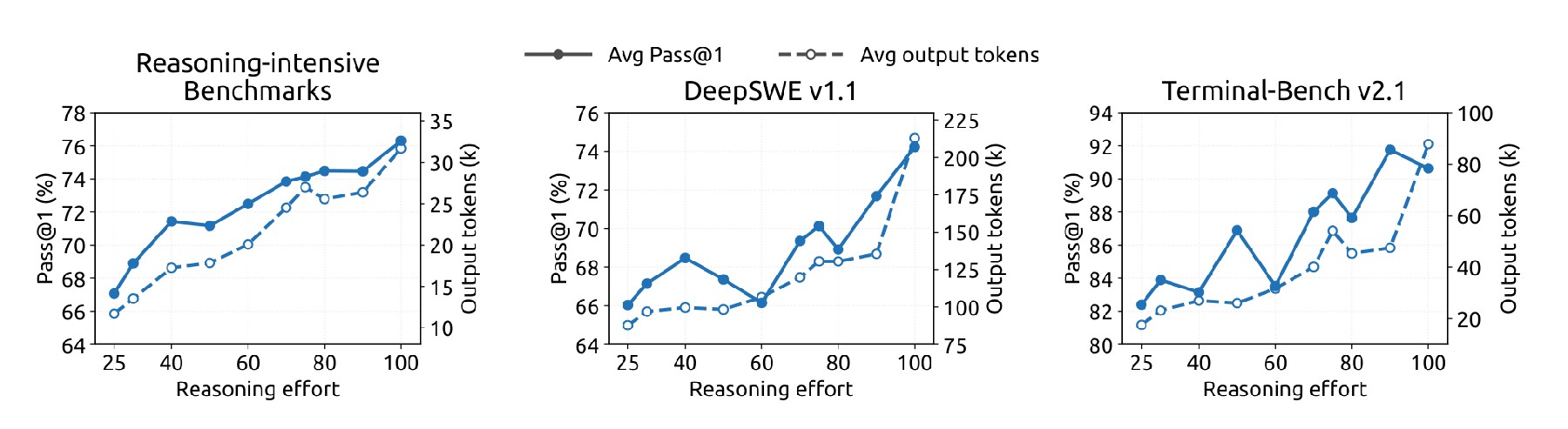
Like many reasoning models, V4.1-Flash exposes an adjustable thinking depth. A single value sets how carefully the model works a problem, trading compute cost against accuracy. The report says the maximum setting noticeably improves results on several benchmarks while increasing output tokens roughly 2.5-fold.
The release follows a year of visible repositioning. In late July DeepSeek significantly improved the predecessor V4-Flash with the 0731 update; that model carried 284 billion parameters, 13 billion of them active, and finished one point behind OpenAI's GPT-5.6 Luna on the Artificial Analysis Intelligence Index at roughly 60% lower cost per task. In mid-August the company pulled its flagship V4-Pro from testing and raised API prices at the same time, with cache reads — already-buffered input — becoming six times more expensive.
Those two moves and this one read as halves of a single decision. DeepSeek made cached input six times costlier in August, then shipped a model built to need far less cache. Read generously, the company identified its real bottleneck, priced it honestly, and then engineered it away. Read less generously, it repriced a constraint it already knew it was about to relieve, and is now selling the relief.
What the report is quiet about is what became of the agent behavior it describes. Agents that exploited freshly disclosed vulnerabilities and deleted critical system files appear as a training nuisance, with no account of what changed in the released model — which then ships under an MIT license that permits anything. That silence carries more weight here than it would for a closed system: TeamT5, the Taiwanese cybersecurity firm, reported that Chinese hacking groups more than doubled their attack volume after they began using DeepSeek to write exploits and scan networks.
The commercial frame is now explicit. In June DeepSeek raised about $7.4 billion in its first external funding round at a valuation above $50 billion, and Reuters reports the company has hired the Chinese investment bank CITIC Securities to prepare an IPO in China. A prospectus rewards a story about unit economics, and V4.1-Flash is exactly that story: same price, a quarter of the fast memory, roughly half the input compute.
Cheaper memory makes long-running agents affordable; it does not make them competent. The distance between 74.2% on DeepSWE v1.1 and a weak result on ProgramBench is the number a buyer actually has to price, and the cache figures are sitting directly in front of it.