
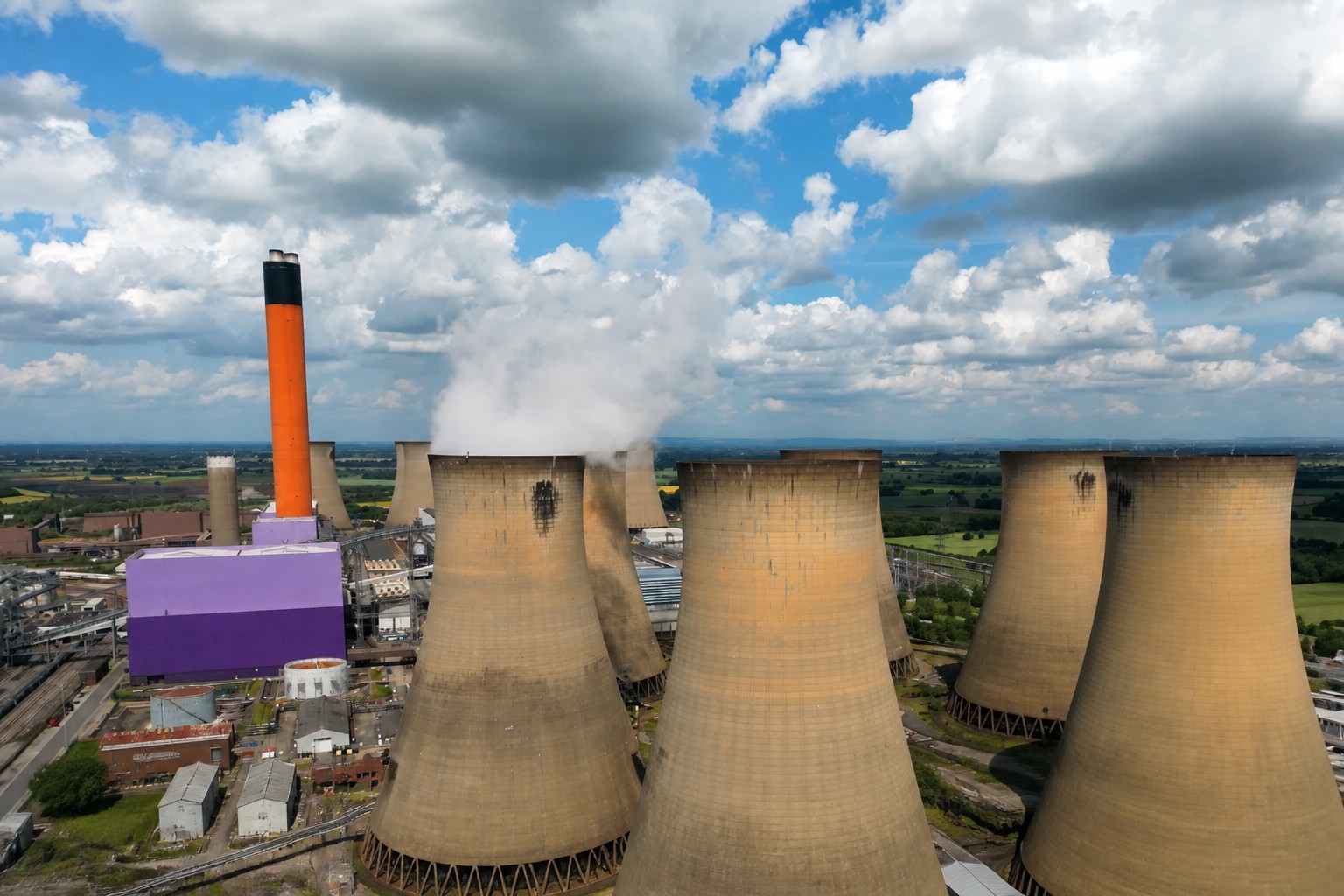
A large load, supplied on site
Drax announced last year that it wanted to convert part of its biomass power station into a data centre, citing rising demand for computing capacity for AI. Company documents describe a 1.2 GW project: 100 MW would come from the shared grid, with the rest supplied by Drax’s own power station.
The scale sits within a wider UK queue. Some 315 data centres are awaiting grid connections, with a combined stated capacity of 73 GW — almost twice the country’s peak winter energy demand.
The Drax estimate, calculated by NRDC using the company’s 2025 annual report, implies annual consumption of 4.9 million tonnes of wood. NRDC says emissions could reach 8.6 million tonnes of CO₂ a year, assuming continuous full-power operation.
That is almost double the 4.79 million tonnes of CO₂ attributed to all flights from Gatwick in 2024. The comparison is not a forecast of the project’s actual emissions: it depends on the data centre running at full capacity, around the clock, all year.
The carbon-accounting dispute
Drax already burns millions of tonnes of imported wood to generate electricity. Biomass has been presented as a lower-carbon option, and sometimes as a route to “negative emissions,” on the premise that regrowing forests absorb CO₂. Scientists and environmental specialists dispute that accounting; research suggests such systems may take 150 years to become carbon-negative.
NRDC senior representative Matt Williams said the data centre would be “one of the dirtiest.” Oliver Hayes, head of policy at environmental group Global Action Plan, said burning millions of trees to power server farms was unacceptable.
Drax disputes NRDC’s figures. A company representative called the organisation a longstanding opponent of bioenergy and said its claims were inaccurate, had not been independently verified, and reflected errors in understanding international biomass-emissions accounting standards and the possible energy balance of the data centre. Drax said the project could support UK economic growth, the government’s plans to renew industry in places such as North Yorkshire, and the development of sovereign AI technologies.
The project has not gone through formal planning. Drax says it could operate at full capacity from 2031 if it secures the necessary approvals.
Planning without a shared policy
Williams has urged the government to set minimum environmental requirements for data centres and rule out power generated by burning wood. Pressure is also growing to make clearer how energy-intensive data centres will meet the UK’s legally binding net-zero target.
The debate is broader than Drax. Two proposed data centres in Buckinghamshire and Bedfordshire were previously reported as potentially emitting more greenhouse gases together than ExxonMobil. After those reports, Labour MP and Environmental Audit Committee chair Toby Perkins warned that data centres could seriously threaten the environment and the country’s climate commitments without adequate safeguards.
Hayes called the absence of a coordinated national policy a “dereliction of duty.” He argued for a moratorium on new data centres until the government decides how many the country needs, what they are for, where they should go and how to avoid pollution.
The government has rejected a moratorium, saying it could push investment and good jobs overseas. In September, Scottish lawmakers voted to pause consideration of all new data-centre applications for up to a year while a national strategy is developed.
My read is that the dispute is not only about whether Drax’s calculation is right. It is also about what the planning system is willing to count: a project’s claimed contribution to AI and industrial policy, or the fuel burned to keep its servers running. Until the rules make that trade-off explicit, “sovereign” computing can still depend on a carbon-accounting argument the project’s critics reject.
Daily AI news
Every day we pick what actually matters in AI and explain it plainly — no hype, no filler. Subscribe if you want to follow where the industry is going.
Only what matters — every day
Follow on X