
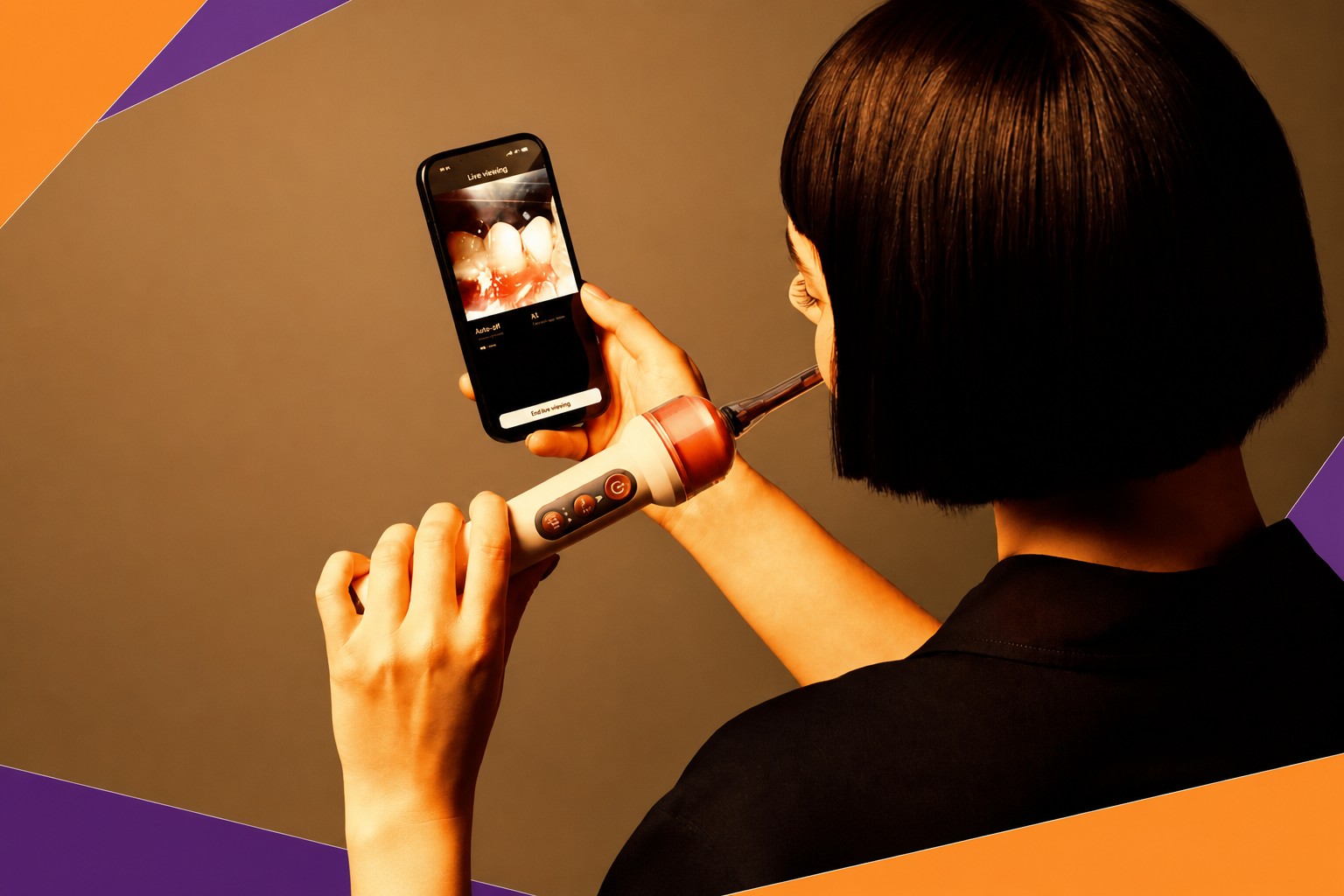
Dyson has put a camera inside a toothbrush. The CameraJet carries a macro sensor of 100,000 pixels that reads 28 images a second while you brush, a machine-learning model that finds and highlights the gaps between teeth, and a strobe light to illuminate a closed mouth. The British appliance maker says the result is that you see what your dentist sees. It costs $499, and it connects to Wi-Fi and Bluetooth.
The timing is a small comedy of its own. Americans are being called folk heroes for cutting down Flock surveillance cameras across the country, and into that mood Dyson has introduced its own camera, pointed at the inside of a human mouth.
James Dyson, the company's founder and chief engineer, said the CameraJet brings together a camera, machine learning, precision fluid dynamics, modern tooth-cleaning technology, connectivity and Wi-Fi to create a new way of caring for the mouth. The list is accurate, which is part of the problem: it is a list of capabilities, not of reasons.
The $499 buys two brush heads, a charging cable and what Dyson calls a refill dock. The device is complicated enough in construction that it looks less like an electric toothbrush than a shrunken curling iron. Dyson also sells a dedicated non-foaming toothpaste, formulated without sodium lauryl sulfate, the common synthetic foaming agent, so that foam does not obscure the camera's view while you brush.
That last detail is the one worth pausing on. A camera that cannot see through foam requires toothpaste that does not foam, and the toothpaste that does not foam is sold by the same company that sold you the camera. Add the refill dock and the shape of the business becomes clear: the brush is the razor, and what goes into it is the blade. Dyson has not framed it that way, but the parts fit together too neatly for it to be an accident.
The company says 661 engineers worked on the product. Take that number seriously for a moment and it says something about how appliance makers now compete. Six hundred and sixty-one engineers is a mid-sized hardware company, aimed for years at the problem of seeing between somebody's molars. Dyson's own suggested comparison is that the buyer should decide whether the brush is worth the price of an iPad Air, or roughly ten Oral-B Pro 1000 brushes, the popular budget model for people who do not need AI to clean their teeth. It is unusual for a company to hand the reader that comparison itself, and it does not flatter the product.
Then there is the part the announcement is quiet about. A Wi-Fi and Bluetooth connection on a device with a camera in it is an attack surface, and it takes only someone finding a vulnerability in Dyson's software for a brush that watches the inside of your mouth to become something else. Nothing in the announcement addresses where those 28 images a second go, how long they persist, or what leaves the brush. For a product whose entire pitch is capturing imagery of your body, that silence is the most conspicuous thing in it.
The interesting question is not whether the CameraJet works. It probably does exactly what Dyson says. It is whether a household is willing to install a networked camera, in a room it otherwise treats as private, for the sake of a better view of its own gums.