
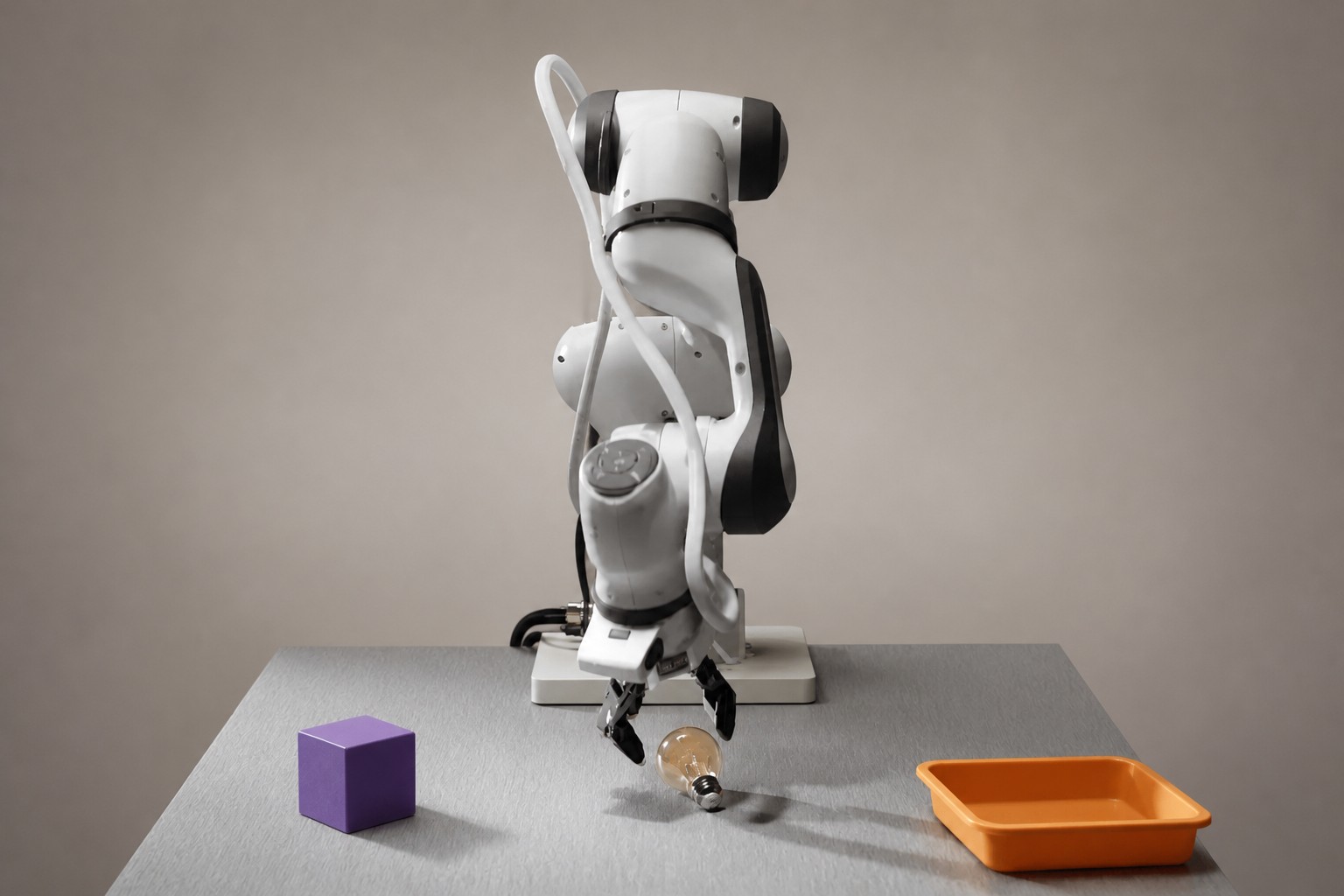
A different input for robot learning
Eka’s model links vision and force data to robot actions. That differs from the “vision-language-action” approach, which learns to connect language, visual information and actions. Co-founder Agrawal told TechCrunch that vision can estimate an object’s position and orientation, but force is what helps a robot find support and complete the final millimeter of a grasp.
The hardware is part of the method. Eka’s gripper is more flexible than conventional grippers and carries more force sensors, allowing it to respond to touch instead of crushing a raspberry. The company has not disclosed the design details. Its training approach uses a physics simulator to model forces during grasping, then builds reinforcement-learning environments from those simulations. Eka says it can generate thousands of hours of robot experience in minutes.
That emphasis on force puts Eka in the camp of robotics researchers who argue that models need touch, not just vision. Rodney Brooks and other critics of generative-AI approaches have warned that systems without a representation of force and touch will fall short. Eka’s results suggest the criticism has merit.
The company’s bet is to scale reinforcement learning through simulation rather than rely on hours of video recorded by contractors or robot operators. Chris Hauser, a professor at the University of Illinois Urbana-Champaign, was struck by the fact that Eka’s learning is not limited to examples prepared in advance. In his view, reinforcement learning could let the robot exceed the demonstrations it has seen.
Impressive speed, unanswered questions
Eka says its robot can pick up about 1,500 objects an hour, weighing up to 1 kg. A person handles about 600 in the same time. The company reports a grasp success rate above 95%. That pace is also a potential liability: the arm can damage itself if it moves too aggressively. One researcher from an advanced lab, who asked not to be named, wondered how many robots Eka had damaged during development.
The researcher also described a test with a raspberry. The large, heavy robot moved quickly toward his hand, slowed at the right moment and touched it gently. He said the sensation stayed with him. Hauser, comparing the robot with recent demos, praised its ability to adapt to many objects without retraining. The anonymous researcher likened watching it to the first time robots learned to walk reliably, five to ten years ago.
The funding round was led by a16z and F-Prime. a16z general partner Ragu Raghuram, one of the deal’s leads, told TechCrunch that the robot already outperforms people on some tasks and could do so across many dexterous-manipulation tasks in the coming months.
I think the more consequential test is not whether Eka can make a robot look capable in a lab, but whether the system can keep working on a production line. The company is running closed pilots with several industrial customers, where robots grasp and place objects and manipulate wires. Hauser said a serious test would be operating for a full year on real assembly lines without failure. Moving from simulation to the factory may prove nearly as hard as moving from simulation to the physical world.
From dexterity to deployment
Eka’s approach is meant to handle physical interaction; a more general model can decide what the robot should do. For example, Astra, the latest large language model from ChatGPT, can control a robot in an unfamiliar environment and perform tasks, but does so slowly and at high cost. Astra could know that plates belong in a cupboard after a dishwasher cycle; Eka’s model would handle the plate without breaking it.
Eka co-founders Agrawal and Haarnoja met in graduate school at the University of California, Berkeley, where both worked on reinforcement learning for robot control. Haarnoja says most teams focus on planning and work top-down, from general intelligence toward physical actions. Eka is taking the opposite route, building upward from physical capability. The company says it is concentrating on two areas: grasping, moving and placing objects, and working with wires.
Agrawal says Eka’s gripper costs less than $1,000 and is designed for 5 million work cycles. The target is 20 million cycles, the benchmark for standard industrial robots. I think that gap says more about the company’s remaining work than the valuation does: Eka has shown a promising way to teach dexterity, but industrial usefulness depends on keeping that dexterity reliable for years, across more than one kind of task.
Daily AI news
Every day we pick what actually matters in AI and explain it plainly — no hype, no filler. Subscribe if you want to follow where the industry is going.
Only what matters — every day
Follow on X