
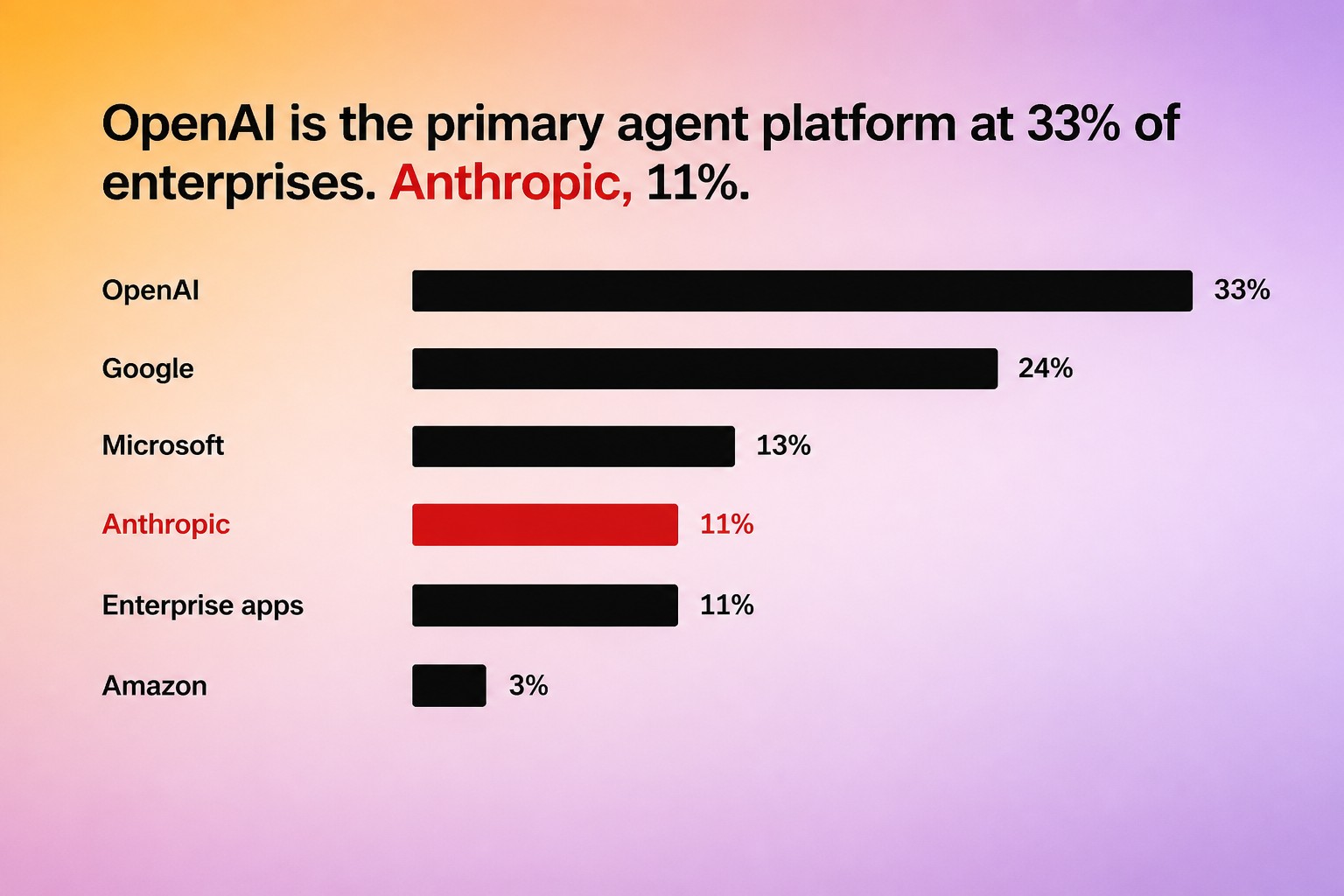
OpenAI is ahead of Anthropic in the enterprise agent-platform race, according to VentureBeat’s August survey of 169 organizations with at least 100 employees. OpenAI appeared in 75 corporate stacks and was named the primary platform by 52 companies; Anthropic appeared in 45 stacks and was primary for 17. Anthropic’s stronger result is elsewhere: 36 companies said they may adopt, add or replace it over the next 12 months, giving it the largest future-interest pool relative to its current user base.
Anthropic’s primary-platform share is 38%, the lowest among platforms present in at least 25 corporate stacks. That pattern held across the company-size and industry groups covered by the survey, although those subgroups were too small for published percentages.
Looking only at the primary platform, OpenAI led the August wave:
The totals include one OpenAI respondent and one Anthropic respondent who identified the platform as primary but did not list it among the platforms their organization uses.
That distinction matters because “used” and “built around” describe different levels of commitment. The popular numbers in the model-provider rivalry—corporate spending data from Ramp and model-routing data from OpenRouter—measure money moving through particular channels. They do not show whether a company is merely testing a platform or making it the foundation for an internal system.
Anthropic does lead on one forward-looking measure. Of the 121 companies that named platforms they planned to adopt, add or replace over the next 12 months, 36 selected Anthropic. Its ratio of potential users to current users was the highest among platforms with at least 40 current users:
The result is a split market signal rather than a clean defeat for one provider. OpenAI has the stronger installed position in this survey, while Anthropic has more room to grow relative to its existing base. Whether that interest becomes a primary-platform choice is the more important question.
The survey comes from the August wave of VB Pulse’s AI agent orchestration tracker, one of five monthly VentureBeat surveys of enterprise AI buyers. It collected 221 responses, of which 169 were considered eligible because the respondents worked at organizations with at least 100 employees. Eighty-three identified themselves as final decision-makers for AI purchases, while 55 described themselves as recommenders or other employees influencing the decision.
The leaderboard has changed with the sample from month to month. Microsoft AI Foundry and Copilot Studio ranked first in the April-May wave, with OpenAI second. Anthropic led in June. Microsoft returned to first place in July. The August figures therefore describe the composition of that month’s respondents, not a market-wide trend.
The platform companies are competing for is not simply a model endpoint. When an agent reads a file, calls a tool, makes a decision and calls another tool, an orchestration layer determines the order of operations, each agent’s access and the system’s response to failure.
That layer is becoming the structural decision enterprise buyers have to make. Engineers building a single agent often call its loop a framework and the managed environment around it a runtime. The control plane sits above both: it determines which agents exist, what each can reach and who is responsible for operating them. Amazon Web Services, for example, places that hierarchy in its interface: the Bedrock AgentCore control plane creates and manages agent runtimes.
Companies are not yet clearly handing that control to model providers. Asked where the primary control plane for enterprise AI agents should sit by the end of 2026, 55 of 169 respondents, or 33%, chose a combination of an embedded provider platform and external orchestration. Another 44, or 26%, chose a provider-managed AI agent service.
The leading concern about giving orchestration control to a model provider was inflexibility across models and tools. Forty-eight respondents, or 28%, selected it. Vendor dependence ranked fourth, at 16%, or 27 of 169 responses.
That concern gives Anthropic’s pipeline a useful qualification. A company can be interested in Anthropic’s models without wanting Anthropic to own the layer that coordinates its agents. The survey does not establish how many of those 36 potential Anthropic users intend to make it their primary platform, rather than add it alongside an existing one.
Two data releases shaped much of the September debate over the provider race.
OpenRouter, which routes developer requests to models selected by the developer, reported weekly spending figures. During the week of September 7, spending on OpenAI models exceeded spending on Anthropic models for the first time since February 2024.
Ramp, which builds an index from corporate-card transactions and invoice payments at tens of thousands of companies, published a chart of corporate spending share by model. In that chart, OpenAI’s Astra overtook Anthropic’s Fable in September.
Both datasets measure real audiences, but neither covers the buyers in this survey. OpenRouter’s “State of AI in 2025” report describes its users as developers and end users, with more than half of usage coming from countries outside the United States.
Large companies may instead obtain models through individual contracts or through Amazon Bedrock, Google Vertex AI and the Microsoft Azure marketplace. That makes a model-routing service an incomplete view of enterprise adoption.
Ramp’s two September snapshots also point in different directions:
Ramp counts corporate-card transactions and company invoice payments made through its platform. Large organizations using other expense-management providers are therefore absent. Its published methodology also says the index may understate AI adoption because it excludes free tools and employees’ personal accounts.
This survey has its own limitations. Respondents selected themselves from VentureBeat’s audience and the publication’s research panel, so the sample is not probabilistic. The August wave also leaned toward mid-market companies outside the technology sector: 27 of 169 respondents, or 16%, worked at organizations with 10,000 or more employees, compared with 51% in July. Seventeen respondents, or 10%, represented technology and software companies, versus 53% in July.
The question the announcement leaves quiet is how much of this competition is actually about platform ownership. The survey shows that buyers are thinking about control planes, runtimes, models and tools as separate layers. It does not show whether the companies expressing interest in a provider will consolidate those layers or keep several vendors in the stack.
The underlying question counts also differ. One hundred sixty-eight respondents named the platforms their organizations use, with multiple selections allowed. One hundred sixty-two respondents named a single primary platform. One hundred twenty-one named platforms their organizations were considering; 48 left that section blank after saying they did not plan changes.
In the August wave, 101 of 169 companies, or 60%, said they planned to adopt, add or replace an AI agent orchestration platform within 12 months. Forty-seven planned to do so within the next quarter. That is a large near-term decision pool, but it is not evidence that any one provider will capture it.
OpenAI’s current position is stronger in this sample: it appears in 75 of 168 corporate stacks and is primary in 52, while Anthropic appears in 45 and is primary in 17. Anthropic’s 36 prospective users give it the strongest future-interest ratio among the leading platforms. The unresolved issue is whether those prospective deployments will turn Anthropic into the control plane—or leave it as another model provider inside a stack controlled elsewhere.
Daily AI news
Every day we pick what actually matters in AI and explain it plainly — no hype, no filler. Subscribe if you want to follow where the industry is going.
Only what matters — every day
Follow on X