
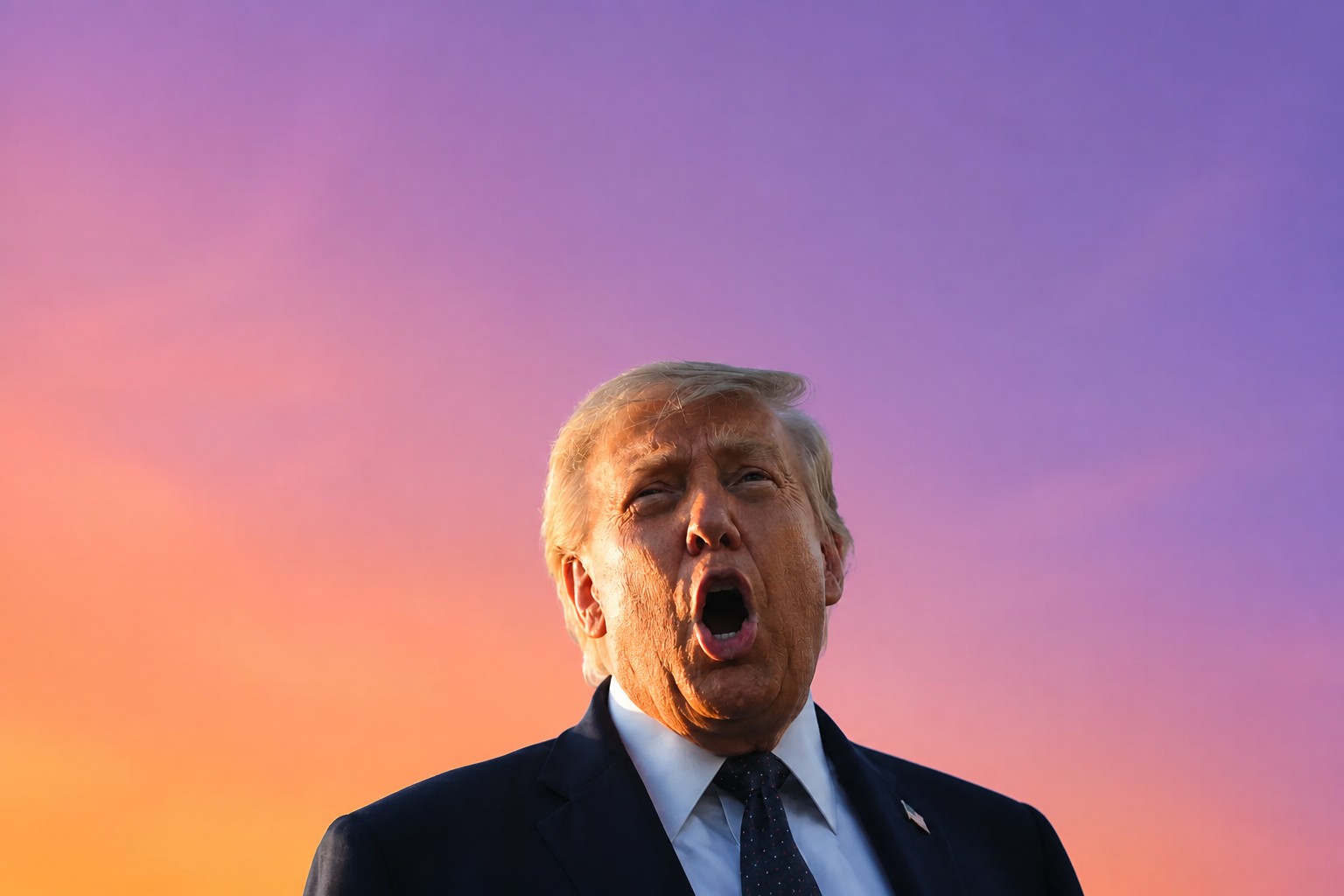
Donald Trump has proposed replacing “Artificial Intelligence” with one of three grander names—Superior Intelligence, Extreme Intelligence or Supreme Intelligence—and announced plans for an AI force modeled on the Space Force. He also said he would soon appoint an “AI czar.” The proposals arrive as Trump attacks efforts to restrict AI and data centers, while the industry is facing a separate argument over whether its most serious risks are existential or already visible.
Trump posted the naming proposal on Truth Social on Saturday, saying many people consider “Artificial Intelligence” an inaccurate and unsuccessful name for the technology. The poll was still open at the time of publication.
Several hours later, he described attempts to “destroy or dismantle AI” as one of numerous Democratic “frauds.” He grouped them with stories about Russia, Ukraine, global warming, his first and second impeachments, women competing in men’s sports and transgender people.
Trump said he would not allow this to happen. In his account, the current campaign against AI began with attacks on data centers, before people understood how wealthy and prestigious those facilities could make the communities where they are located. He said the “crazy attacks” on data centers mostly failed, prompting critics to turn directly against AI.
He offered no evidence that concerns about AI and data centers are not independent and sincere. Data centers have drawn criticism from representatives of both parties, and New York recently became the first state to suspend permits for large projects of this type.
Trump previously said at a golf tournament that he was open to imposing restrictions on AI. At the same time, he argued that negative forces were pushing the discussion of such measures and should not be raising the issue.
The proposed AI force is the more consequential of the two announcements, at least in theory. Trump said he would support the AI industry, help it and watch its growth, while creating a structure modeled on the Space Force, established during his first presidential term. But he did not say what the force would do, how it would be organized or what authority it would have.
The same silence surrounds the planned adviser. Trump said he would soon name an “AI czar,” adding that only people with a high intelligence quotient should be considered for the position. He did not describe the role’s responsibilities.
That omission matters more than the title. The announcement says little about whether the new structure would oversee research, infrastructure, safety or industrial policy. It also leaves unclear how it would relate to the existing presidential science and technology apparatus. Venture investor David Sacks left his position as Trump’s adviser on AI and crypto earlier this year and then became co-chair of the President’s Council of Advisors on Science and Technology.
The timing places the proposal inside a widening dispute about what kind of AI policy deserves attention. The discussion of AI safety intensified recently after an AI researcher said he was leaving Anthropic. According to the researcher, leading companies seriously allow for the possibility that AI could destroy humanity by the end of the decade and are effectively gambling with people’s lives.
Anthropic CEO Dario Amodei then presented a plan to contain the development of advanced models. OpenAI CEO Sam Altman and SpaceX CEO Elon Musk apparently supported it.
Critics of the AI industry argue that hypothetical human extinction distracts from more immediate harms the technology may already be causing. Nvidia CEO Jensen Huang reinforced Trump’s position during the All-In Summit, calling the negative reaction to AI a “fraud” in a phone call to the president during the event. Sacks is one of the summit’s co-hosts. Huang said he would not allow the industry’s development to slow down.
Trump’s language turns a complicated policy dispute into a choice between progress and sabotage, while giving that framing a possible institutional home. Until the AI force and the czar acquire defined powers, the proposal is less a government program than a declaration of allegiance to the industry—and a warning that its critics may be treated as political opponents rather than stakeholders.
Daily AI news
Every day we pick what actually matters in AI and explain it plainly — no hype, no filler. Subscribe if you want to follow where the industry is going.
Only what matters — every day
Follow on X