
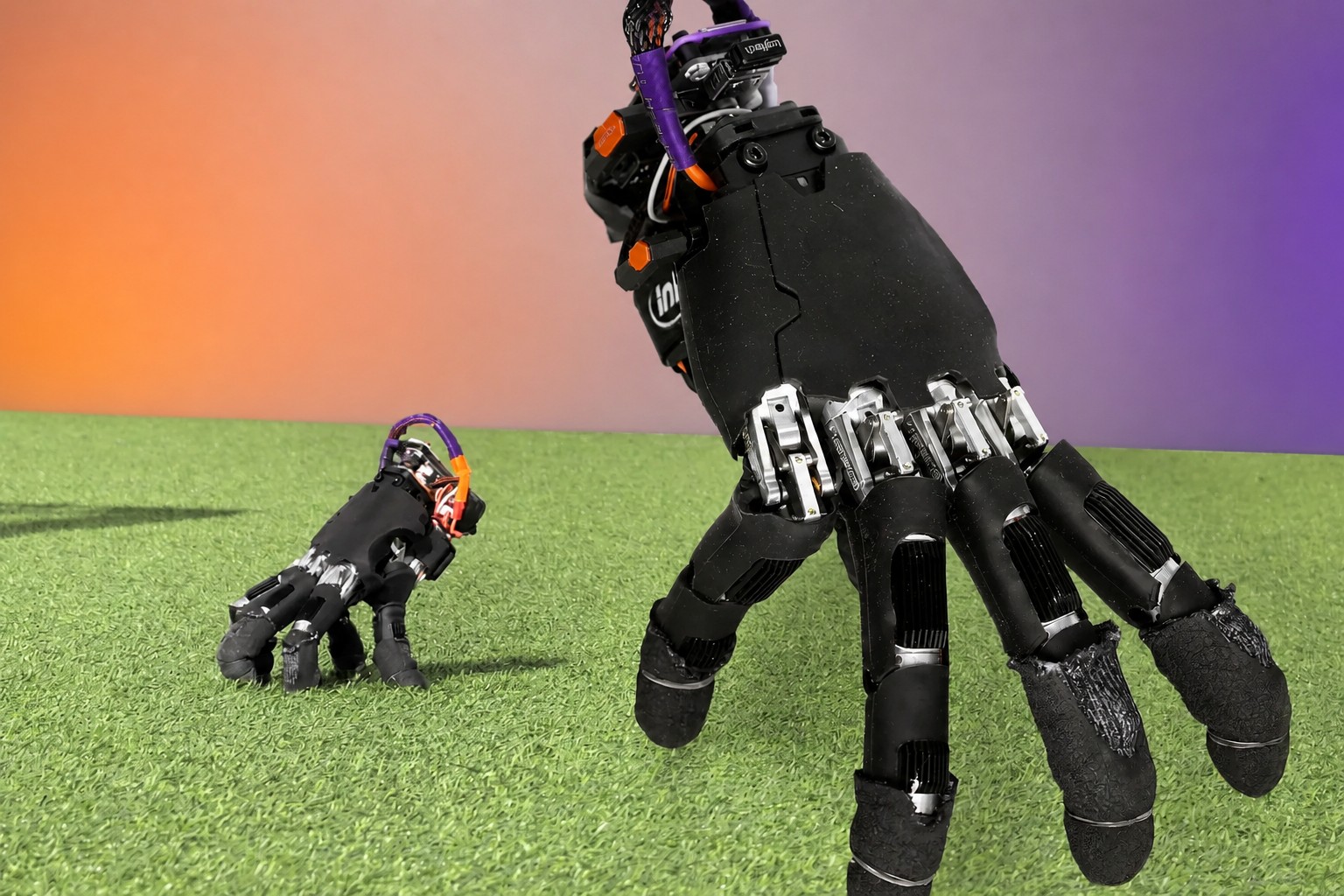
A hand built to do two jobs
The team started with a hand from Wuji Technology and added an 80-gram backpack containing a battery, an inertial measurement unit and a Raspberry Pi Zero. Using a ready-made hand made the project harder: its shape is designed for grasping, not crawling.
Project lead Amirhossein Kazemipour, a graduate student in ETH Zurich’s Soft Robotics Lab in Switzerland, said he wanted to find out what a robot hand could do without the rest of a robot. Earlier attempts to make robotic hands walk generally used purpose-built designs. ETH Zurich’s approach kept the hand’s ability to manipulate objects.
The researchers trained the hand in simulation using reinforcement learning. Its unusual shape ruled out simply applying techniques used for other legged robots: the fingers are different lengths, and the thumb opposes the others, so the hand lacks the symmetry common in bipedal and quadrupedal robots.
To keep the fingers in a crawling pose, the team assigned each one a target position relative to the palm. The model received penalties for straying too far from those targets, creating what Kazemipour described as virtual springs. It was also rewarded for moving at the right speed and in the right direction, and penalized for swaying and abrupt movements. Penalties for moving the fingers forward and backward were much smaller than those for side-to-side movement.
What the tests show
The team trained four separate models: one for walking, one for recovering from a fall, one for pressing keyboard keys and one for pushing objects toward a target. All four fit on the hand’s onboard computer, Kazemipour said, and its control system switches between them as needed.
In tests, the hand crawled across 14 surfaces, including smooth flooring, metal grating, grass and gravel. It could turn in either direction and moved at an average speed of 9 centimeters per second. It got back up on its own in 21 of 25 attempts.
Using video from a camera above the test area, the hand pushed a 41-gram cube toward a target as far as 40 centimeters away without human help. It repeated the task 15 times in a row.
Those results point to a compact machine that can move and manipulate objects, but the tests also leave practical questions open. University of Tokyo professor Masahiko Inami, whose group has developed hand-shaped walking robots, said a mobile hand could work in tight spaces and reach controls that are difficult to access with a full robotic arm. For practical use, he said, it would need onboard perception and more reliable navigation.
Hideki Shimobayashi, a graduate student in Inami’s lab, raised a different concern: the loads on the hand while walking differ substantially from those involved in grasping, which could limit its durability.
Columbia University associate professor of mechanical engineering Mateusz Chocarlie said the work shows that robotic hands need not be limited to capabilities that resemble those of human hands. He sees the possibility of mobile manipulators that can handle small objects, traverse difficult terrain and move loads comparable in size to themselves.
The bigger bet is on parts that change roles
Kazemipour frames the work as part of a longer-term effort to build robots from components not tied to a single task or even one way of assembling them. He calls the idea “autonomous modular embodiments”: robotic body parts that can shift from components in one system to independent robots, depending on the task.
I think the more consequential test is not whether a hand can crawl, but whether it can keep doing so while remaining a useful manipulator. The current results establish both behaviors in trials; they do not settle the durability and navigation concerns that would make the combination dependable outside a test area. If those constraints can be addressed, the hand becomes more than a clever mobile end effector: it becomes a component that can leave the robot it belongs to.
Daily AI news
Every day we pick what actually matters in AI and explain it plainly — no hype, no filler. Subscribe if you want to follow where the industry is going.
Only what matters — every day
Follow on X