
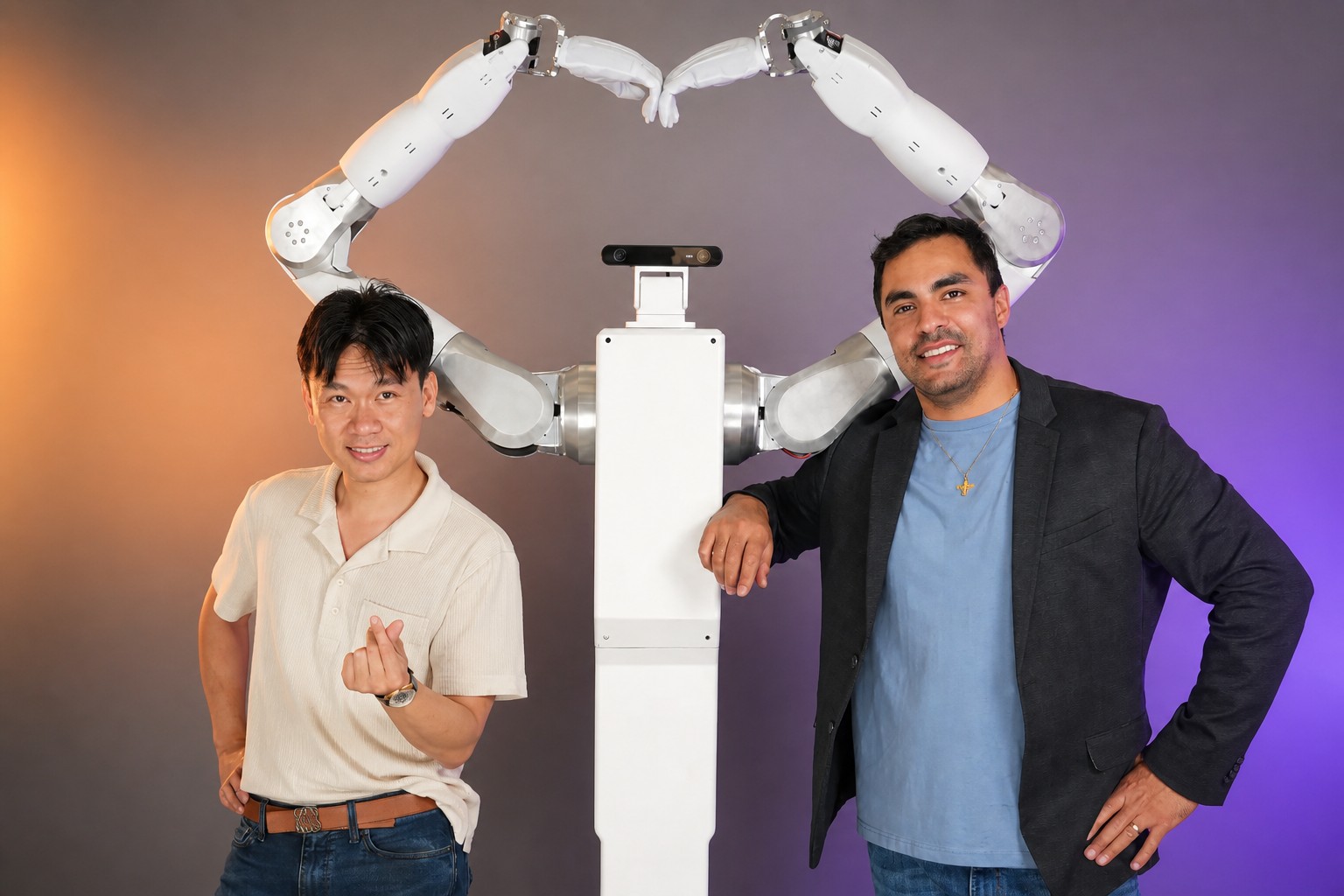
What Feather is shipping
Feather was founded last year by Hoa Mai and Parsa Bakhtiari. Mai previously sold a humanoid-robotics startup to 1X in 2025. Bakhtiari, a former Tesla Model 3 engineer, at one point reported directly to Elon Musk.
The founders want Feather to become an “Android for robotics.” That means giving developers a working robot they can adapt, rather than asking them to build both the machine and its underlying intelligence from scratch.
That puts Feather in a different position from Tesla and Figure, which are developing their own robot bodies and core systems. Mai’s argument is practical: developers cannot simply buy a Tesla robot today and start building their own products on top of it. He points instead to Nvidia and Apple, which began with useful products and added complexity over time.
Gradient Ventures backed Feather at launch, helping the company complete its previously announced $7.6 million seed round.
The platform is modular. Developers can adapt the hardware for different tasks, including changing the length of the robot’s arms. Feather says its robots are already being used to:
The hardware can run models from leading robotics-AI providers, including Generalist, Skild and Physical Intelligence. After a year of field testing, Mai says Feather has almost entirely eliminated the problems it found. The company has sold small batches so far and is now preparing for a larger product launch.
A $30,000 position in the market
Gradient general partner Darian Shirazi sees no direct US competitor for Feather. He divides the current hardware market into three groups:
Mai acknowledges that Feather borrowed some ideas from Chinese robotics companies, including Unitree. Restrictions on supplying newer foreign-made models in the US have nevertheless given Feather a distinct position as a domestic company offering this type of product.
Price is another part of that position. Feather’s robot costs $30,000, roughly half the price of the Unitree H2 Edu.
Shirazi compares the robot with a worker who would cost $50,000–60,000 per year in wages, before training, human-resources support and other overhead. Feather’s pitch is that a company can buy the robot to perform similar tasks instead.
He also says the startup has operated efficiently and spent only a small portion of its seed funding.
The ecosystem is the real bet
The hardware is not the main argument. Feather is betting that the value in robotics will come from the ecosystem built around a common platform.
Mai says the market for companies developing physical-AI solutions is small today. Feather expects there to be thousands of them in five years, and wants its robots to become the layer on which those businesses operate.
I think that makes the $30,000 price less important than the developer proposition. A cheaper robot can attract customers, but a platform only becomes valuable if outside companies can reliably turn it into products. Feather’s current deployments show that the machine can handle real tasks; they do not yet show how large the developer ecosystem is.
The announcement is also quiet about the identities of its customers and the scale of those deployments. That matters because the company’s next step is not merely to sell more robots. It is to prove that a modular platform can support a market larger than Feather’s own engineering team.
Daily AI news
Every day we pick what actually matters in AI and explain it plainly — no hype, no filler. Subscribe if you want to follow where the industry is going.
Only what matters — every day
Follow on X