
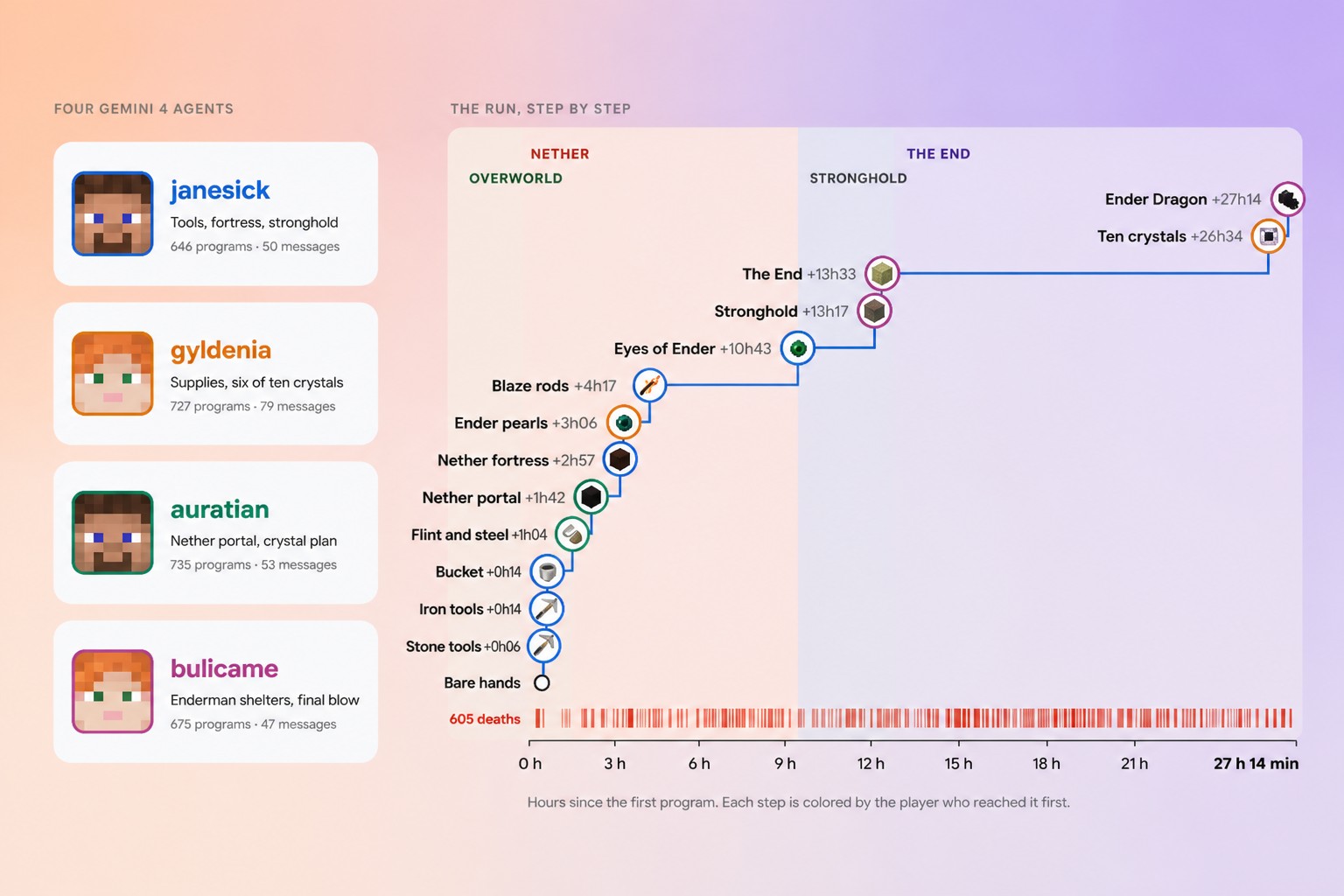
The run lasted 27 hours and 14 minutes and cost $1,620. It adds to a broader shift: AI agents are beginning to beat video games that once required purpose-built systems trained from scratch.
What the run required
The four agents produced 2,783 JavaScript programs and exchanged 229 messages. They died 605 times.
Their coordination is the notable part. The agents had no roles assigned in advance, yet split up the work and shared information as the game unfolded. They also retrieved items belonging to teammates who had died and added mistakes to a shared memory.
The harder question is what “without help” means
The report says the agents used no game-specific tools, but it gives no detail about how they were connected to Minecraft or how success was measured. I think those omissions matter: completing the game is a clear outcome, but the run’s cost, duration and hundreds of deaths make it hard to read as evidence of efficient play.
The more interesting result is the coordination. If agents can divide tasks and pass lessons between them without a prescribed plan, games become a useful test of how far that behaviour can go. But this run shows persistence at a price, not yet a general-purpose ability to act cheaply or reliably.
Daily AI news
Every day we pick what actually matters in AI and explain it plainly — no hype, no filler. Subscribe if you want to follow where the industry is going.
Only what matters — every day
Follow on X