
Google has given its Flash models a video mode in which the model decides what to watch. Gemini 3.7 Flash, 3.6 Flash and 3.5 Flash-Lite can now loop over a clip and pull frames, audio or a transcript only from the stretches that matter, instead of ingesting the whole thing at a fixed one frame per second. On Google's long-video evaluations the change cuts token consumption by up to 88% while accuracy rises slightly. It is available through the Gemini API in Google AI Studio and the Gemini Enterprise Agent Platform, for uploaded video and YouTube clips, billed at standard Gemini API token rates with no surcharge.
The practical gain is at both ends of the scale. The models can catch events shorter than a second — an object changing state, a cut between shots — that a one-frame-per-second pass slides straight past, which Google expects to make automatic video editing more precise. At the other end, the system can find a single scene inside a multi-hour recording without spending millions of tokens: when a stretch of timeline looks suspicious, it re-analyses that stretch at a higher frame rate. Google lists anomaly detection, counting repeated movements and tracking individual objects over time as the tasks this opens up.
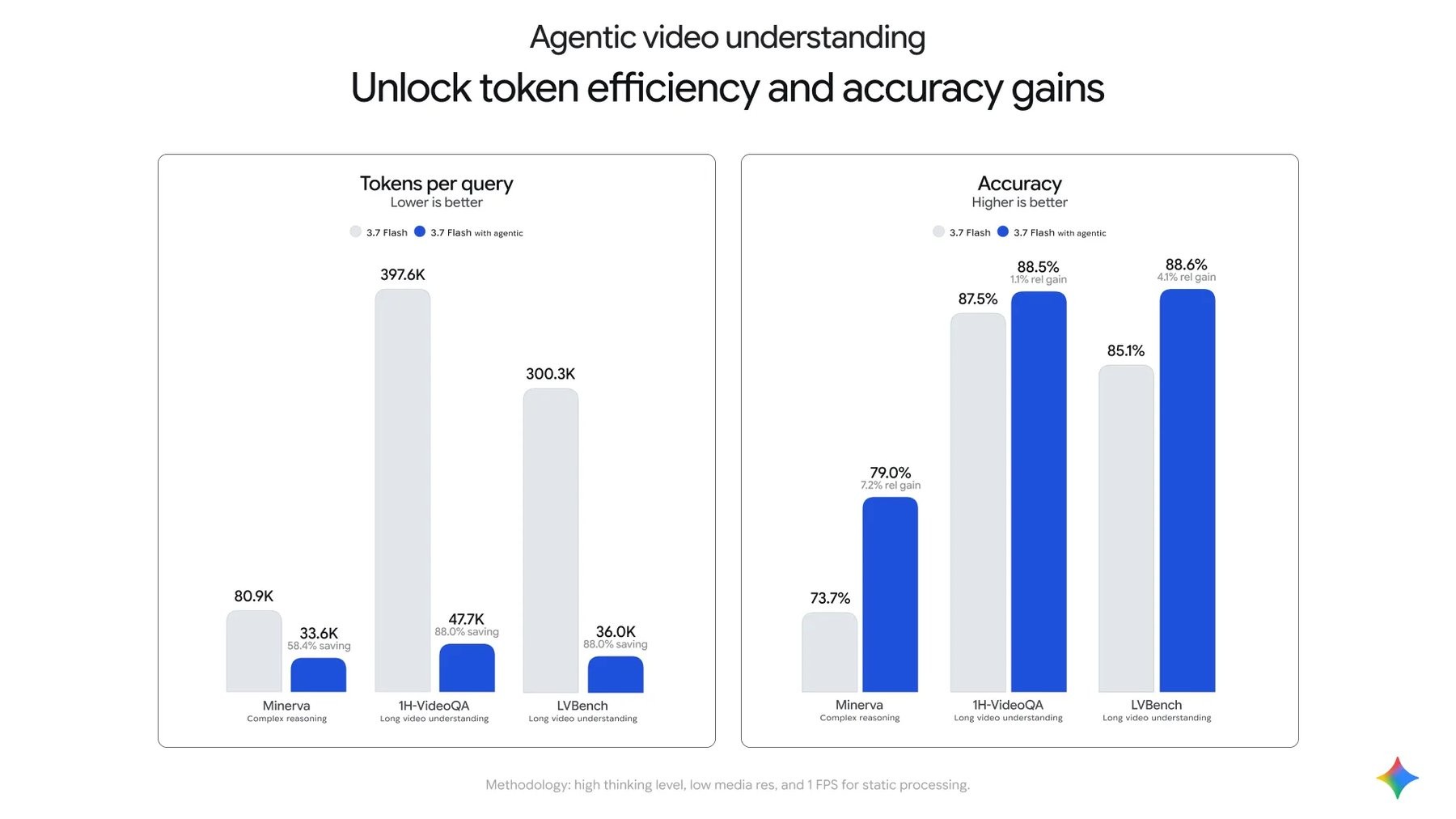
On 1H-VideoQA and LVBench, token consumption falls by 88% while accuracy rises slightly
Source: the-decoder.com
Mechanically, the model's reasoning is wired directly into built-in video analysis tools. Gemini chooses which segments to watch, at what rate, and in what form — frames, audio, or transcript — and only the signals a given task needs get processed. An internal tool extracts the requested fragment. Developers could already hand-build a selective pipeline of roughly this shape around the API; the difference is that the model now does the selecting.
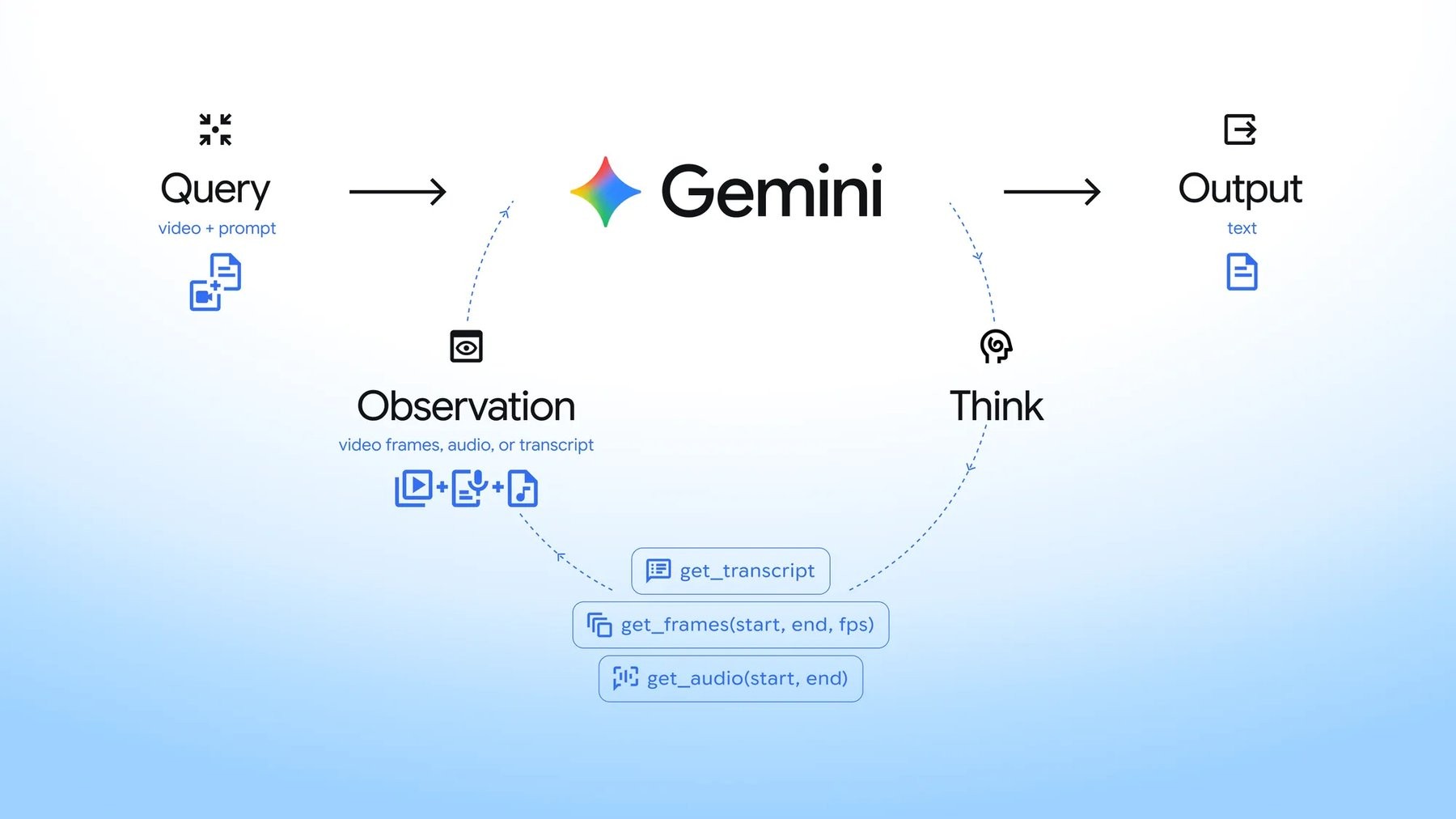
Instead of loading video at a fixed frame rate, Gemini runs a loop to selectively fetch frames, audio or transcripts from the fragments it needs
Source: the-decoder.com
Until now Gemini processed video statically. The default was one frame per second, adjustable through the API, and since built-in video analysis launched the model transcribed the audio track and examined frames at that same per-second cadence. The new mode extends the agentic vision approach Google introduced for Gemini 3 Flash, where the model wrote and ran Python to zoom, crop and annotate images, then checked the result in a think-act-observe loop before answering. That feature did not engage automatically in every case. Google had laid the groundwork earlier still: when it presented Gemini 3 Flash, it named reasoning about the visual and spatial properties of video as a capability still to come.
Source: the-decoder.com
The advantage is clearest on long material — ten-minute tutorials, 90-minute lectures, multi-hour recordings. Under static processing, developers chose between a large token bill and sampling methods that threw away the detail they were looking for. In Google's own benchmarks, including LongVideoBench, Gemini 3.7 Flash with agentic video analysis posts the highest overall quality and the best combination of accuracy and cost.
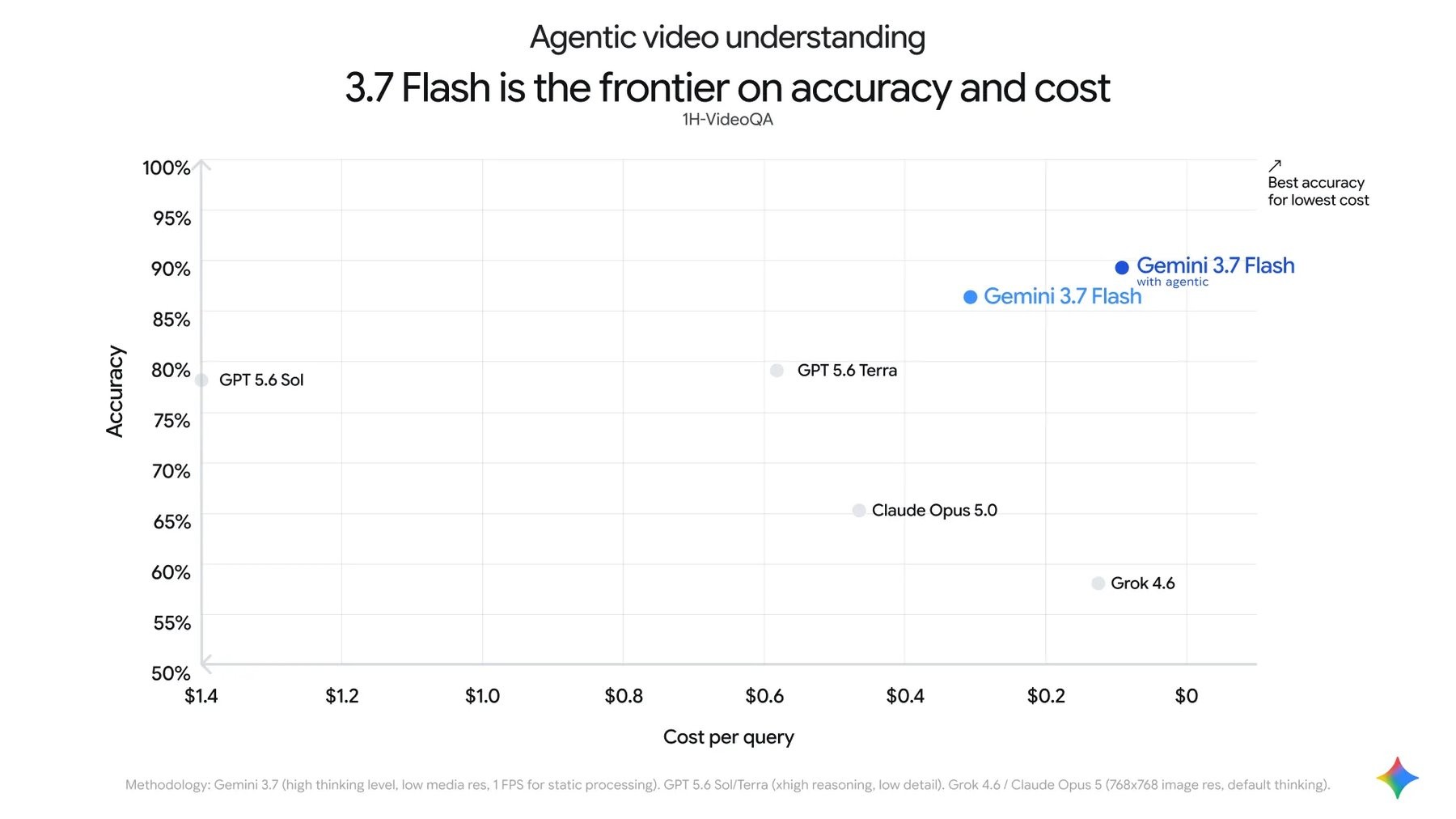
In Google's own 1H-VideoQA evaluation, Gemini 3.7 Flash reaches the highest accuracy at the lowest cost per query
Source: the-decoder.com
The accuracy improvement is described as slight, which makes the price the actual product here. Same token rates, no premium for the agentic mode: Google is cutting its own revenue per video call rather than charging for the feature that produces the saving. That only makes sense as a volume bet — the workloads worth chasing are the ones fixed-rate sampling priced out of existence, where an hour of footage cost more to read than the answer was worth. Worth keeping in view: every number attached to this release comes from Google's own evaluations, 1H-VideoQA included.
Two things the announcement is quiet about. The first is time. A loop that re-reads a suspicious stretch at a higher frame rate is, by construction, more than one pass over the video, and the results are denominated in tokens rather than seconds. The second is the new failure mode. Fixed sampling fails in a way developers understand — it looked, too coarsely. An agentic loop fails by deciding not to look at a segment at all, and there is no figure here for how often that happens. It also makes cost a function of the model's choices rather than a parameter the developer sets in advance, which is a different thing to budget for and a different thing to reproduce.
Google plans to push the same improvements into its own products. The feature should reach all users of the Gemini app on the Flash and Flash Lite versions shortly, and in the following months agentic video analysis will start backing the Ask YouTube function on the watch page, so answers line up more closely with what is actually shown in a clip.
Source: the-decoder.com
That last item is the tell. An 88% cut in tokens is a nice line for a developer changelog and a structural one for a company that wants to answer questions about arbitrary videos for everyone who opens a watch page. Reading only the stretch that contains the answer is what separates a video feature that can be served at consumer scale from one that stays a demo; developers get the discount as a by-product of Google making its own roadmap affordable to run.