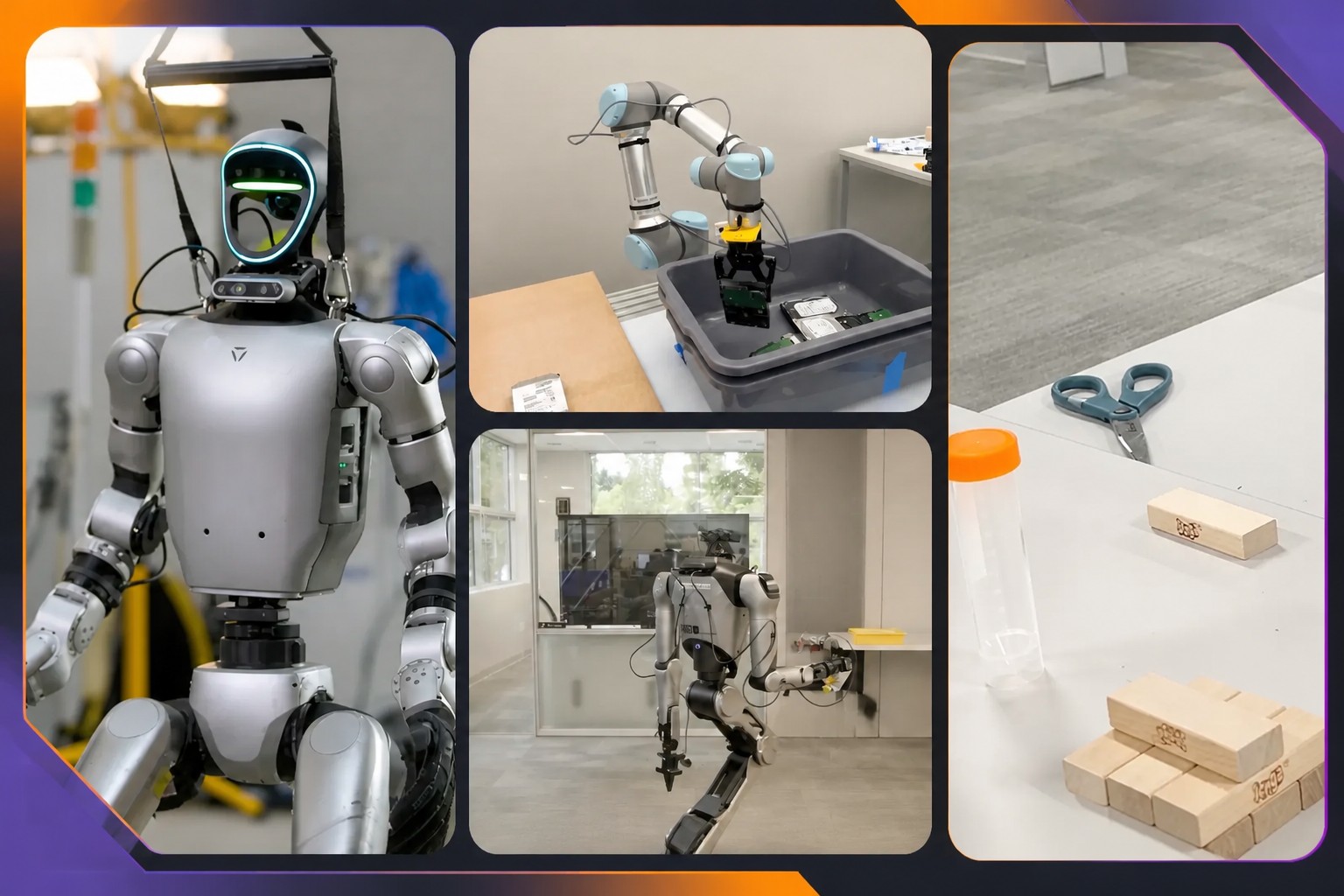
General Robotics, the Nvidia-backed startup founded by former Microsoft robotics lead Ashish Kapoor, says its GRID platform cuts the time to put a robot into service by up to 99.7%, the time to import a new AI model by up to 99.5%, and the time to move a skill from one robot type to another — a robot arm to a humanoid, for instance — by up to 97.9%. The company describes GRID as an agentic training platform that improves its own procedures and teaches itself, and says more than 80% of GRID's own code was written by AI agents. It is already deployed at a major US automaker, the world's largest port operator, a leading oil and gas producer and several government agencies.
The concrete number in that list is the one the headline figures obscure. General Robotics says the first task GRID ran took several hours. Each cycle left artifacts behind — calibrations, trackers, control fixes, catalogued failures — and subsequent skills on the same platform deployed in 10 to 15 minutes. That is a claim about caching engineering work, not about a model getting smarter, and it is the only figure here with a stated before and after.
The architecture is borrowed openly from coding agents. General Robotics argues those agents became effective once they were given access to repositories, feedback from execution, the ability to revise their own actions, and objective grading from tests, compilers and benchmarks. The company built four equivalent scaffolds for physical AI: one ingests a description of a specific robot's morphology and calibration, one assembles the simulations used for training, one creates skills, and one deploys those skills and validates them on real hardware in the real world.
In some cases, the company says, GRID taught a robot a new skill from a single short video. The platform picked an approach for turning video into simulation, reconstructed the motion in simulation, generated its own training data, trained the skill, and transferred it to the robot. In others it found and fixed problems in existing AI models and in hardware calibration. General Robotics calls this Auto-Engineering.
Kapoor's argument is that the deployment method has not changed in fifty years. Advanced robotic systems, he says, have been rolled out in roughly the same way for the last 50 years, and the pace of progress in AI now requires a different approach. GRID's design point is to fold robotics, software, AI models, simulation, data and hardware into one platform organised around AI agents rather than around a systems integrator.
The underlying thesis is the strongest part of the pitch, and it is stated plainly in the company's blog: robot capability is becoming abundant while the knowledge of how to deploy it reliably stays scarce. That matches what the humanoid wave has actually produced — impressive demonstrations, very few installations. If most of the cost, complexity and schedule of a robot programme sits in commissioning rather than in the robot, then the company that automates commissioning captures more value than the company that builds the arm.
The percentages, though, are doing less work than they appear to. Every one carries an "up to" and none carries a baseline. A 99.7% reduction in commissioning time is meaningless without knowing what the comparison deployment was, who performed it, and how many attempts produced that figure. The customer list has the same shape: "the world's largest port operator" is a description, not a reference, and an unnamed customer cannot confirm a number. The 80%-of-code statistic is a claim about how GRID was built, not about whether GRID works, and it belongs to the genre of metrics that sound like evidence while measuring effort.
The question the announcement does not answer is the one the fourth scaffold implies. That scaffold exists to validate new skills on real hardware in the real world, which means General Robotics is measuring how often a transferred skill actually holds up outside simulation. That pass rate is the number an automaker or a port operator would ask for first, and it is not in the announcement. A platform that deploys a skill in 10 to 15 minutes and gets it right half the time is a different product from one that gets it right nineteen times in twenty, and the published figures cannot tell those apart.
The company's history explains who this is being sold to. Kapoor ran robotics and autonomous systems at Microsoft and built AirSim, the simulator a large share of the autonomous systems research community trained on. He founded the company as Scaled Foundations in 2023 with backing from Khosla Ventures and E14, renamed it General Robotics in May 2025, and added Nvidia, Construct Capital, Shorooq and Valo Ventures to the cap table. In April, Accenture invested and folded GRID into its manufacturing and logistics practice.
That last line matters more than the investor names. Accenture is a systems integrator, and GRID automates the part of robot deployment that systems integrators bill for. Either Accenture has decided the margin moves from labour to software fast enough to be worth owning, or GRID's real market is not robot builders at all but the consultancies holding the customer relationships — in which case the 99.7% is a story about who gets paid for commissioning, not about whether it gets any easier.