
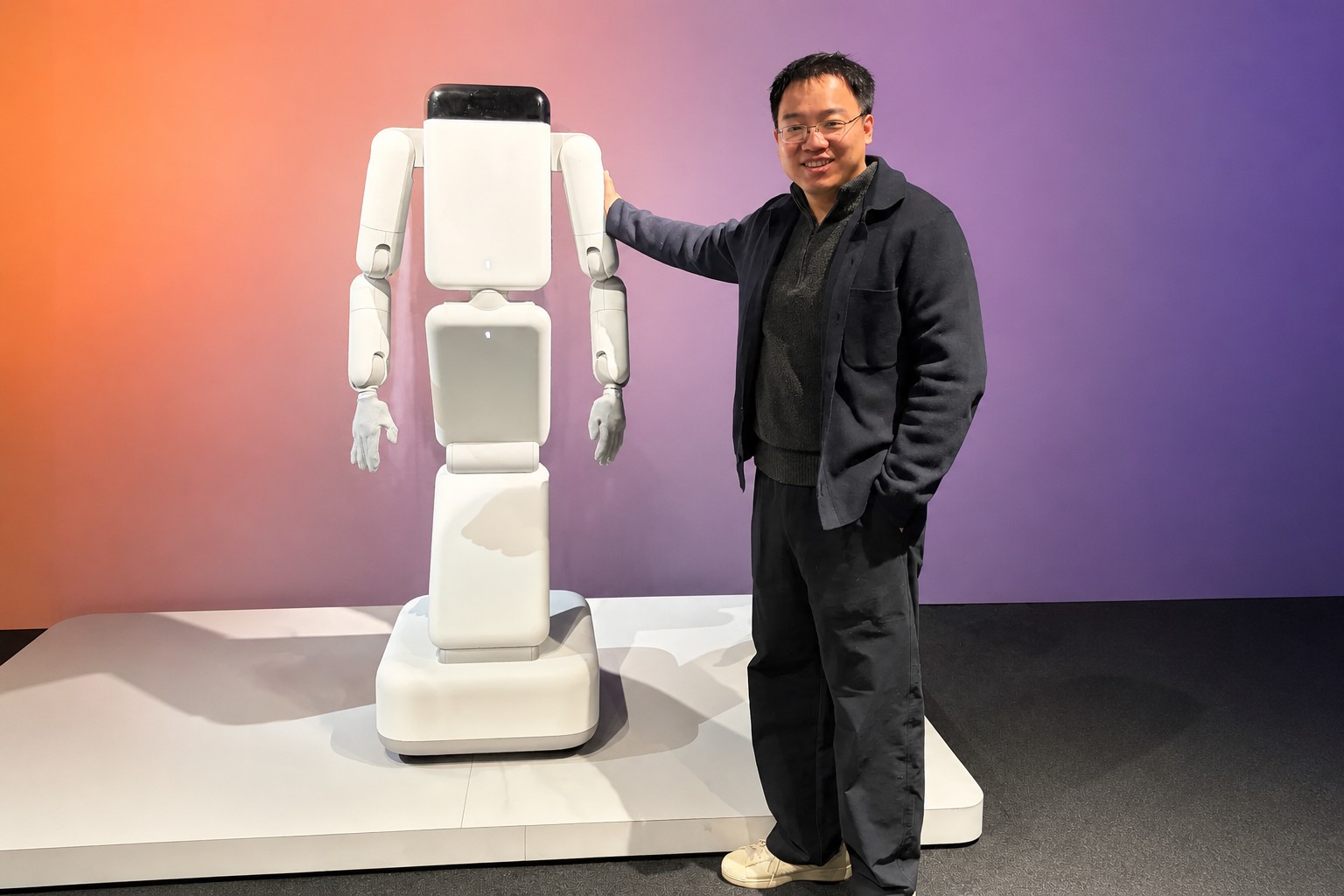
Genesis AI raised $500 million in a Series A round to develop robots that work with their hands and prepare them for mass production. The company collects data on workers’ movements and exertion using sensor gloves, trains its own model on that data, and is developing a humanoid robot, Eno, in parallel. In a demo, robotic hands packed boxes and attached labels, but on a repeat run the robot dropped a box and struggled to peel off a label. These are the kinds of failures that show the gap between a demo and reliable automation.
Funding and strategy
The round was led by Khosla Ventures, Premji Invest and Eclipse. Genesis was founded in 2024 by Xian Zhou and the company’s president, Théophile Gervet. They met while studying for master’s degrees in a lab at Carnegie Mellon University. In July 2025, the company announced a $105 million seed round.
Genesis is building its business around vertical integration: it collects most of its training data itself, develops a generative model, and designs and manufactures a humanoid robot. Zhou says the company wants to create the best robot as a finished product, from start to finish.
At Genesis’s site in Silicon Valley, TechCrunch saw the model control two finished robotic arms. In the first demo, they picked up two small cardboard boxes, scanned them, placed them in a larger box, closed and sealed it, then attached a label peeled from a printer roll.
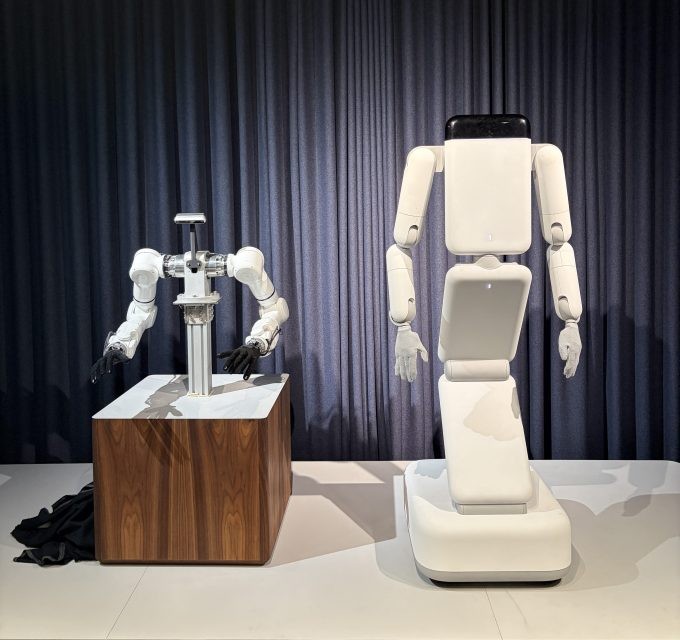
A pair of robotic arms, left, and Genesis AI’s Eno Robot, right. Image Credits: TechCrunch / Tim Fernholz
Source: techcrunch.com
In a second attempt, the robot dropped one box and took a long time to peel a small adhesive label from the roll. Genesis called such errors data for improving the model; one company executive suggested the term “stumble data.” The journalist was not allowed to test the robot by changing the objects’ positions, but the company repeated the demonstration.
Gloves and robot training
Genesis is focused on dexterity — a robot’s ability to perform tasks with its hands — and on collecting the data needed to improve it. This sets the company apart from competitors including Figure and Agility. The sensor gloves measure exertion, which appears to help robots manipulate objects more effectively.
More than 100 workers around the world wear the gloves and cameras mounted on headsets. Their actions add to the training dataset used by Genesis’s model. The company’s robots also work in sensor-equipped gloves, and their hands are proportioned to resemble human hands. Zhou links this resemblance to the robots’ ability to sort objects and handle wires.
Another area of investment is simulation. Genesis adviser Minchen Li co-authored an influential physics algorithm that the company uses to create millions of detailed models of robot experience.
The Eno robot and manufacturing constraints
The demo used standalone robotic arms, not Eno, Genesis’s flagship humanoid robot. Zhou says the model performed better when controlling Eno, but the robot was not yet ready to show TechCrunch what it could do.
Eno’s appearance is intended to convey the feeling the company wants buyers to have. Instead of a “Terminator”-style metal skeleton, the robot resembles an iMac on wheels. Its design reflects the influence of Steve Jobs and his approach to technology products and their marketing.
Genesis said it has built 30 to 40 Eno robots, but did not say how many it plans to produce next year. The company has chosen a contract manufacturer that is expected to begin work in the United States next year, and the design for the production version has already been approved. Several unnamed customers are currently testing Eno.
Zhou sees the capabilities of the hardware as the main constraint, both in mechanical design and in the supply chains needed to produce industrial machines. The robots’ hands can currently withstand only a few weeks of normal use before they need to be replaced.
Data and model development
Genesis needs more data to build more general-purpose robotic AI. Zhou does not consider the differences between vision-language-action models and world-action models fundamental: ultimately, he believes, the software is built on transformers and attention. He says the main factors are training infrastructure, data infrastructure and the quality of the data itself. He assigns model architecture about 10% of the final result.
Zhou does not expect a new fundamental scientific breakthrough and believes the necessary methods are already known; the task is to implement them.
Dataist’s take: Genesis is trying to bridge the gap between a successful demo and real-world operation with its own data, models and hardware. But the company itself points to problems that still need solving: the hands wear out quickly, and plans for future production volumes have not been disclosed.
Daily AI news
Every day we pick what actually matters in AI and explain it plainly — no hype, no filler. Subscribe if you want to follow where the industry is going.
Only what matters — every day
Follow on X