
Genesys wants to run the layer that coordinates enterprise AI agents, including agents built by Salesforce and ServiceNow — which are, at the same time, its investors, its partners and the two companies making the same claim. The contact-center vendor is pitching a four-part orchestration architecture in which its cloud platform holds customer context and decides what happens next across systems, workflows and people. Two of those parts, Navigator and Orchestrator, are scheduled for future releases. What ships now is a new action model from Scaled Cognition and an AI control plane.
The scale under the pitch is real. In the second fiscal quarter ended July 31, annual recurring revenue for the Genesys cloud business reached almost $2.9 billion, up more than 30% year over year, across more than 8,000 organizations. The company carries over 33 billion conversations a year. That is the argument stripped of its architecture diagram: Genesys is already sitting inside the live interaction when a customer states what they actually want.
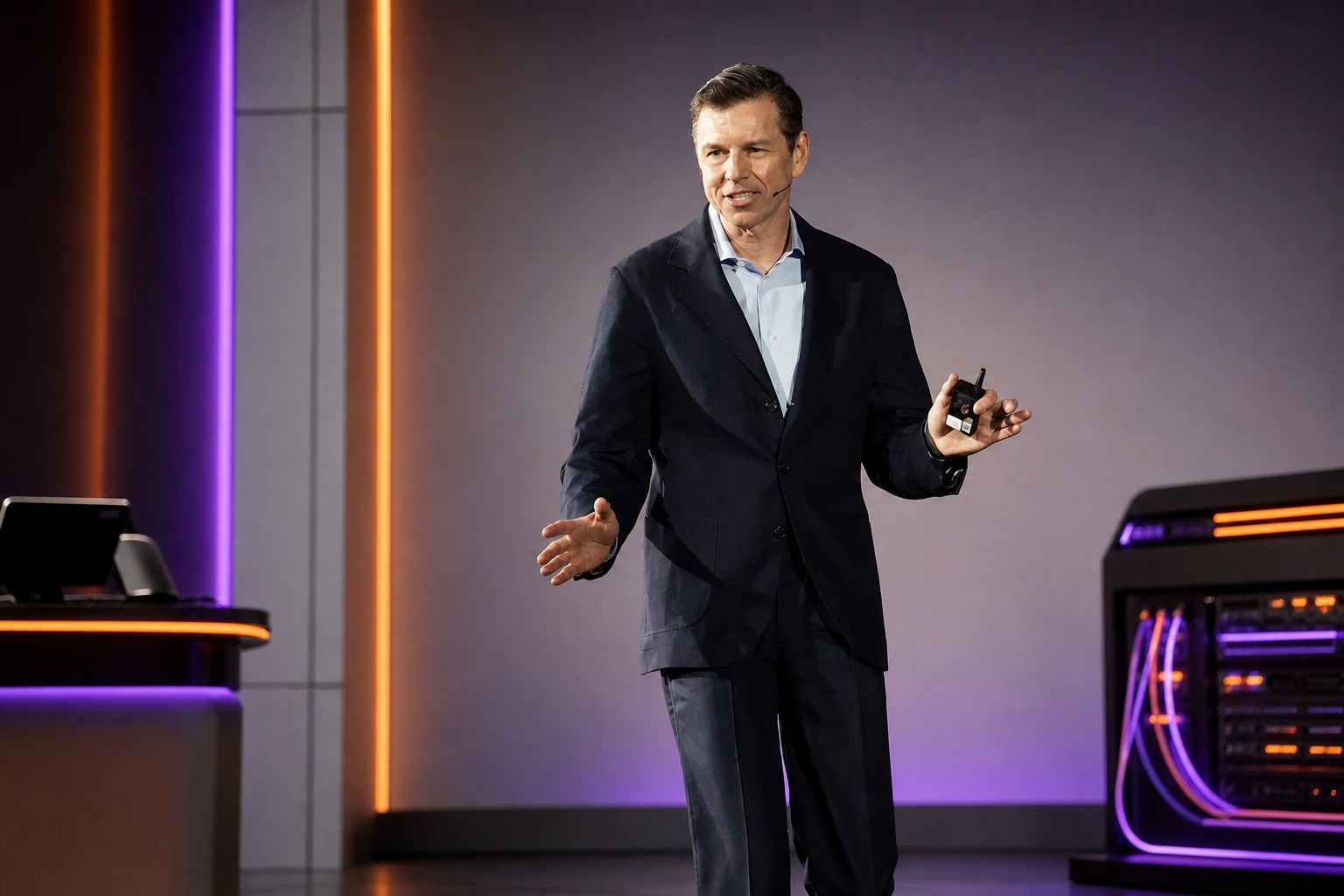
Tony Bates frames the shift as one from managing interactions to orchestrating outcomes — five years ago, he says, customer experience was mostly the former. His claim is that customers now expect a company to know who they are, what they are trying to accomplish and what the relationship looks like, and to adapt in real time. A disputed charge is his kind of example: resolving it can touch several systems, an AI agent and a human before anything is settled. Doing that, Bates argues, needs a different architecture — one that coordinates people, AI, systems and workflows around the customer while preserving context across the whole journey.
The architecture is described as four components, and three are named. Navigator is meant to be the intelligent entry point, deciding whether a customer goes to an AI agent, into a workflow or to a person, and carrying the relevant context with them. Orchestrator sits behind it, holding the state of the customer journey and applying context, policies and guardrails as a request moves across systems and resources. An AI control plane is supposed to centralize discovery, policy and observability.
Available today, by the company's own accounting: customers already running the Agentic Virtual Agent, the APT-2 model, developer tooling, Contextual Intelligence and the AI control plane. Native voice improvements, A2A compatibility and AI-assisted solution building are slated for later. Navigator and Orchestrator come later still. So the two components that would perform the orchestration are the two that do not exist yet. Bates rejects the framing that customers are being told to wait — they are, he says, already deploying agentic AI in Genesys Cloud, using live customer and journey data, connecting AI to enterprise applications, and getting gains in self-service, resolution, satisfaction and efficiency.
The model layer changed too. The Agentic Virtual Agent now runs on APT-2, a large action model from Scaled Cognition, which Genesys says is built for reasoning, factual grounding and reliable task execution. On the company's internal benchmarks, APT-2 is roughly 25% more accurate than APT-1 and roughly three times better at grounding in facts. Bates draws the distinction he wants the category judged on: an AI that produces the right answer versus one that takes the right action. In customer experience, an agent may need to authenticate the customer, choose a tool, comply with a policy, update a system and confirm the action completed. A system that answers persuasively and acts wrongly has failed the task.
That distinction has a shelf life, and Bates knows it. Frontier models from OpenAI, Anthropic and Google keep improving at tool use, reasoning and autonomous execution. If that continues at pace, a specialized action model becomes less interesting. His answer is that the advantage was never the model: it is the surrounding system — customer context, tools, testing, governance — that determines how AI behaves inside a real interaction, and Genesys intends to use better models wherever they fit best.
The build story is more concrete than the architecture story. Genesys says teams can feed existing process documentation, standard operating procedures and interaction transcripts into the system to describe the experience they want, and have AI translate those specifications into deployable configurations. Developers can work in Claude Code, Codex, Cursor and Kiro, then move specifications into Genesys Cloud for testing and governance. That is a real answer to the question of who writes all this, which most orchestration pitches leave unanswered.
For proof, Genesys points at Riachuelo, the Brazilian clothing retail chain and one of the country's largest companies, which replaced a conventional chatbot with the Agentic Virtual Agent. Reported results: customer retention up from 30% to 84%, CSAT up 60 points in the first year, productivity up more than 400% with no added headcount. Bates attaches his own caveat — individual deployments should not be extrapolated to a market, and AI ROI numbers deserve hard scrutiny — while noting these are figures Riachuelo itself reported and confirmed against its previous chatbot, not Genesys forecasts or models.
Genesys owns neither of the assets its rivals own. It has no CRM, as Salesforce does, and no control of the broad enterprise workflow layer, as ServiceNow does. Its argument is that customer experience itself can be the organizing layer for AI-driven work. It does not intend to wall the others out: the Agentic Virtual Agent is meant to talk to specialized Salesforce and ServiceNow agents over Agent2Agent, with Model Context Protocol connections reaching enterprise systems and tools. The result would be a layer that supervises a fleet of agents, competitors' agents included, with enterprises setting policies and permissions and every action remaining auditable and governable.
Rebecca Wettemann, principal analyst at Valoir, puts the stakes plainly: whoever owns the control layer has the most influence over which agent gets which job or process, and over how the token pie is divided. She credits Genesys with a legitimate claim to the customer-experience control layer governing CX-related agent behavior — but notes Salesforce and ServiceNow make the same claim with more data and the systems of record behind them. Buyers, she says, can source agents and orchestration from a platform vendor, a CRM, a CCaaS provider or another enterprise system, which leaves Genesys to explain why the CCaaS vendor should hold the layer while the others argue the opposite.
Bates offers neutrality as the differentiator — Genesys does not make customers choose among platforms they already run, it coordinates them around the outcome the customer is after. This reads less like a strategy than like a description of the position Genesys is in. Vendors that own the system of record do not need to be neutral; neutrality is what you sell when you cannot sell ownership. It can work — plenty of value has accrued to integration layers — but it works only while the thing being integrated stays dumb enough to need an integrator. The scenario Genesys has to fear is not losing a bake-off to ServiceNow. It is Salesforce agents handling more of the interaction end to end, at which point Genesys becomes the voice and messaging plumbing under somebody else's agentic experience. That is also the quiet risk running the other way: if the permissions and orchestration logic for other platforms' agents concentrate inside Genesys Cloud, enterprises acquire a new dependency, on a vendor that would sit in a position to shape where the economic value of agentic AI lands.
Notably absent from the announcement is any date for the two components the whole story rests on, and the pricing question that follows from Wettemann's token pie — who pays for agent-to-agent traffic that Genesys routes but does not originate — is not addressed at all. NICE is arguing a close variant of the same case with CXone Mpower, whose agents also push past single conversations into front-, middle- and back-office automation, on a different architecture.
Genesys has the installed base and the infrastructure to make the orchestration story plausible rather than aspirational. Wettemann's read is that customers are still early enough in adoption that they will need time to be ready for the vision being described. That is the tension the company is now living inside: those 8,000 organizations are either the moat that makes Genesys the control layer, or the largest single pool of accounts for Salesforce, ServiceNow, NICE and AI-native entrants to work through while Navigator and Orchestrator remain on the roadmap.