
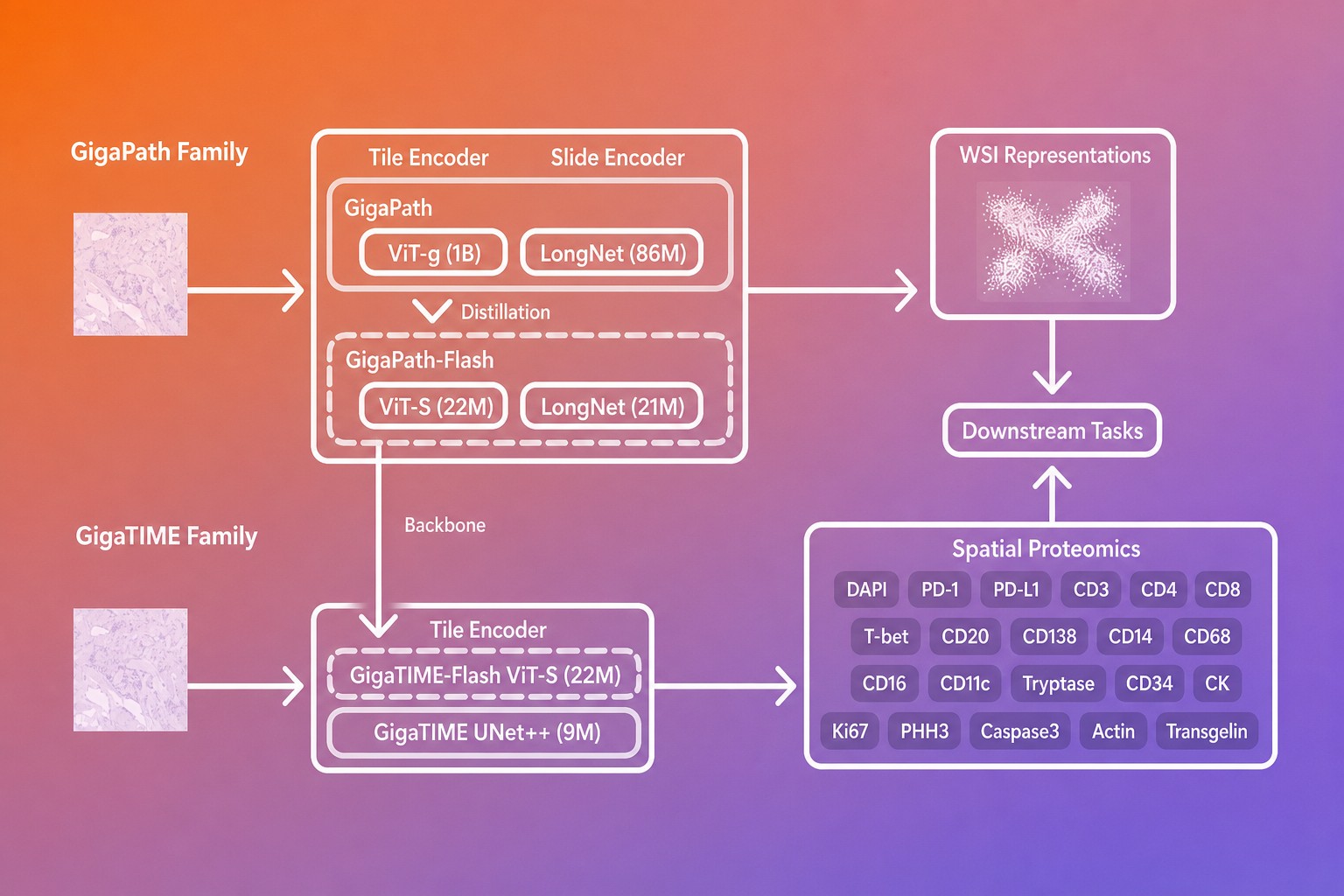
Microsoft Research, the University of Washington and Providence have released GigaPath-Flash and GigaTIME-Flash, distilled versions of two pathology foundation models, with open weights and source code on Hugging Face under Apache 2.0. The tile encoder drops from a billion parameters to 22 million. On whole-slide classification benchmarks the smaller model lands within 3% of the original GigaPath while using roughly 50 times less compute. The target here is not the single slide. It is the study that runs across tens of thousands of patients and then runs again, for every hypothesis and every subgroup.
That loop is the reason the Flash models exist. A whole-slide image can exceed a gigapixel, so one file is processed as thousands of small tiles, and hospitals produce millions of such images a year. A population-scale study is not one model run either: it is feature extraction, then statistical analysis, then hypothesis testing, then checks across patient subgroups, biomarkers and clinical measures. At the price of a billion-parameter encoder, researchers trim the study to fit the compute bill — fewer patients, fewer datasets, fewer tasks, fewer hypotheses.
The two models being compressed are recent and well placed. GigaPath, published in Nature in 2024, is a general-purpose whole-slide model pretrained on large volumes of real histopathology data from Providence. Unlike systems that work only on isolated tiles, it builds a contextual representation of the entire slide, holding local cellular detail and overall tissue architecture together. GigaTIME, published in Cell in 2026, extends the idea to the tumor microenvironment: trained on 40 million cells with paired H&E and multiplex immunofluorescence, it converts ordinary H&E images into virtual spatial proteomics maps across 21 protein channels.
GigaTIME's flagship result is itself the argument for cheap inference. Applied to more than 14,000 cancer patients, it produced a virtual population and surfaced over 1,200 statistically significant associations between immune cell states and clinical biomarkers. That is output that scales with how many times you can afford to press run.
Both Flash models keep the representations and shrink the machinery underneath them. The common component is a compact ViT-S tile encoder distilled from GigaPath's billion-parameter original.
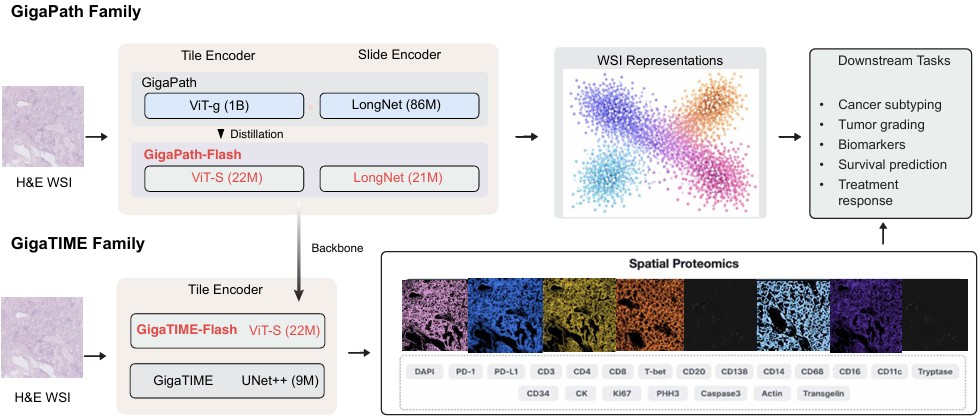
Overview of the GigaPath/GigaTIME model family. GigaPath-Flash provides efficient 22M-parameter tile and slide encoders. GigaTIME-Flash predicts spatial proteomics from H&E, replacing the CNN backbone with a distilled ViT-S encoder
Source: microsoft.com
GigaPath-Flash pairs a 22-million-parameter ViT-S tile encoder with a 21-million-parameter LongNet slide encoder. The tile encoder is distilled from the original GigaPath ViT-g teacher, carrying a billion-parameter model's representations into a backbone about an order of magnitude smaller. The slide encoder stitches all tile embeddings together with sparse attention, so its compute grows linearly with the number of tiles.
On PANDA, the prostate cancer grading benchmark, and EBRAINS, for brain tumor subtyping, GigaPath-Flash posted the lowest inference cost of any whole-slide pretrained model in the comparison, landing within 3% of the original GigaPath for roughly 50 times less compute.
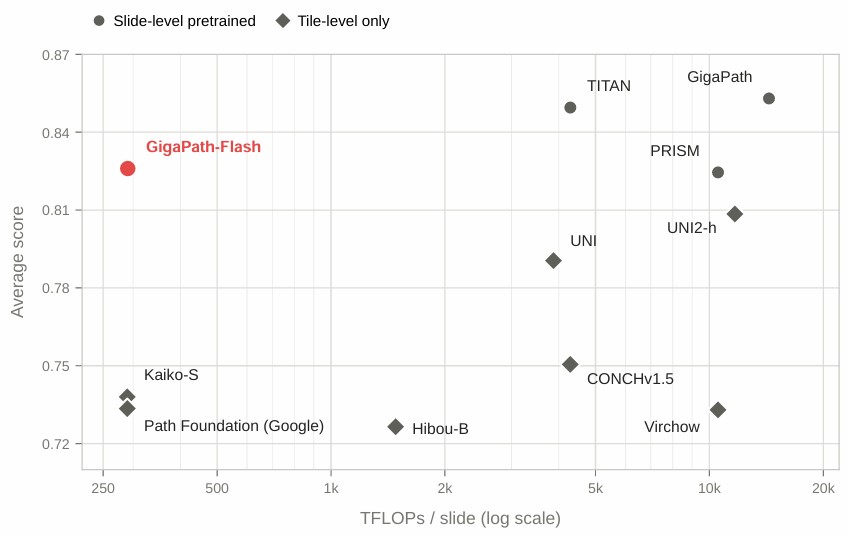
Efficiency-performance trade-off on whole-slide benchmarks. GigaPath-Flash (red, top left) reaches comparable performance at far lower compute cost than other whole-slide pretrained models
Source: microsoft.com
GigaTIME-Flash swaps the original model's convolutional backbone for the ViT-S encoder from GigaPath-Flash and uses a lightweight convolutional decoder to translate H&E into multiplex immunofluorescence. Fine-tuning runs through LoRA adapters, so the pretrained encoder's weights largely stay frozen.
Across both in-distribution and out-of-distribution patient cohorts, covering brain, breast, colon and lung tumors, GigaTIME-Flash matched or beat the original GigaTIME at predicting spatial protein distribution. The advantage was clearest out of distribution, which the authors read as evidence that a general-purpose backbone transfers to tissue types the model has never seen.
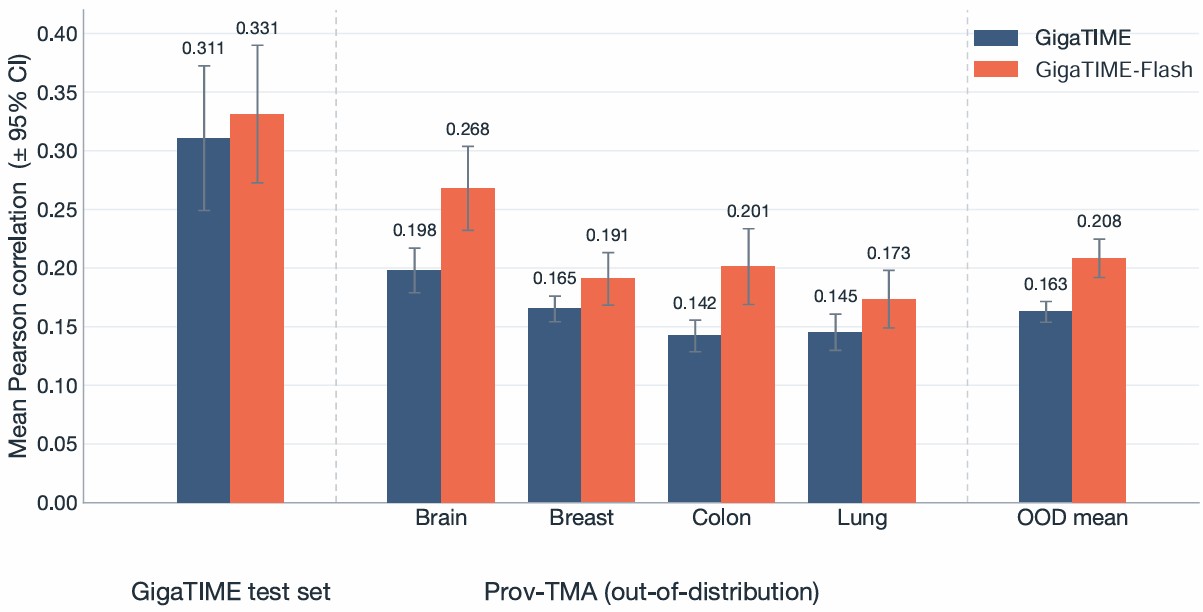
Mean windowed Pearson correlation for GigaTIME and GigaTIME-Flash on the GigaTIME test set and four out-of-distribution Prov-TMA cohorts. GigaTIME-Flash matches or exceeds the original model in every cohort
Source: microsoft.com
For one slide, the savings show up as shorter runtime and lower hardware requirements. At tens of thousands of slides, they decide whether the experiment happens at all. The authors estimated the time to generate virtual multiplex immunofluorescence for cohorts of different sizes on a single A100, assuming around 10,000 tiles per slide.
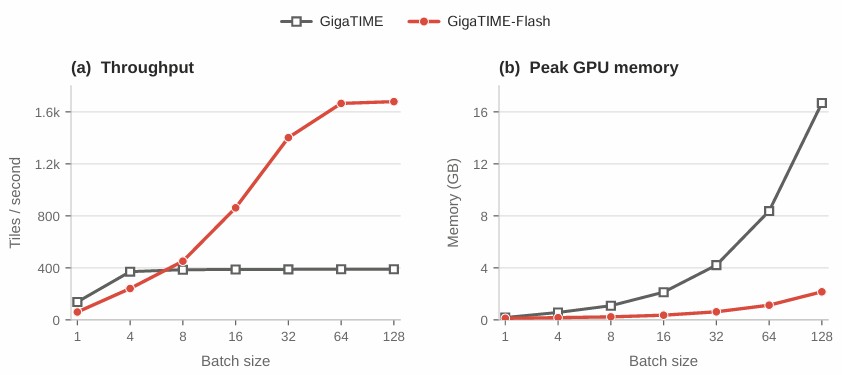
GigaTIME efficiency scaling. Left: throughput (tiles/s) versus batch size. Right: peak GPU memory (GB) versus batch size. GigaTIME-Flash scales past 1,600 tiles/s while using a fraction of the memory
Source: microsoft.com
"Within 3%" is carrying a great deal of weight in this release, and I would read it as a cost rather than a rounding error. In a study hunting for effects across subgroups, a uniform 3% haircut is usually survivable; a 3% haircut that falls unevenly on rare subtypes is not, and nothing published here says which of the two this is. The 50x figure is also a ratio against a model that was, by the authors' own framing, too expensive to use the way it was meant to be used. Shipping Flash is a tacit admission that GigaPath at a billion parameters was never going to serve the population-scale research its own Nature and Cell papers advertised.
The more interesting result is the one not in the headline. GigaTIME-Flash matching or exceeding its own teacher, most clearly on tissue outside the training distribution, is not what distillation is supposed to do. Replacing a CNN backbone with a distilled general-purpose encoder appears to have bought generalization: the small model is strongest exactly where the large one was weakest. That is a claim about architecture, not about efficiency, and it deserves more than the one sentence it gets.
Notably absent from the announcement: any word on those 1,200 associations. They came out of full GigaTIME running over 14,000-plus patients, and the obvious test of a cheap substitute is to rerun that study and count how many findings survive. The release does not say it was done. The A100 exercise has the same shape — the authors describe measuring generation time for cohorts of different sizes, and what gets reported is throughput and peak memory against batch size, not the number a research group actually budgets against.
The fine print is blunt about the rest. This is an early research release, evaluated on a limited set of benchmarks and cohorts; the models are not intended or validated for diagnosis, prognosis, treatment selection or any other patient-care decision; results may vary by dataset, scanner, institution, population and task; clinical use would need multi-site and prospective studies. Distillation solved the half of the problem that money could already solve. The half that decides whether any of this reaches a patient — validation across scanners, sites and populations — costs exactly what it did before, and a 50-times cheaper encoder generates more findings in need of it, not fewer.