
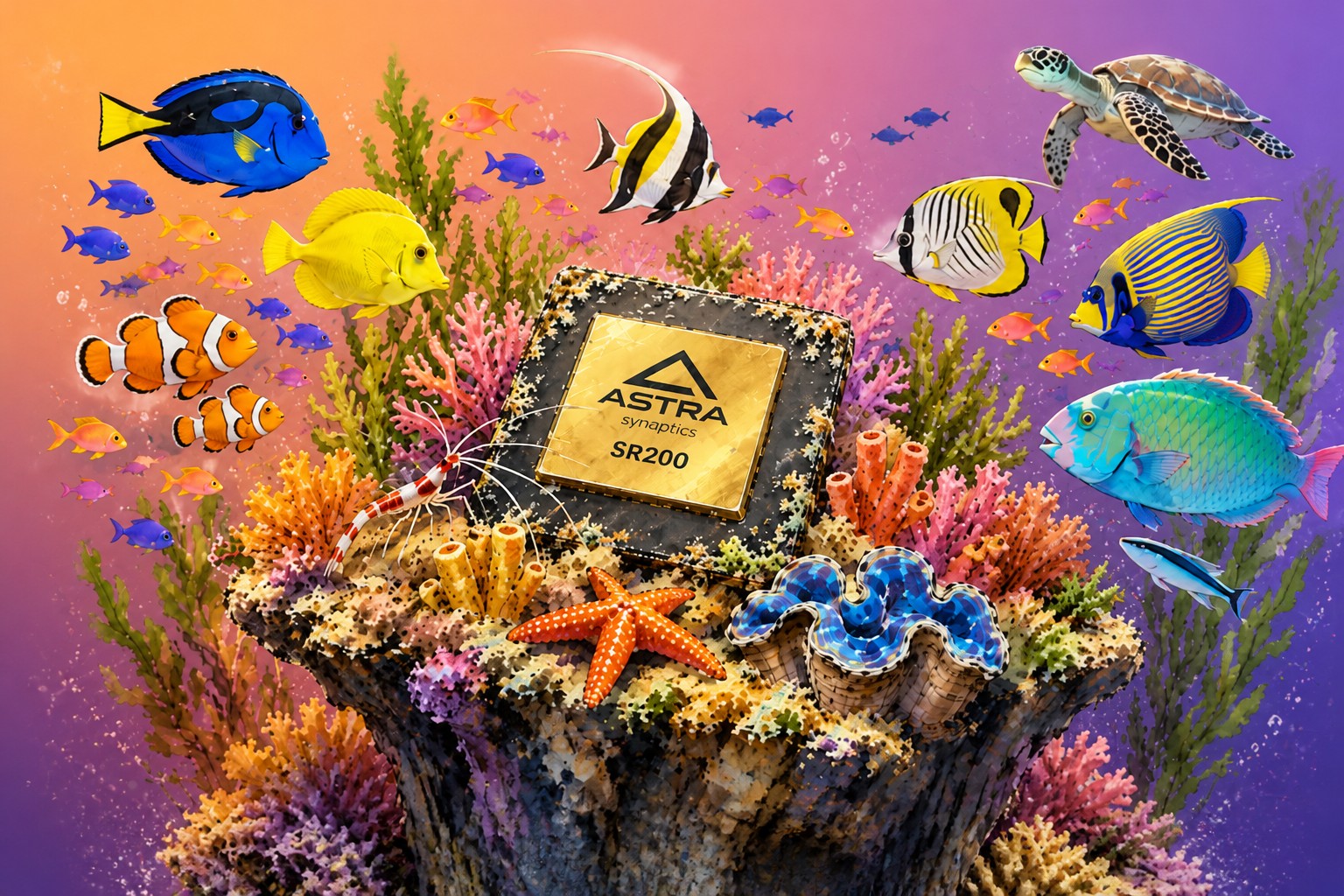
An open architecture, not a Google chip
Google Research opened the Coral NPU architecture in October 2025. Google does not manufacture the processors; it lets semiconductor companies incorporate the design into their own chips. Coral uses the open RISC-V instruction set and software intended to help move AI applications between hardware platforms.
Synaptics is Coral’s first commercial chip partner. Its Apache 2.0 license allows companies to use the architecture in commercial processors without license fees or royalties to Google. Synaptics is adding its own data-processing technology and Torq, an open compiler based on MLIR and IREE. Torq is intended to help developers bring models built with frameworks including PyTorch, JAX and Google’s LiteRT to different hardware.
At a closed VentureBeat briefing on October 13, Billy Rutledge, Google Research director and head of its Systems Research team, described the difficulty of running the same models across many proprietary chips in consumer and industrial devices. Google’s answer is to offer a shared hardware architecture rather than build a chip itself.
Three processors, no independent comparison
The Astra SR200 family has three processors, with peak AI performance ranging from 200 to 400 billion operations per second:
The chips combine Arm Cortex-M85 and Cortex-M52 cores with Google’s Coral NPU, distributing workloads across components with different performance and power characteristics. Synaptics says the processors can include up to 8 MB of SRAM and special DRAM configurations reaching hundreds of megabytes. Its planned Coralboard SR will support up to 256 MB of memory.
Synaptics says its memory architecture uses about one-third the energy of conventional system DRAM under comparable workloads. But independent benchmarks have not established how much that would extend a device’s battery life. Nor does a peak GOPS figure show how quickly or efficiently a processor will run a real model: memory, power use, software compatibility and model choice all matter.
That leaves the headline performance figures short of a practical comparison. STMicroelectronics already sells the STM32N6 microcontroller, with an AI accelerator rated up to 600 GOPS; Renesas introduced the RA8P1 series in 2025, rated up to 256 GOPS. Those numbers alone do not settle which chips perform better on actual workloads.
Small models and unconfirmed product plans
The companies name Gemma 3 270M, Liquid AI’s LFM2.5 models and Ultralytics’ YOLO computer-vision models among the models supported or targeted. Synaptics says Gemma 3 270M generates about 12–16 tokens per second at different model-compression settings. It has not provided a full independent performance comparison for the SR200 hardware.
Potential uses include industrial smart glasses that interpret their surroundings, factory cameras that recognize objects, and security systems that analyze audio and video locally rather than continuously sending data to cloud servers. Synaptics also cited work with audio-equipment maker Sonos, security company Verisure and augmented-reality equipment maker Jorjin Technologies. Their comments describe current Astra work or possible uses for the new processors; they do not confirm products based on the SR200.
For now, developers can try the existing Coralboard SL, which uses Synaptics’ Astra SL2619 processor, a 1 TOPS AI accelerator and 2 GB of DDR4 memory. DigiKey lists the board at $99.79. Synaptics announced on October 20 that it was available for general sale through the distributor.
The Coralboard SR, built around the new SR250, is not yet on sale, and SR200 processors are at the sampling stage. Synaptics has not disclosed chip prices or precise mass-production dates.
The open question is what ships
I think the more important test is not whether Coral’s architecture can support more models, but whether developers can use it across products without giving up battery life, reliability or privacy. Synaptics’ claimed memory-efficiency advantage could matter in devices that process camera, microphone and sensor data locally, but the announcement offers no independent battery-life results to show what that advantage means in practice.
The timing also puts the launch alongside Synaptics’ pending $5.7 billion acquisition by onsemi, which is now expected to close by mid-2027. Google’s strategy reaches beyond one processor: it is trying to establish common ground for AI devices through an open accelerator architecture and partnerships with chipmakers and model developers. That foundation matters only if partners turn it into affordable products—and the announcement has yet to show when the SR200 chips will reach mass production.
Daily AI news
Every day we pick what actually matters in AI and explain it plainly — no hype, no filler. Subscribe if you want to follow where the industry is going.
Only what matters — every day
Follow on X