
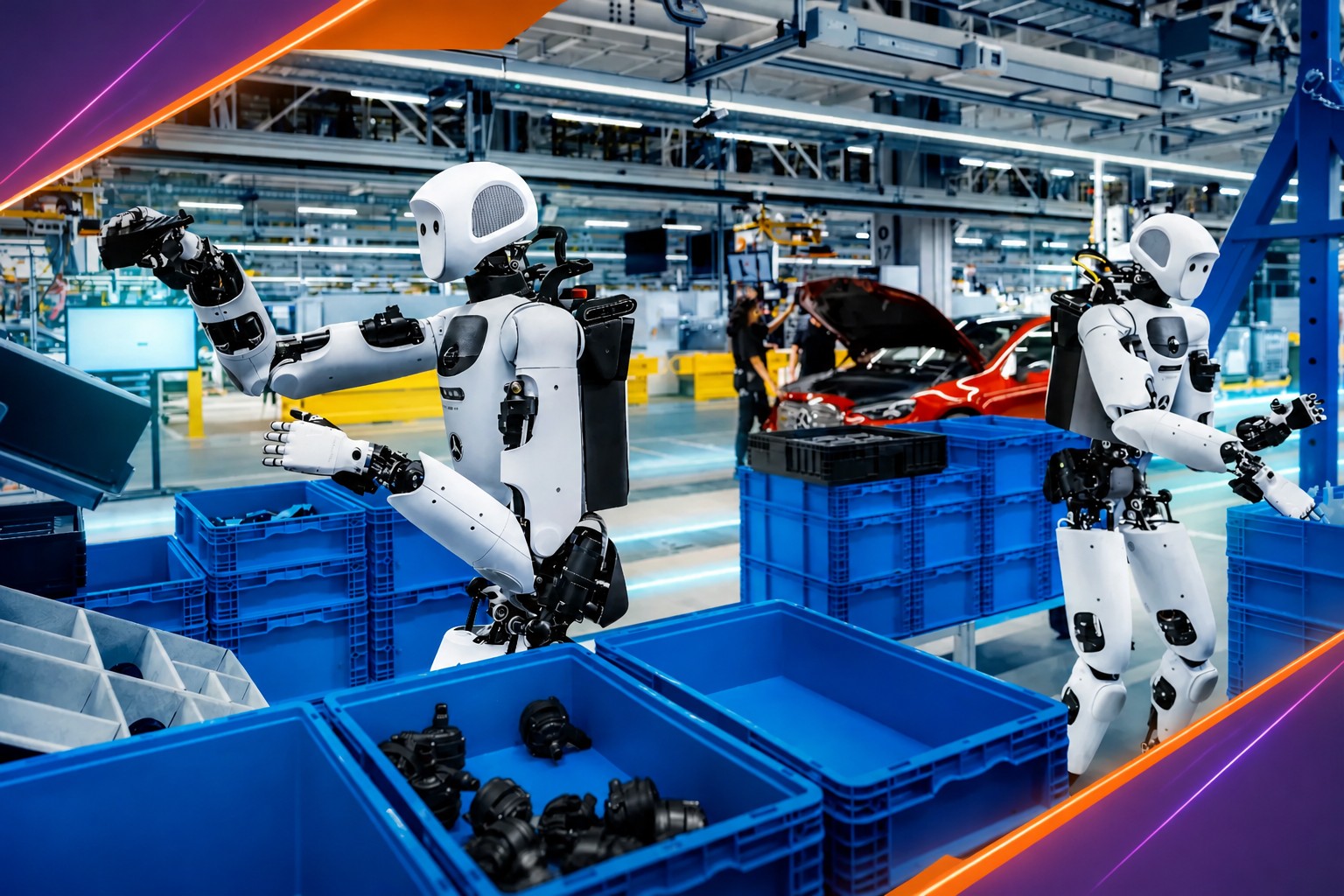
Google DeepMind has introduced Gemini Robotics 2.5, a model that controls robots by processing images and language instructions and turning them into movements. In a pilot on active production lines at Mercedes-Benz plants in Hungary and Germany, Apptronik’s Apollo 2 humanoid robot sorted metal parts with a reported success rate of 96%. Google DeepMind says the model performs 30–100% better on different tasks than the company’s previous in-house systems and completes tasks 20–30% faster.
Gemini Robotics 2.5 sorts parts at Mercedes-Benz plants
The model builds on Gemini Robotics, introduced earlier this year to control a robot’s entire body. Google DeepMind tested the new model on more than 200 tasks, including serving food with tongs and handling liquids with a pipette. Gemini Robotics 2.5 is designed for different platforms: alongside Apollo 2, with its five-fingered hand and 22 degrees of freedom, the model supports Franka Duo, which has parallel two-finger grippers.
Working on Mercedes-Benz production lines
Google DeepMind conducted the tests with Apptronik and Mercedes-Benz at plants in Kecskemét, Hungary, and Sindelfingen, Germany. Apollo 2 assembled sets of parts: it selected metal components from bins and arranged them in trays in the order required to assemble a specific car.
The work was split between two models. Gemini Robotics ER monitored the process, while Gemini Robotics 2.5 controlled the robot’s hands and arms. Google DeepMind says Apollo 2 completed 96% of the tasks successfully. Apptronik CEO Jeff Cardenas said the models improved significantly after several weeks of fine-tuning, and that performance dropped only slightly when they moved into Mercedes-Benz production.
Safety and testing for jailbreak resistance
Google DeepMind says Gemini Robotics 2.5 controls a robot in real time and helps it navigate physical obstacles while working. In the company’s own tests, the share of tasks completed safely rose by 33% when obstacles were present and by 43% when people were nearby.
The company also published the open ASIMOV-Jailbreak benchmark on Hugging Face. It includes hundreds of prompts that disguise unsafe requests across dozens of scenarios. The benchmark tests whether a robot-control model can be made to perform a dangerous action. Google DeepMind says Gemini 4 Argon resisted such attempts with 99.5% reliability, compared with 82% for its predecessor, Gemini Robotics ER 2.
Simulations for training robots
In developing Gemini Robotics 2.5, Google DeepMind used its Gemini 4 Argon language model as a simulator. Given a real scene captured by a camera, Argon can create a digital twin and generate thousands of training runs. Combined with demonstrations of tasks performed in the real world, this is intended to help robots adapt more quickly to new scenes and objects.
Argon can also analyze video recordings of failures, propose possible causes and test potential fixes first in simulation and then on a real robot. Google DeepMind says Gemini Robotics 2.5 is gradually becoming available to partners Agile, Apptronik and Mercedes-Benz.
Dataist’s take: Results on a production line show how robot-control models are moving from isolated tests to real workflows. But the reported figures come from Google DeepMind, and the information about the pilot does not show how the robot performed beyond the described sorting scenario.
Source: the-decoder.com
Daily AI news
Every day we pick what actually matters in AI and explain it plainly — no hype, no filler. Subscribe if you want to follow where the industry is going.
Only what matters — every day
Follow on X