
Agents move into the developer workflow
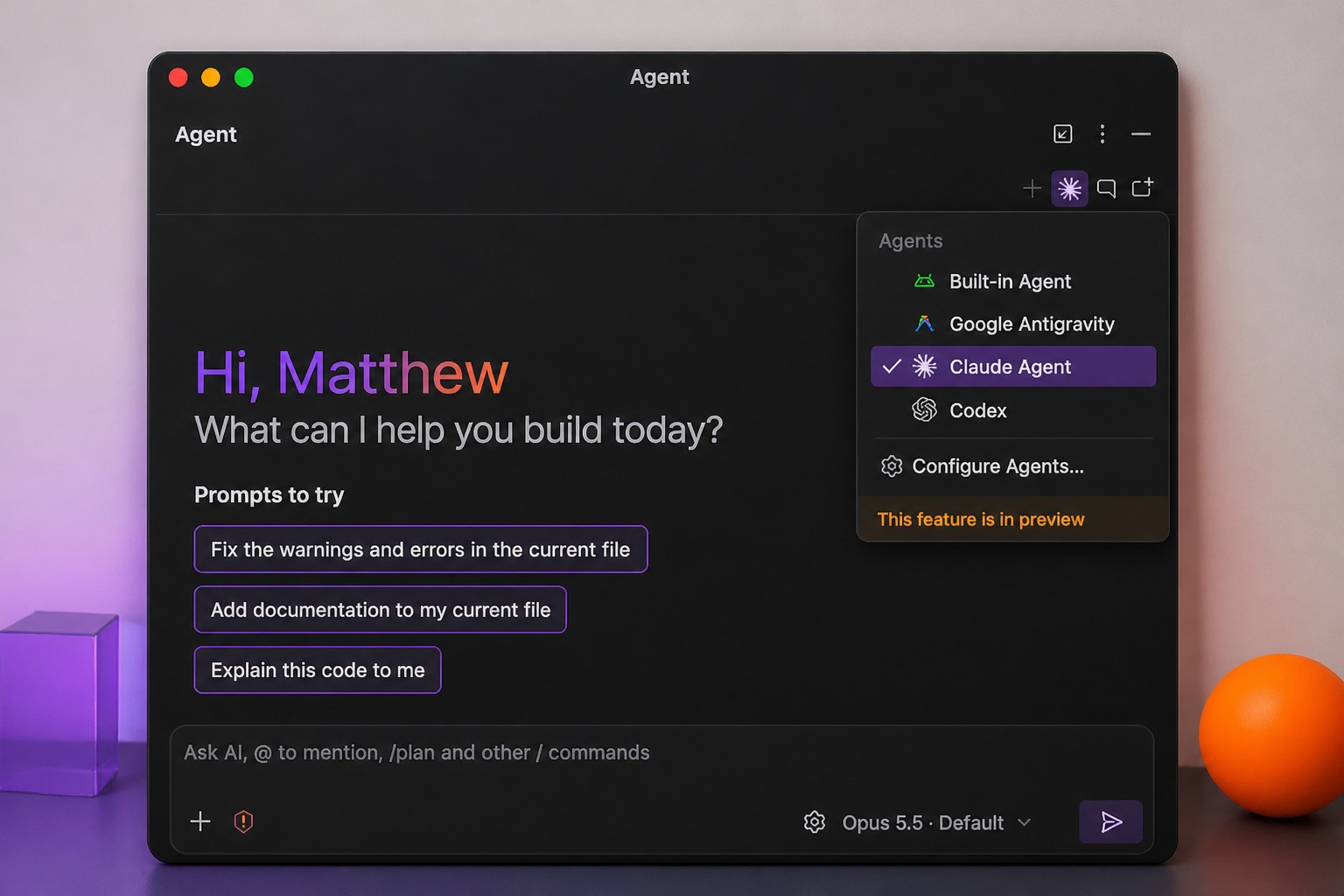
Android Studio Rabbit 2 will support Bring Your Own Agent, or BYOA, through the open Agent Client Protocol. Developers will be able to run more than 40 coding agents in the IDE, including Claude Agent, Codex and Google Antigravity. Those agents can access project structure, symbol resolution, the emulator and Logcat.
Google is also adding tools to review and migrate code produced by agents:
Android Bench 2.0 will evaluate language models on complex, multi-day development projects, measuring functionality, time spent and cost. That is a more useful test than a short coding task, though it still leaves open how well a benchmark predicts the work of maintaining a real application.
Faster workflows, with Google’s numbers attached
Android CLI is now an official plugin for Claude Code, Codex and Google Antigravity. New commands let agents preview Compose interfaces in the terminal rather than launching an emulator. In Google’s internal tests, agents completed UI tasks 77% faster and used up to three times fewer tokens. The CLI can also connect to physical test devices in Google’s labs, giving agents a way to investigate device-specific bugs.
Google has integrated the open-source LeakCanary memory-leak detection library into Android CLI and Android Studio Profiler. It analyzes heap dumps on a computer rather than on the phone, avoiding a slowdown on the test device. In an A/B test using Anthropic’s Claude Opus 5.5, Google says the CLI tool found and fixed memory leaks almost twice as fast, while cutting token use by about 25%.
Other CLI tools let agents collect system traces with Android Performance Analyzer, retrieve crash reports from Firebase Crashlytics and check code optimization with the R8 compiler. Google is also offering more than 30 Android Skills: documentation packs intended to help agents work with current APIs, Google Play requirements, permission security and layouts for foldables and Googlebook laptops.
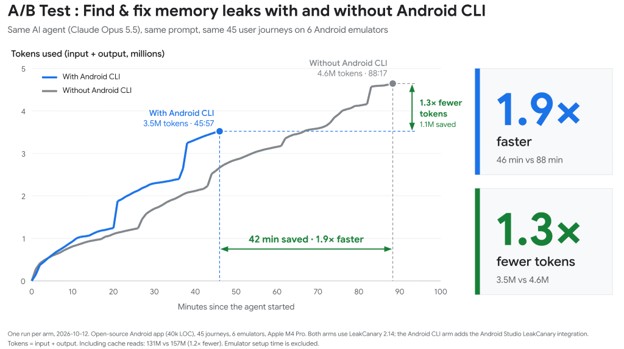
Google says integrating LeakCanary into the Android CLI reduces both runtime and token usage for AI agents. | Image: Google
Source: the-decoder.com
Apps become callable by agents
For on-device agent features, ML Kit will get an alpha Agentic API based on Gemini Nano 4. It handles function calls, chat history, coordination between components and safety filters.

The XREAL AURA projects up to five virtual windows into the user's field of view and connects to a laptop via cable. | Image: Google
Source: the-decoder.com
Google is also beta-testing AppFunctions, a shared layer for calling app functions through the Model Context Protocol. Apps will be able to expose those functions to local agents or agents operating at the system level. An alpha Agent-to-UI interface for Jetpack Compose builds on that approach: instead of returning only text, agents can assemble interactive interfaces from an app’s own components.
The Connected Apps Platform is a separate preview for linking app services to Google Search and Gemini. Developers can connect through Android MCP or hosted MCP servers and manage integrations from one console. Google says Gemini already has more than 50 partner integrations, including Adobe, Peloton and Experian; they are due to reach web search in the coming weeks.
The hardware bet
Google’s XR development tools are now stable: Jetpack XR SDK, Android Studio XR emulators and Engine Hub for Unity, Godot and Unreal. Alongside those releases, Google and device maker XREAL introduced XREAL AURA, wired smart glasses running Android XR.
The glasses weigh less than 95 grams and have transparent dimming lenses with a 70-degree field of view. Their computing unit and battery sit in an external device that also functions as a touchpad, powered by Qualcomm’s Snapdragon Reality Elite chip. Users can place up to five Android apps in view or connect a laptop over USB-C. Gemini can see both the physical surroundings and virtual screens, and can organize windows, offer video-game guidance and highlight objects in a room.
XREAL AURA is available to order in the US, Canada and South Korea for $1099, with shipments starting in mid-November.
I think the more consequential part of this announcement is not the glasses or any single API: it is Google trying to make Android’s development environment and apps legible to agents from multiple vendors. The unanswered question is how much control developers will have over what those agents can do once app functions become callable across the system. That boundary will matter more than the number of integrations.
Daily AI news
Every day we pick what actually matters in AI and explain it plainly — no hype, no filler. Subscribe if you want to follow where the industry is going.
Only what matters — every day
Follow on X