
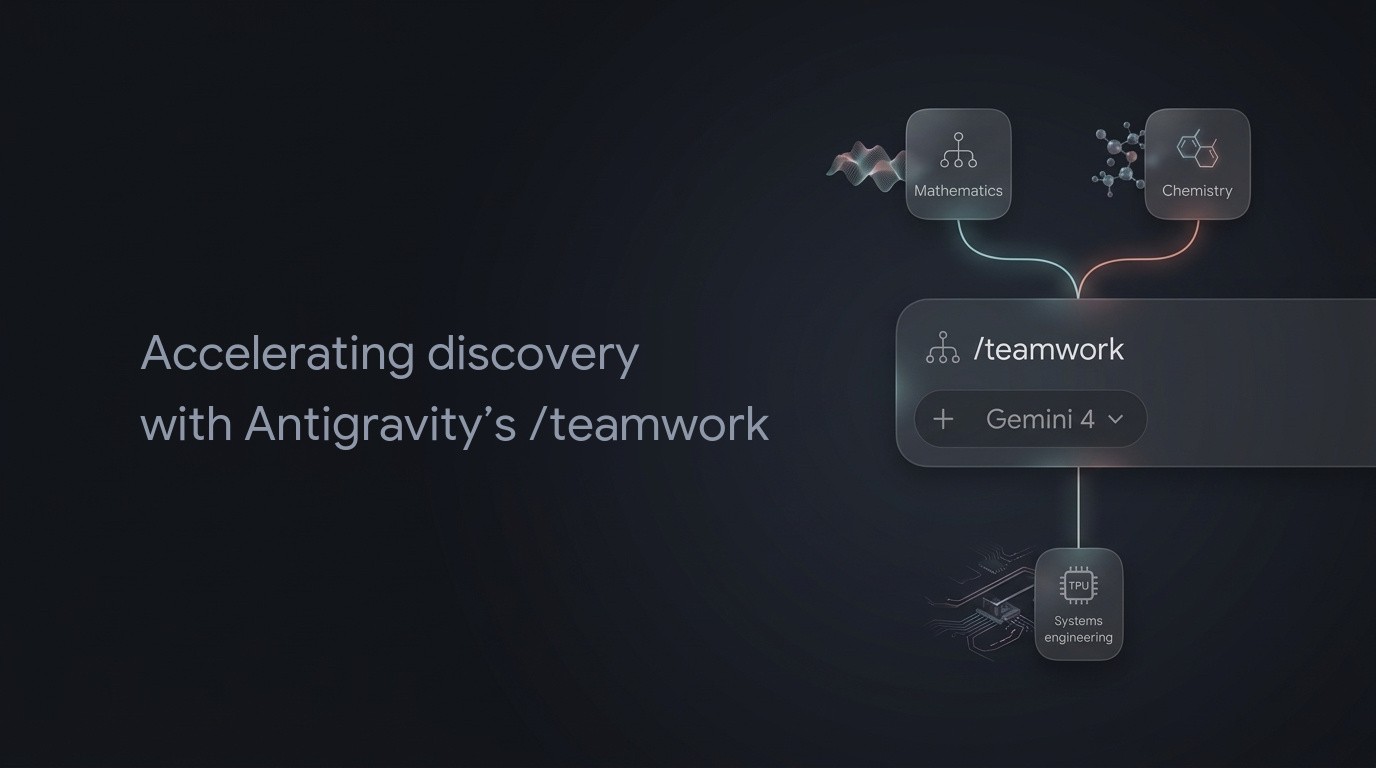
Google has presented new results from /teamwork, a multi-agent system built on Gemini 4 models. Researchers and engineers used it to tackle problems in mathematics, chemistry, software development, and machine learning, including formalizing mathematical proofs and optimizing code for TPUs. Google is opening /teamwork and the /boost team to external users in Antigravity. It is also accepting applications for six months of free access to its top-tier plan for 10,000 academic researchers.
Google opens Antigravity’s multi-agent tools to researchers and developers
Source: research.google
Google describes the system as a collaboration between people and AI: specialists define a task and set theoretical or physical constraints, while AI agents write solvers, explore options, check solutions, and connect long chains of reasoning. The projects involved teams from Google and academic partners. In recent weeks, they have taken on problems that had remained unsolved for years and produced results in information theory, formal verification, molecular structure search, and operating-system kernel optimization.
To check candidate solutions, the system uses independent tools: the Lean 4 proof checker, unmodified software test suites, execution simulators, web search, and hardware counters. Agents also work with limited context: each receives only the files and tools needed for its step. Coordinators hand work to new agents, while critics and auditors check results in separate contexts without relying on the solution author’s reasoning.
How /teamwork works
The system routes a user’s request to a suitable workflow template. These include parallel code development, sequential solving with verification, long proofs, and document analysis. The /boost team separately packages a sequential solve-and-check cycle for everyday programming tasks.
Google says many of these capabilities are already available in Antigravity, with new features for external users to be added in the coming weeks. The new results presented in the publication include tasks completed using versions of /teamwork and Gemini 4 models.
Mathematics and computer science
Researchers from Google, CUHK, USC, and CMU used the Long Proof template in /teamwork to prove the Cortade–Kumar conjecture in full generality. Formulated in 2013, it concerns transmitting a random bit string through a noisy channel: the conjecture states that compressing the input to one bit cannot preserve more information than a dictator function, which copies one of the input bits.
Gemini first found counterexamples to a generalized conjecture from earlier work by the CUHK team. The researchers then proposed a new candidate function, reducing the problem to optimization over 14 variables and obtaining an important analytical lower bound. Gemini 4 Argon and earlier models divided the parameter space and derived most of the new analytical bounds and interval-arithmetic certificates. They also extended the proof from balanced functions to unbalanced ones without human involvement. The team formalized the full proof in Lean 4; it took 50 million lines of code.
In other problems in mathematics, statistics, and computer science, researchers posed open questions to Gemini 4 and the Stellar Colosseum and /teamwork systems. The resulting algorithms and proofs, including those formalized in Lean 4, were checked, simplified, and edited by the authors before publication.
Formal proof verification
Manually checking a manuscript alongside computer calculations makes reviewers’ work harder, and errors can hide in long derivations. Formalization in Lean 4 turns a proof into code checked by a computer kernel. Once mathematicians confirm that the formal statement matches the original problem, the proof compiles only if every logical step is correct.
The LEAP multi-agent framework, developed with colleagues from Google Cloud AI and running on Gemini 4 Argon, was applied to problems involving the propagation of physical waves, dynamical systems, and integer solutions to polynomial equations.
The /teamwork-LEAP system autonomously produced an end-to-end formalization of the Weil conjectures, results on counting solutions to polynomial equations over finite fields that culminated in Pierre Deligne’s proof in 1974. The formalization took about 1.8 million lines of Lean and required 28,800 runs of subagents. The system also synthesized more than 919,000 lines of Lean to formalize, for the first time, a recent proof of Hilbert’s tenth problem over general rings of integers.
The system also independently reproduced a complete formalization of a recent proof that solutions to the three-dimensional Navier–Stokes equations can become unbounded in finite time under smooth external forcing. The problem is one of the Millennium Prize Problems and had been open for about 90 years.
Other results include the first formalization of the Birkhoff conjecture on dynamical systems, open since 1927, and the Bochner–Riesz conjecture for three-dimensional space, a central problem in harmonic analysis that had remained open for more than 50 years. While working on the latter, the system found and corrected a gap in a recently published informal proof. It also resolved a question about C¹ regularity for infinity-harmonic functions in three or more dimensions, open for about 20 years; formalized the Killip–Visan theorem on the well-posedness of the Korteweg–de Vries equation in H⁻¹; and checked informal proofs from a UCLA group for the 40-year-old Jamison “Caterpillar” conjecture, the Aghevli–Ollis conjecture, and an improved upper bound for Erdős problem No. 1063.
Before the STOC 2027 conference, authors of 578 papers—more than a third of all submissions—agreed to receive Deep Review feedback on their drafts. In an ongoing author survey (N = 70), 90% of respondents rated the feedback as mostly or almost entirely factual, and 90% said they would use the tool again. More than 30% reported that Deep Review found substantial errors in proofs or mathematically significant typos; 14% said the system found technical gaps that took more than an hour to fix. Authors also noted that tools like this could help produce more accurate research faster and increase confidence in scientific results. Users receive two free Deep Review requests per week. The tool is also available in Antigravity as a document-analysis template for /teamwork.
Finding molecular structures
Determining a molecule’s structure from experimental nuclear magnetic resonance data is one of chemistry’s difficult problems. For HIV protease inhibitors, one misplaced bond can be the difference between a drug and an inactive molecule that resembles it.
Google combined 30 specialized agents in a self-correcting /teamwork cycle and connected them to a physics-based spectrum simulator. On difficult molecules from the benchmark, the system achieved 95% accuracy in selecting the single best candidate and 100% among its top three—almost twice the result of a single agent. The work lays the groundwork for further research into protein dynamics and complex structures in three dimensions. Google also reports that /teamwork and the Argon model helped with nuclear fusion and quantum algorithm problems described in the Gemini 4 publication.
Causal inference benchmark
Google also used multi-stage verification to prepare an empirical benchmark. Starting with five criteria set by people, including data anonymization, 29 agents on Argon turned 13 publicly available tables into a benchmark of 50 causal-inference tasks in 11.5 hours.
For each task, models must determine whether a causal effect can be identified and estimate it, given the correct answer. After initial checks, separate reviewer and auditor agents found simplified workarounds, wording clues, and fabricated scenarios. The problems they found were turned into permanent tests. Automation helped prepare the challenging tasks needed to answer Gemini’s counterfactual “what if” questions.
Software development and systems engineering
In software and hardware projects, /teamwork combines long autonomous campaigns with objective verification: network benchmarks, game engines, unmodified test suites, and hardware timers.
Distributed systems
Using /teamwork and Argon, Google created FarArray, a low-latency, kernel-bypass system built on a distributed global address-space model and the SNAP microkernel. FarArray runs, among other things, lock-free connected-components algorithms. They scale to graphs with one trillion edges, delivering 60–90 times the throughput and 40–180 times the speed of TCP-based key-value stores while using six times less RAM.
The InstantEmbedding system for personalized PageRank reduced peak dynamic-memory use by up to 14 times and running time by 11–27 times compared with accelerated MapReduce implementations. The team also developed custom TPU kernels for graph neural networks using /teamwork and Argon. They cut high-bandwidth memory use by up to 185 times and sped up forward and backward passes by 8–15 times.
Autonomous optimization of a Go engine
To test long-running autonomous optimization, the team used Argon to train a 9×9 Go engine from scratch, starting with a basic AlphaZero implementation. People set the compute-resource distribution and evaluation scheme, after which the system independently accelerated self-play training and Elo rating calculations. Winners were selected only through statistical tests on held-out game records.
Self-play training became 2,300 times faster. In less than eight days, the engine’s rating rose by about 2,600 points to 1,885—between KataGo’s results at 16 and 32 visits per move. For the publication, the final champion played black against the network that had started Elo optimization, playing white. The champion won by 22.5 points under territory scoring with 7.5 komi.
Rust porting and TPU optimization
Large codebase migrations can fail if agents replace dependencies with stubs or change tests to hide errors. A new /teamwork template, coming soon to Antigravity, starts work on a module only after its dependencies build. Each leaf module is checked against the original, unmodified test suite.
After the initial port of 25% of the Zircon microkernel, a two-week campaign on Argon rewrote the remaining C++ code: it added about 800,000 lines of safe Rust that passed all kernel unit tests and booted on arm64 hardware. /teamwork also rewrote Google’s AV1 video decoder, libgav1, from C++ into about 170,000 lines of Rust. The new version matched the original bit for bit across a broad conformance test suite. At first, the port ran about four times slower than the original. After the system was given profiling tools and the task of maximizing speed on short videos, the Rust version became 20–30% faster than the original C++ and hand-optimized assembly on x86_64 and ARM.
For everyday tasks, the /boost team in Antigravity uses /teamwork’s iterative approach to programming. Analysis of past runs showed that tightly coupled code is better written and reviewed sequentially than split into parallel pieces. Based on that analysis, Google improved /boost for programming tasks. This is an example of one workflow template optimizing another in terms of token use.
Full evaluation of custom JAX and Pallas kernels for TPUs takes 7 to 32 minutes, limiting the number of candidates optimization algorithms can test. In the DuoDiscover template on Argon, four parallel agents found bottlenecks and built fast evaluators—“rulers”—that run in 23 seconds. They rank candidates, and their results are regularly checked against full hardware runs using Kendall rank correlation.
DuoDiscover achieved a geometric mean speedup of 4.09× over reference implementations on 17 JAXBench kernels and 2.99× on seven manually optimized Pallas kernels for TPU inference with vLLM on leading open-weight models.
Use across Google’s infrastructure
Google also used /teamwork and /boost for production tasks and hardware modeling. For fleet-wide memory optimization, the team analyzed internal metrics and past successful approaches to reducing memory use, then created reusable workflows. They identified savings opportunities exceeding the initial estimate of 1 PiB. Further savings came from a memory-efficiency monitoring agent operating with human involvement. Techniques used included removing struct padding, narrowing scalar types, using cross-size allocation jumps, code outlining, and tagged pointers.
A /teamwork- and /boost-based scheduling optimization workflow was also launched in Borg. It led to the deployment of two changes: on some hardware types, TPU task preemptions fell by 24% while service-level and cluster-utilization targets were maintained.
Access for researchers and developers
External researchers and developers can already use Gemini 4 models with /teamwork, /boost, and Deep Review in Antigravity. Google has also opened applications for six months of free access to its top-tier plan for 10,000 academic researchers.
Upcoming Antigravity updates will add a formal-proof template and other specialized workflows. In the coming weeks, Google says it will publish detailed tutorials on the Antigravity blog to help developers and researchers build, verify, and steadily improve their own multi-agent teams.
Contributors
Work on /teamwork brought together Google employees and academic partners. The main Google contributors named include Yuan Deng, Honghao Lin, Jimin Mao, Vahab Mirrokni, Vishnu Viramachaneni, David Woodruff, Song Zuo, Shubham Agarwal, Santiago Balciero, Mohammadhossein Bateni, Mohsen Bayati, Garrett Bingham, Guy Blelloch, Douglas Chen, Vincent Cohen-Addad, Boyan Cui, Tulsi Doshi, Eric First, Mike Galkin, Elena Gribelyuk, Anupam Gupta, Guru Guruganesh, Mike Heddles, Patrick Heisel, Iman Hosseini, Kevin Hou, Lalit Jain, Adel Javanmard, Rajesh Jayaram, Xiaoen Ju, Po-Nien Kuo, Silvio Lattanzi, Samuel Lavoie, Chung-Liang Lee, Matthew Lee, Yinan Li, Yuchen Li, Yiming Liu, Thang Luong, Brandon Mayer, Simon Meyerhans, Swarup Mishra, Ashish Naik, Sebastian Nowozin, Renato Paes Leme, Nikos Parotsidis, Ali Parviz, Neil Patel, Violet Peng, Brian Perozzi, Anshul Ramachandran, Shashir Reddy, Lizhe Ren, Madhavi Sevak, Di Shin, Reza Shokri, Sukhdeep Singh, Samuel Smith, Linfeng Song, Dilara Soylu, Zheng Tan, Sasan Tavakkol, Hadi Tavassol, Yifeng Teng, Tom Wollschlaeger, Haifeng Xu, Zhicheng Xu, Yihao Xue, Amir Yazdanbakhsh, and Goran Zuzic.
Program management was led by Carla Bromberg and Lauren Fraser; Francis Duan, Pan-Pan Jiang, Xiyan Shao, Jane Shapiro, Weilun Shi, and Xinyu Ye also contributed to the project. Google leaders named as supporters include Sergey Brin, Demis Hassabis, Koray Kavukcuoglu, Pushmeet Kohli, James Manyika, Yossi Matias, Varun Mohan, and Amin Vahdat.
Academic partners involved in the research included Jieze Chen, Amin Gohari, and Chandra Nair of CUHK; Songbin Liu, Aryan Maleki, Chen Shang, Hanbo Yang, and Wenjin Zhang of Columbia University; Zihan Hao, Qipeng Liu, and Jianan Shao of UCSD; Lorenzo Beretta of IBM Cambridge; Simone Bombari of BYU and the Flatiron Institute; Mahbod Majid and Margalit Glasgow of MIT; Rafael Arcadi Meyer of UC Berkeley, ICSI, and LBNL; Ki Jun Shin of CMU; Huacheng Yu and Elena Gribelyuk of Princeton University; Xin Liu of UCB and ByteDance; Samson Zhou of Texas A&M; Eric Weingarten of UPenn; and Sorrachai Yingcharnttawornchai of ETH-ITS.
Dataist’s take: Google presents /teamwork as a set of verifiable workflows for research and engineering, with results grounded in external tests, formal proofs, and human review. Access for external users will expand gradually, while some specialized templates are still being prepared for launch.
Source: research.google
Daily AI news
Every day we pick what actually matters in AI and explain it plainly — no hype, no filler. Subscribe if you want to follow where the industry is going.
Only what matters — every day
Follow on X