
From conference pilot to public tool
Deep Review grew out of Paper Assistant Tool (PAT), an experimental system for reviewing manuscripts before conference submission. Over the past year, Google worked with four computer science conferences: STOC 2026, ICML 2026, NeurIPS 2026 and ICLR 2027. Authors of more than 16,000 manuscripts agreed to receive private feedback before submitting.
The public service is available worldwide. Each user gets two free document reviews per week; a Gemini API key raises the limits and enables integration through the Deep Review API. For now, it accepts PDFs and plain text. Support for multiple files is planned.
Google says uploaded documents are not used to train, fine-tune or improve its models. They are stored for one year, solely so users can view them in the Deep Review interface.
A growing review burden
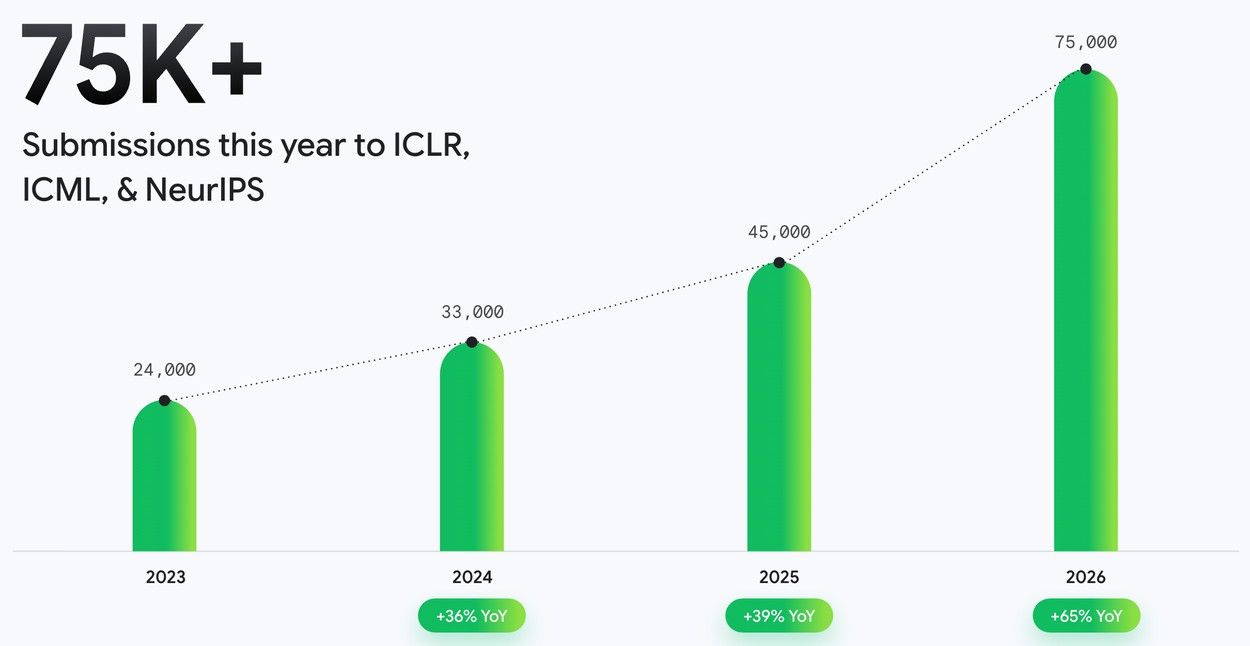
The scale problem is clearest in academic peer review. ICLR, NeurIPS and ICML received more than 74,000 papers this year, compared with about 45,000 in 2025, 32,000 in 2024 and 23,000 in 2023. Each paper needs several quality reviews, adding to the load on experts.
Source: research.google
Deep Review is designed to check reasoning, mathematical claims and factual statements, compare a document with existing research, and suggest improvements. The aim is to take on some of the most time-consuming work while leaving people to judge the work as a whole.
Google says PAT pilots showed strong results with authors. Those programs were separate from the conferences’ official review processes; PAT did not collect training data, and Google removed papers from its systems after each program. The current system supports Gemini 4 Argon, which Google says has expanded its capabilities beyond earlier PAT versions.
How the system divides the work
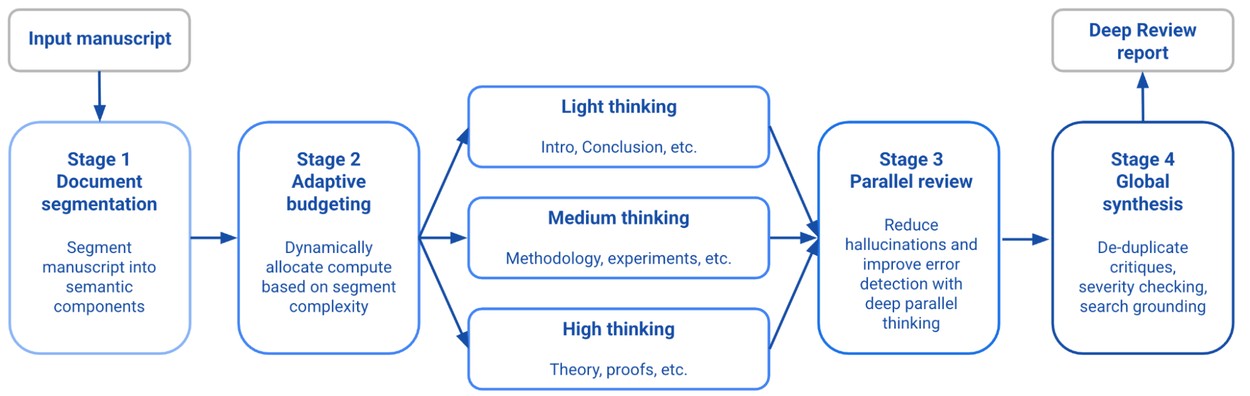
A single language-model prompt can struggle with a long document: it may miss links between distant sections or accept a subtle claim without checking it carefully. Deep Review instead uses a four-stage agent pipeline:
The system is no longer limited to research papers. Google says it can check project documents for unstated architectural assumptions and edge cases, presentations for gaps in the logic between slides, and legal or financial documents for contradictions, ambiguous language and unsupported claims.
Source: research.google
Google has also introduced the Teamwork Deep Document Review Pattern, a template for Antigravity built around the Teamwork framework for coordinating multiple agents. It uses an agent hierarchy, self-checks and criteria for reviewing individual sections. Antigravity users can invoke it with /teamwork-preview.
The unanswered question is trust
I think the most consequential detail is not the promise of faster feedback but the boundary Google draws around it: Deep Review handles parts of the check, while people remain responsible for evaluating the work overall. That distinction matters when the system is asked to assess claims in fields where a missed qualification can change the meaning of a document.
The announcement describes a pipeline for checking logic and facts, but says less about how users should judge the reliability of its findings. That leaves a practical tension: the more useful the feedback becomes, the more important it is to know when the system is wrong. More file formats and review capacity may broaden access; they do not, by themselves, settle that question.
Daily AI news
Every day we pick what actually matters in AI and explain it plainly — no hype, no filler. Subscribe if you want to follow where the industry is going.
Only what matters — every day
Follow on X