
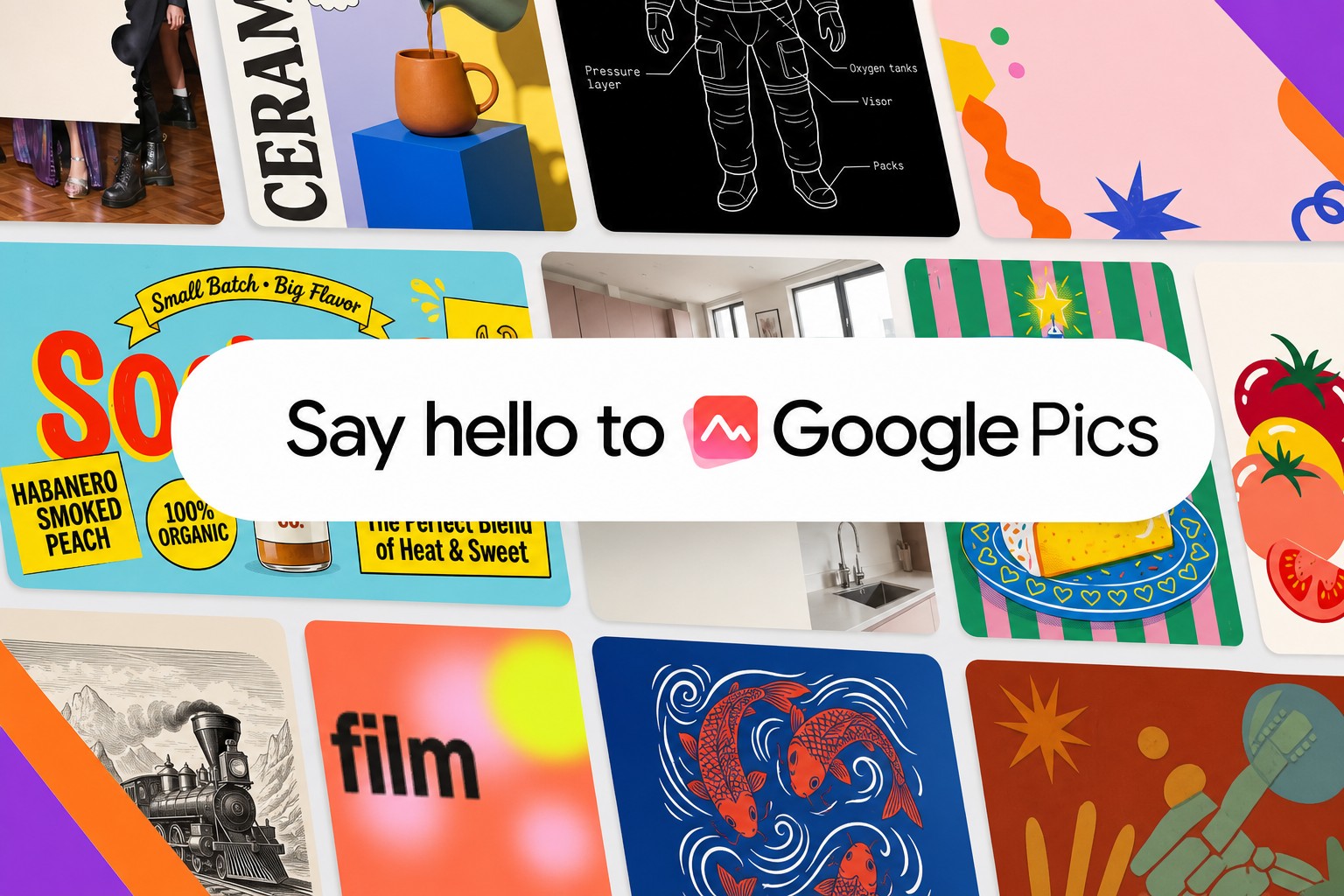
Google has launched Google Pics, an AI image tool aimed at the ground Canva and Adobe Express occupy. It starts appearing today in Docs and Slides, and Google says it will reach Google Drive later. The functional overlap with the incumbents is real, but the starting point is inverted: rather than opening a template and arranging elements until a layout exists, the user writes a prompt and gets the finished image.
Meet Google Pics from Google Workspace
Source: techcrunch.com
The generation step is not the whole product. Google Pics also carries editing tools that let a user select and transform individual objects, change or translate the text inside an image, and perform other operations on what came back. It supports collaborative editing, and it can produce several variants of an image from a single prompt so the user picks the one that fits.
The gap between Google Pics and Canva is not a feature gap. Canva runs a marketplace: artists, illustrators and photographers publish templates, graphics, photos and other work there and are paid when it is used. Google Pics produces its material with AI trained on artists' work. Same output category, two different supply chains — one that pays the people upstream and one that has already absorbed them.
Adobe Express sits in the third position, as the tool people open when they intend to do the design themselves. Google Pics is built for the user who does not intend to design anything and wants the artifact.
The more interesting thing here is not the model, which Google did not name, or the quality, which nobody outside Google has seen. It is the placement. Canva and Adobe Express are destinations: a person leaves the document, makes the thing, comes back, pastes it. Google Pics arrives inside Docs and Slides, which is where the person already was when they discovered they needed an image. That removes the moment at which a user chooses a design tool at all — and a competitor that is never chosen against is a competitor that is never chosen.
What the announcement does not address is the part everyone will ask about: there is no pricing, no model name, no word on how the artists whose work trained the system relate to a product that competes with the marketplace paying them, and no date for Drive beyond "later." Google has said what Google Pics does and where it appears, and stopped.
Canva built a marketplace because it needed a supply of human work and had to pay for it. Google Pics does not need one, which makes it the cheaper business right up until the point where the only design work left to learn from is the kind that Google Pics generated.