

Google Research has published a library of more than 30 AI-generated interactive learning simulations and opened a pilot that lets teachers commission their own. The materials target middle and high school students, and every one of them was built by a model and cleared by a teacher before it went into the library. Schools on Google Workspace for Education can apply to the Google for Education Pilot Program to request simulations built against their own curriculum and send feedback back. The bet underneath the project is not pedagogical but economic: interactive material has always worked, and almost nobody has been able to afford to make it.
Source: research.google
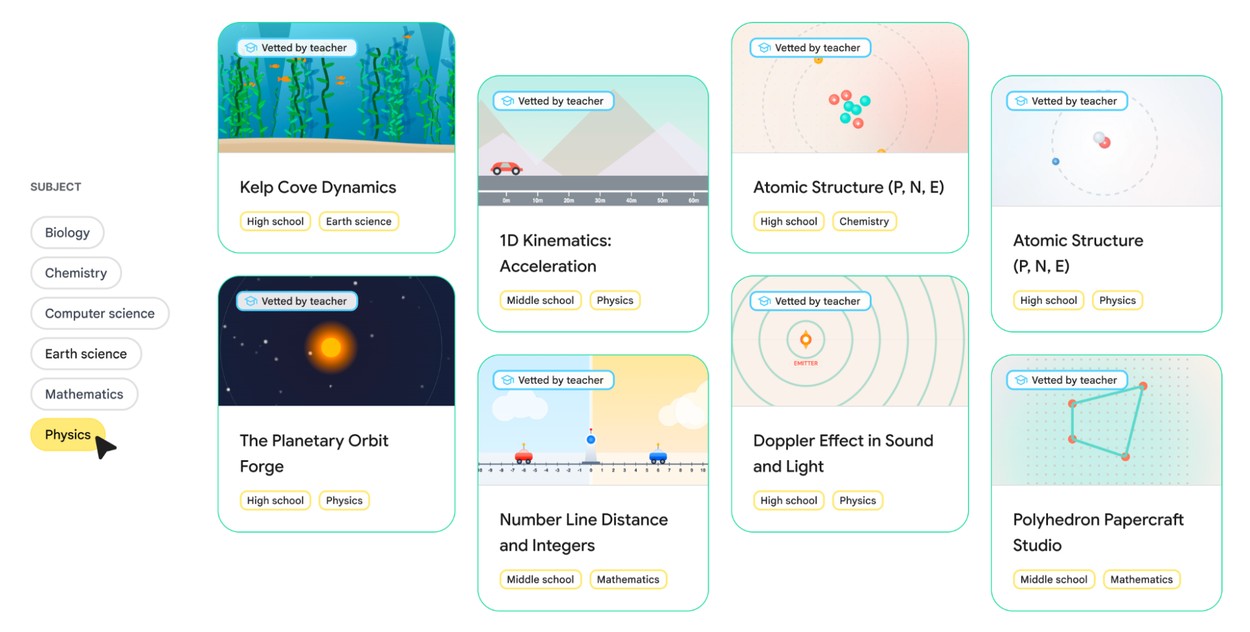
Google describes the published set as covering physics, chemistry, biology and math. The library's own topic index lists six subjects, adding computer science and Earth sciences.
The pedagogy here is settled and Google does not pretend otherwise. Its framing reaches back to John Dewey, who wrote in 1916 that students should be given something to do rather than only something to be told, and to Jean Piaget, whose work showed that knowledge forms through the learner's own activity. Newer cognitive research, including the ICAP framework, ties interactive behavior to deeper knowledge formation and better long-term retention than passive listening or reading. Students understand more when they run experiments, test hypotheses and solve problems, because that is how they build a complete mental model of what they are studying.
What has never worked is the supply side. Digital tools changed what students could reach — e-textbooks, video libraries, online resources — but learning through a screen stayed passive. Interactive and multimedia assignments that force a student to reason are expensive and difficult to produce, so there are few of them, and a teacher who wants one spends a great deal of time preparing it. Google Research set out to test whether AI narrows that gap.
This is the third education project in the same line. LearnLM, Google's family of generative models for education, shipped in 2024 after fine-tuning for learning tasks. Learn Your Way, a 2025 research project, reworked a conventional textbook with generative AI. Read in sequence, the three move steadily from text a student reads toward material a student operates.
The mechanism is generative user interface — a research direction in which models build interfaces dynamically rather than having developers program each screen in advance. Google Research's specific contribution was adapting that idea to long instructional sessions rather than short interactions, using guided instructional design and pedagogical constraints so that teachers can build their own interactive environments tied to a curriculum and fitted to a particular assignment.
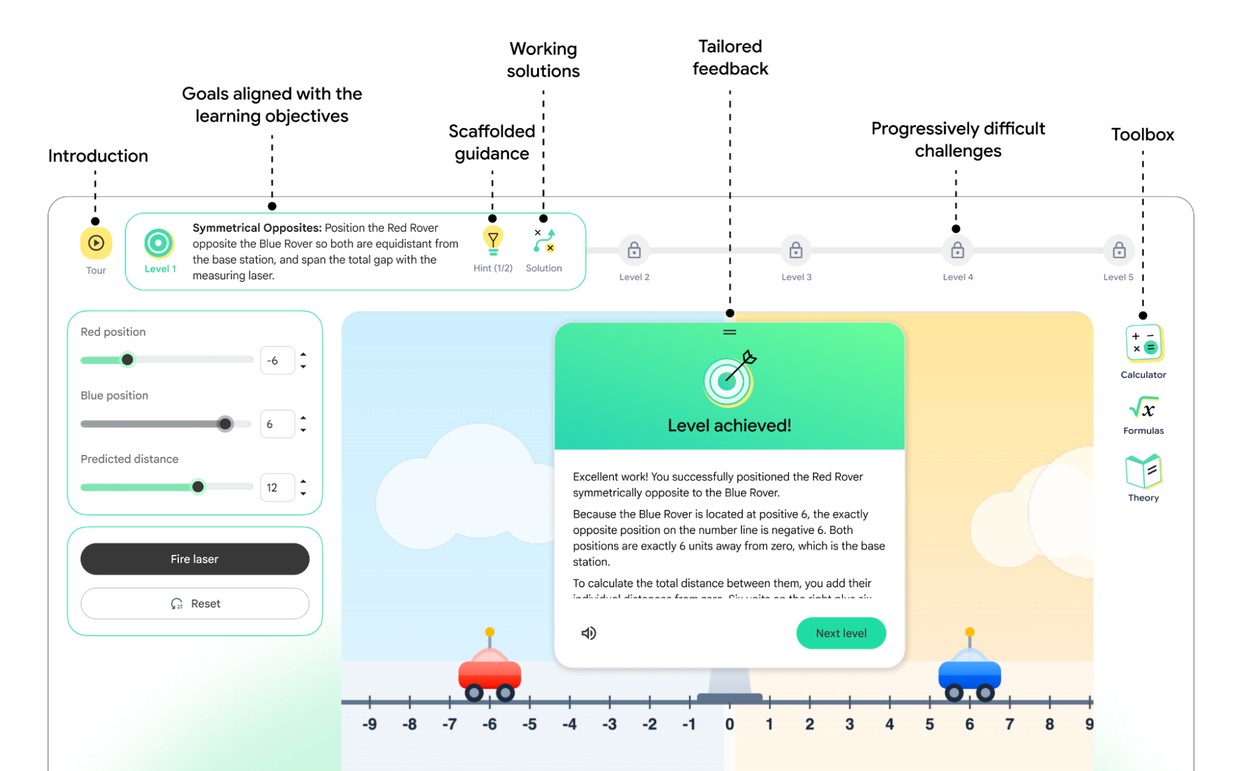
The design rules are the ones used to build LearnLM: alignment with the curriculum and teacher-approved learning objectives, active learning through exploration that supplies both motivation and hints, and factual accuracy in every simulation. In practice this becomes a game. Each interactive is a series of progressively harder challenges tied to the objectives. In an Earth sciences example, a student compares how different cloud cover affects local temperature and predicts how wind speed and direction change weather conditions; the first level deals with temperature, and later levels move to rapid warming and storms.
Generation has to satisfy three requirements. The teacher supplies a topic and the system returns a set of precise, interlocking learning objectives, which the teacher can edit and must approve before anything is built. The topic is then broken into structured levels with clear goals tied to learning outcomes, ramping in difficulty so the student keeps experimenting. Finally the system generates the support: an introduction that activates prior knowledge, the formulas and theories the student will need, hints at several levels of specificity, explanations for both correct and incorrect answers, and step-by-step solutions offered only after the student has explored on their own. Those elements were tested and reworked with teachers and students, and the stated design goal is real-time help that pushes a student to reason rather than handing over the answer.
Source: research.google
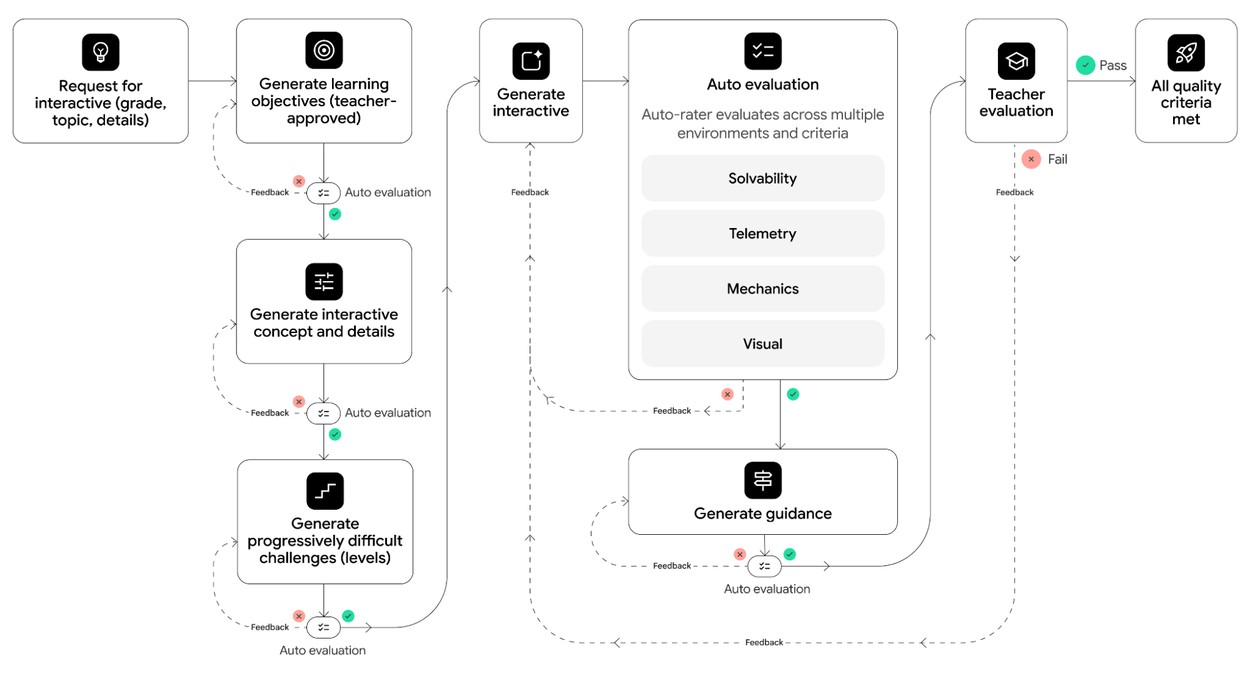
Quality control is where the engineering gets interesting. Generation runs through several iterations governed by a set of pedagogical constraints, with self-check loops built into the process. Google concedes this makes producing a finished interactive slower, and accepts the trade for tighter adherence to the criteria. The checks cover pedagogy — whether levels match the objectives and genuinely escalate — mechanics, meaning whether the buttons work and the task can actually be solved, and the visual layer, meaning whether anything on screen is extraneous enough to distract. Automated evaluations run inside the loop, including checks performed by AI agents: the system opens Chrome, interacts with the simulation as an ordinary user would, and verifies that the level can be completed. It tests not only the intended solution but also awkward behavior, such as dragging sliders to their extremes. The loop repeats until the material clears every criterion.
Source: research.google
That agent-driven QA is the most portable piece of this work. An adversarial agent that plays a generated artifact like a bored teenager, checking whether the thing is solvable and whether it breaks under extreme inputs, is the answer to a problem every generative-UI product has, not just an educational one. The learning-science wrapper is what makes it publishable; the loop is what makes it work.
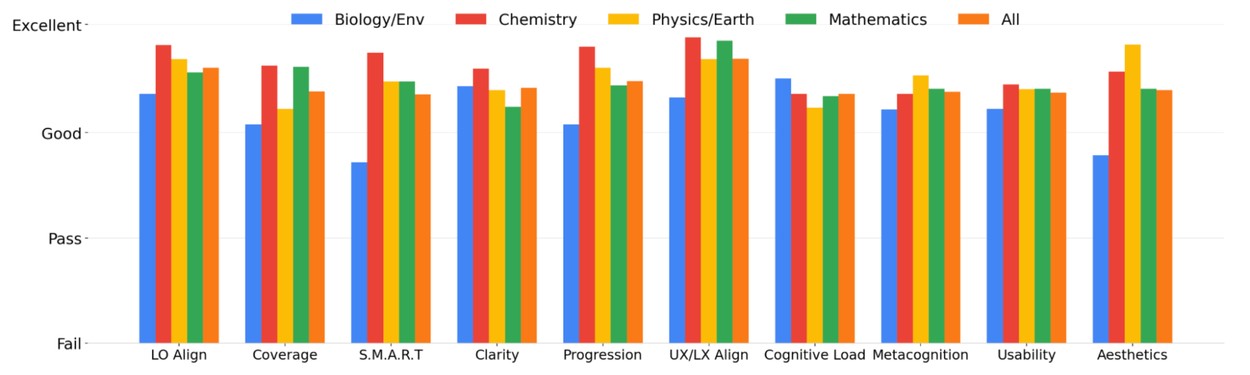
The evidence Google offers is teacher judgement. STEM teachers in the United Kingdom evaluated the collection and, on average, rated the materials good to excellent, with physics and chemistry emerging as the subjects easiest to simulate. Detailed results are in a technical report. The library's teacher-approved topics include Kepler's laws of planetary motion, data visualization and projectile motion.
Source: research.google
A first study ran with 12 teachers in the United States, each of whom requested three custom interactives for their own class. Average quality score: 8 out of 10.
Teachers said dynamic generation addresses a long-standing limitation of off-the-shelf simulations, which cannot be adapted to different classes or different learning goals. A high school science teacher said being able to type in any curriculum topic and get a simulation for it would be genuinely useful, since ready-made material normally has to be taken as it comes. A middle school science teacher singled out being able to produce material tied precisely to a lesson's goals and outcomes. Teachers also compared the layered hints and step-by-step solutions to the help they give a student one-on-one, and said the level sequence mapped well onto real assessments and practice work.
All of which measures how much teachers like the material, not how much students learn from it. Twelve teachers scoring, on average, 8 out of 10 on interactives built to their own briefs is a satisfaction reading from the person who wrote the spec. The studies that would test whether any of this moves comprehension or engagement in an actual classroom — the user experience research and the field trials — are described in the future tense. This reads like a system validated on the buyer rather than the user, which is an entirely normal place for a research preview to be, as long as nobody mistakes the 8 for an outcome.
The number underneath is also smaller than the framing suggests. Twelve teachers requesting three interactives each is 36 generated items; the public library holds just over 30. Whatever the exact overlap, the library is roughly the size of one small study, offered to a product surface used by schools worldwide. And "physics and chemistry are easiest" is a quiet admission about the other four subjects in the topic index, made without saying how much harder biology, computer science, Earth sciences or math turned out to be, or what the failure rate looks like in each.
The more interesting question is what the approval gate does to the economics. Generated material goes back to the teacher who requested it, and only enters the shared library once that teacher signs off. That is the right call, and it is also the admission that the output is not yet trustworthy enough to publish unreviewed. Notably absent from the announcement is any rejection rate — how many generated interactives a teacher sent back, and for what. Without it, "reviewed and approved by teachers" describes a process, not a quality level.
Next comes scale. Google Research and Google for Education will run pilot trials in schools and classrooms worldwide, with schools applying through the Google for Education Pilot Program. Participating teachers will be able to request simulations on any custom STEM topic, specified against their curriculum, their goals and their grade level. Google Research will also run user experience studies and field trials to measure what the interactives do to comprehension and engagement in real classrooms, and plans to keep refining the system alongside teachers as the library grows.
Source: research.google
If generation cost really does collapse, the constraint moves rather than disappears. A teacher can ask for a simulation on any topic in the syllabus, but every one of those simulations has to be read, run and approved by a teacher before anyone else can use it — and review time is the one input in this system that does not get cheaper when the model gets better.