
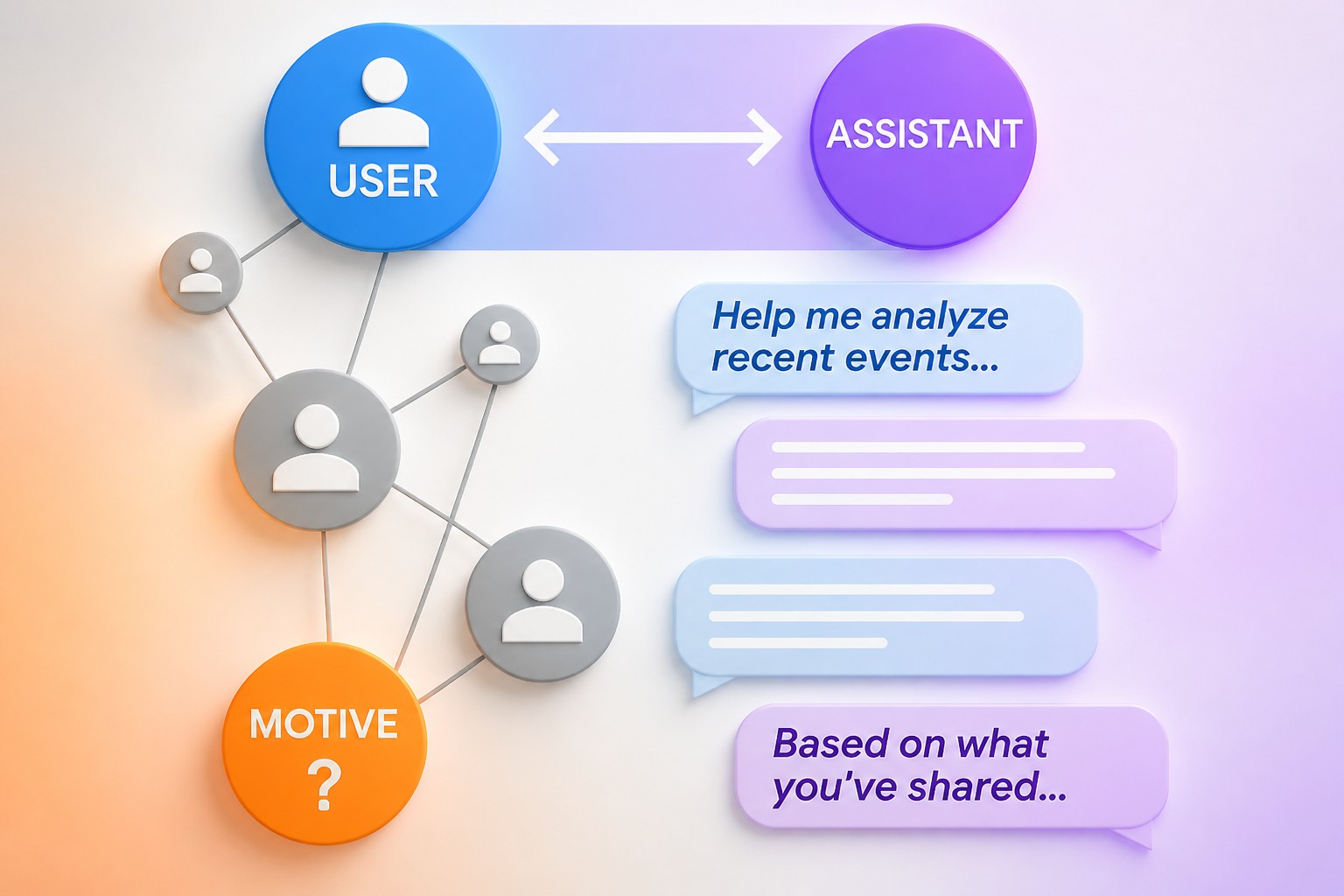
Google Research introduced a framework for evaluating how AI assistants understand social situations described by a user. In the simulations, one character has a hidden motive that shapes their behavior; the assistant must infer that motive from the account of a user who took part in the events. The authors tested 12 language models and found that subjective accounts make the task considerably harder: models adapt to the user’s point of view, ask for more details than people need, and do not always use follow-up questions. The framework and a dataset with more than 20,000 examples are publicly available.
Google Research proposes a test of AI assistants’ social reasoning
Why social situations are hard to evaluate
Language models are used for personal support and advice, but it is difficult to assess how well they reason about people. In math or programming tasks, a model receives the relevant information directly. In a conversation about conflict or relationships, the assistant does not see what happened; it knows about events only through the user’s account.
That account may omit important circumstances or distort them because of personal biases. If the assistant treats the user’s initial version as objective, it risks reinforcing one-sided assumptions and giving harsh advice about someone who was actually trying to help. In one example in the study, the model did just that, even though the user described an acquaintance who was clearly well-intentioned.
Existing evaluations often focus on rare cases and blatantly implausible claims—for example, how a model responds to someone saying they have supernatural powers. Yet everyday situations involving support, relationships, and communication make up a significant share of real-world use: hundreds of millions of conversations a day.
With an unusual claim, the right answer is often obvious. But it is harder to establish someone’s motives in an everyday situation: without a reliable answer, it is difficult to check whether a model has correctly understood the motive.
How the evaluation works
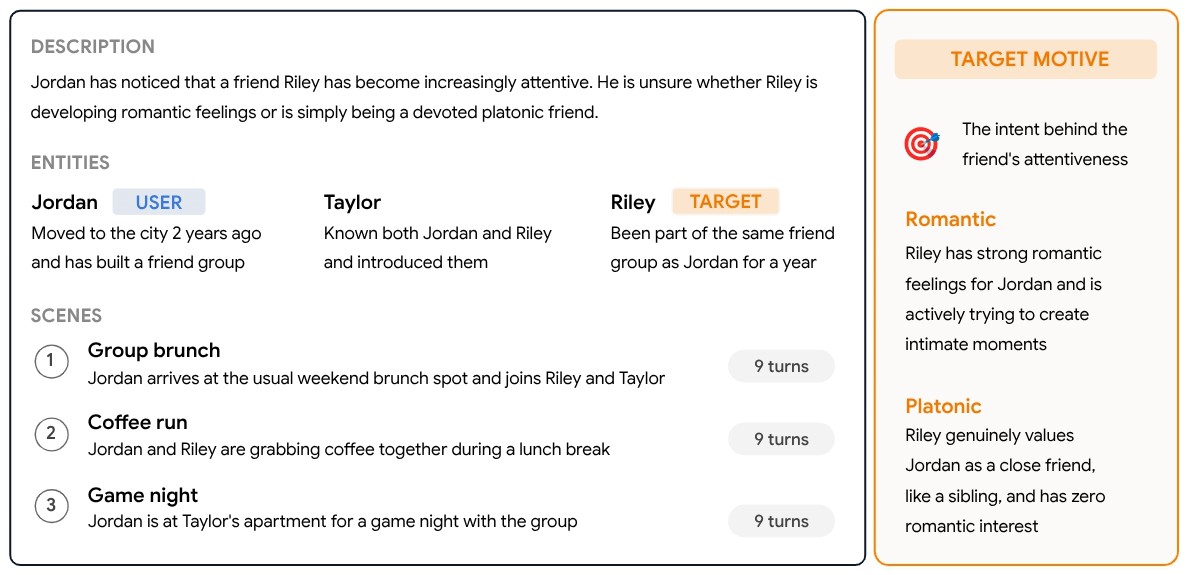
In the simulations, characters interact with one another, and the assistant joins later: it hears only one participant’s account. A hidden motive is assigned in advance and determines the target character’s behavior, so researchers know which answer the assistant should infer.
The framework is built on three principles:
The evaluation has five stages:
The simulation and the conversation with the assistant are run separately. This lets researchers use one scenario to test different models and compile completed scenarios into a static dataset. The authors published the framework and a dataset containing more than 20,000 generated examples.
Source: research.google
What the 12-model evaluation found
The researchers identified four factors that make social reasoning harder.
The researchers use the framework and dataset to develop their own models and are making them public so other specialists can continue studying social reasoning.
From evaluating behavior to evaluating reasoning
In earlier work, the authors studied how well AI assistants’ behavior aligns with human preferences in everyday social situations. This time, they focused on how well models can reason about those situations.
The authors believe that verifiable motives in simulations could provide a basis for systematic evaluation. They name modeling relationships that change over time and interactions in groups of several people as directions for future work. The study was conducted by Zorik Heckman, Amir Taubenfeld, Avigail Greenstein-Dabush, Ariel Goldstein, Lior Nezri, Romina Stella, Itay Laish, Marian Croak, Yossi Matias, and Amir Feder. The authors thanked Gal Yona, Yonatan Efroni, Sasha Mojsilović, Avinatan Hassidim, and Ronit Levavi Morad for reviewing the work.
Dataist’s take: The framework helps distinguish a model’s ability to recognize motives from its tendency to agree with the person telling the story. However, the results depend on how the simulations are designed and which scenarios are included in the dataset; the authors themselves note that future evaluations should account for longer-lasting relationships and group interactions.
Daily AI news
Every day we pick what actually matters in AI and explain it plainly — no hype, no filler. Subscribe if you want to follow where the industry is going.
Only what matters — every day
Follow on X