
Why standard residual connections are not enough
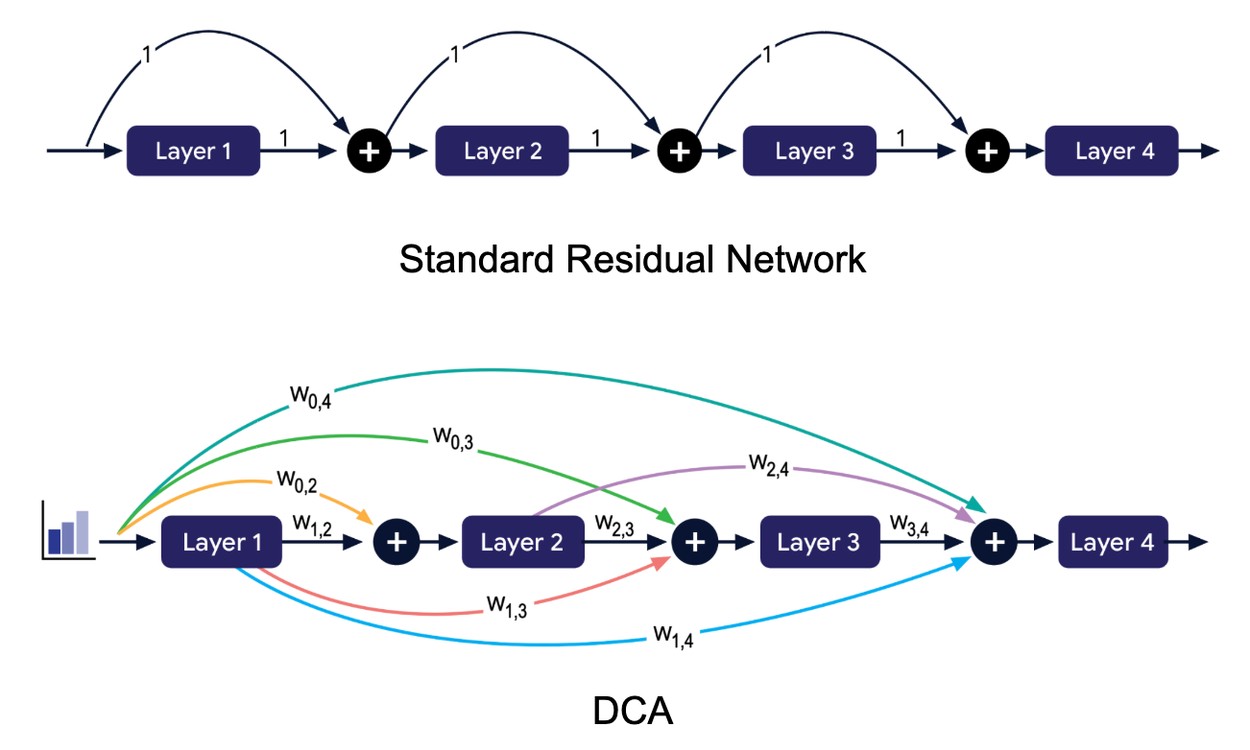
In deep neural networks, the training signal can weaken as it passes through many layers. This is known as the vanishing gradient problem. Transformers mitigate it with residual, or skip, connections: these add a layer’s input to its output, allowing information to bypass complex computations.
Source: research.google
A standard residual connection adds the input and output element by element. This saves computation, but gives all representations equal weight. In a deep network, details extracted in earlier layers can become mixed with later information and get lost. The model then has to compute them again, making training less efficient.
In their ICML 2025 paper “DeepCrossAttention: Supercharging Transformer Residual Connections,” the researchers examined this limitation and proposed DCA. The architecture lets each layer select and route features from the history of previous layers. The authors report that this approach delivers comparable or better training performance and can reduce the number of parameters by 30–40%.
How DCA works
DCA treats residual connections as a dynamic routing problem. A lightweight module decides how to combine previous layers’ representations separately for each token, rather than passing them forward with equal weight.
Source: research.google
The architecture has two main mechanisms:
This selection helps recover details from earlier layers and reduce their loss through repeated mixing.
Experimental results
The researchers tested DCA on synthetic tasks, large language-modeling benchmarks and image-classification tasks. Across these experiments, the architecture improved convergence speed, training stability and final model quality.
Source: research.google
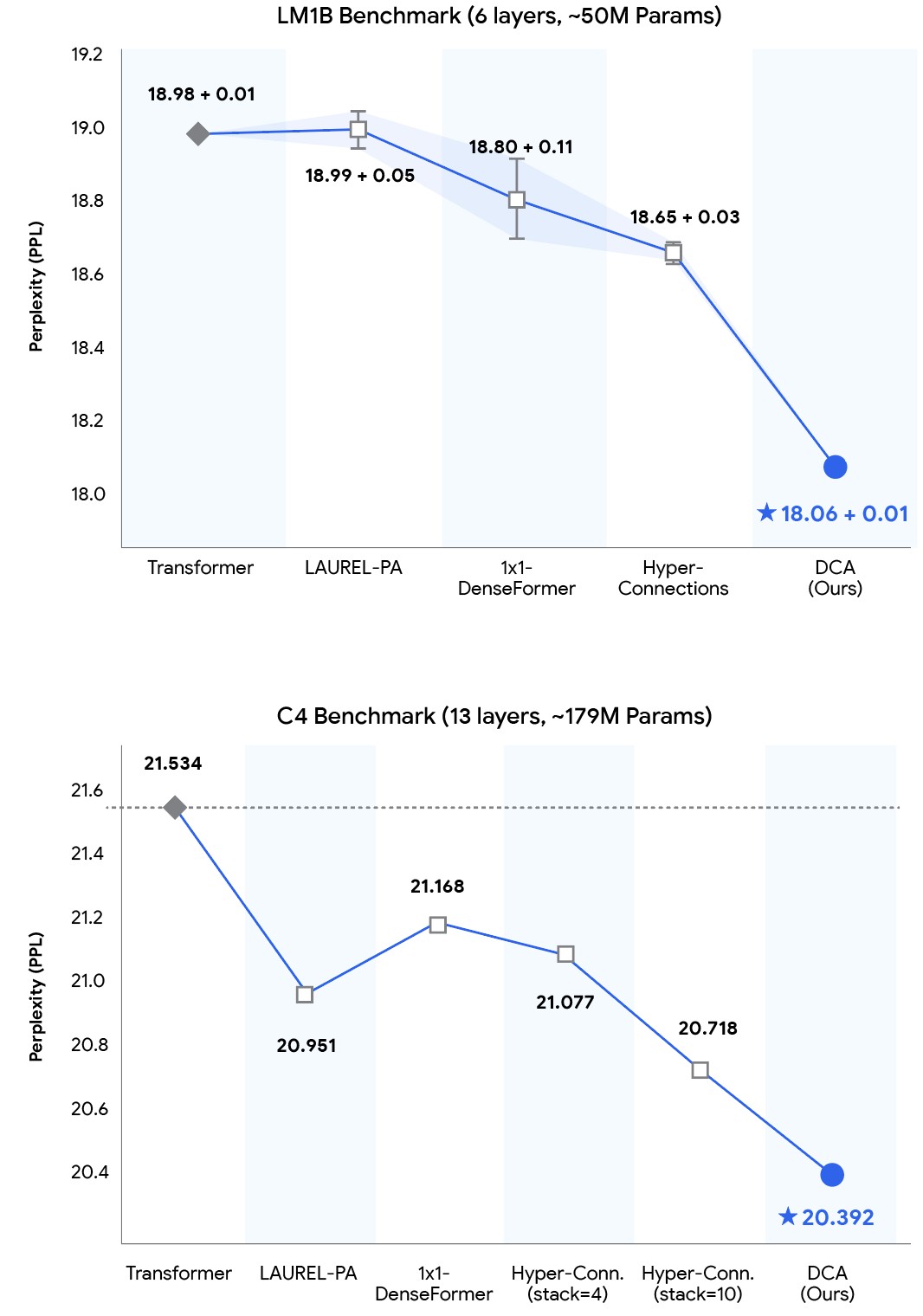
On the cleaned, large-scale Common Crawl C4 web corpus and LM1B, a language-modeling benchmark with one billion words, DCA matched a standard transformer’s performance using up to five times fewer training steps. For the same training duration or number of steps, DCA achieved lower perplexity — meaning it predicted examples more accurately. The authors say this makes more efficient use of the same training budget.
To reach a perplexity below 14 on LM1B, a standard transformer of fixed width required 42 layers. DCA achieved even lower perplexity with 30 layers — 29% fewer in depth and parameter count.
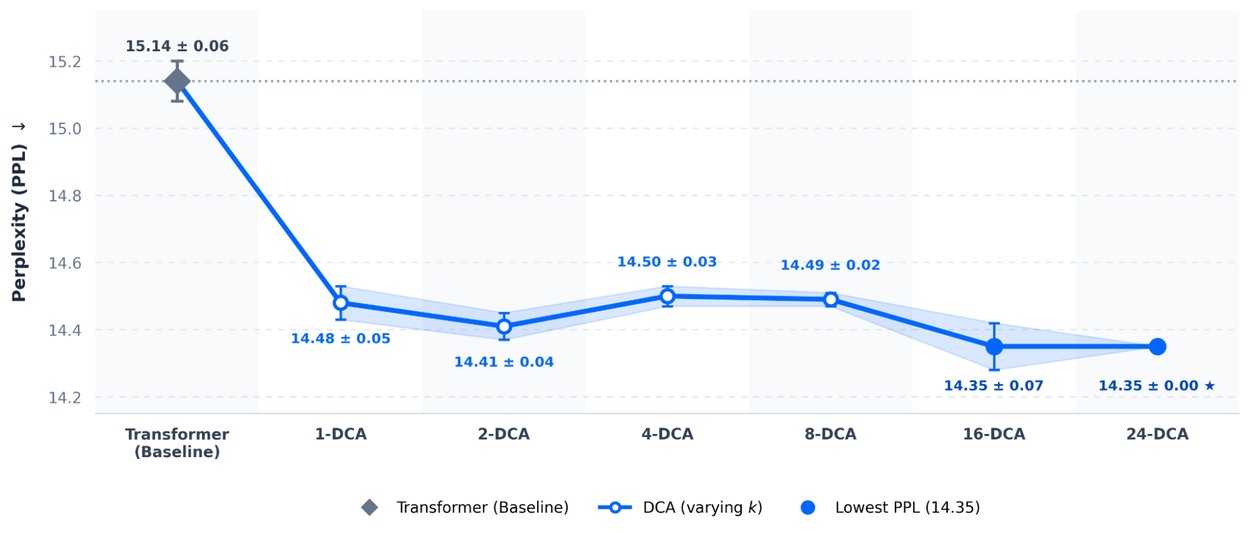
The number of previous layers included in DCA also made a noticeable difference: increasing the depth of this history consistently lowered perplexity compared with a standard transformer. The 16-DCA and 24-DCA variants performed best in the graph shown.
Source: research.google
The increase in model size is small: DCA requires less than 0.2% additional parameters. The authors consider this negligible in terms of computation and memory use, but note that memory bandwidth increases because representations from different layers are passed in their original form rather than mixed in advance.
DCA can also be added to a transformer that has already been trained. The architecture can be configured to initially behave like a standard residual network. After a short period of continued training, perplexity on LM1B fell by 0.19; for a standard transformer, continued training reduced it by 0.02.
Other approaches to dynamic residual connections
DCA is part of a broader effort to replace static summation of layer outputs with dynamic selection. The authors note that these methods are attracting researchers’ attention and are already being used in new models.
The authors view the shift from static residual connections to attention-based dynamic routing as a way to improve model efficiency. They predict that future architectures will select and weight representations from previous layers based on specific tokens and inputs, using layers as specialized experts.
The work involved researchers from Google and their academic partners: Mike Heddes, Adele Javanmard, Mohammad Hossein Bateni and Vahab Mirrokni.
Dataist’s take: The results show that a transformer’s performance depends not only on the number of layers, but also on how the network uses the representations accumulated in them. For now, the findings concern specific experiments and benchmarks; the data presented do not establish how broadly DCA will improve other models and tasks.
Daily AI news
Every day we pick what actually matters in AI and explain it plainly — no hype, no filler. Subscribe if you want to follow where the industry is going.
Only what matters — every day
Follow on X