
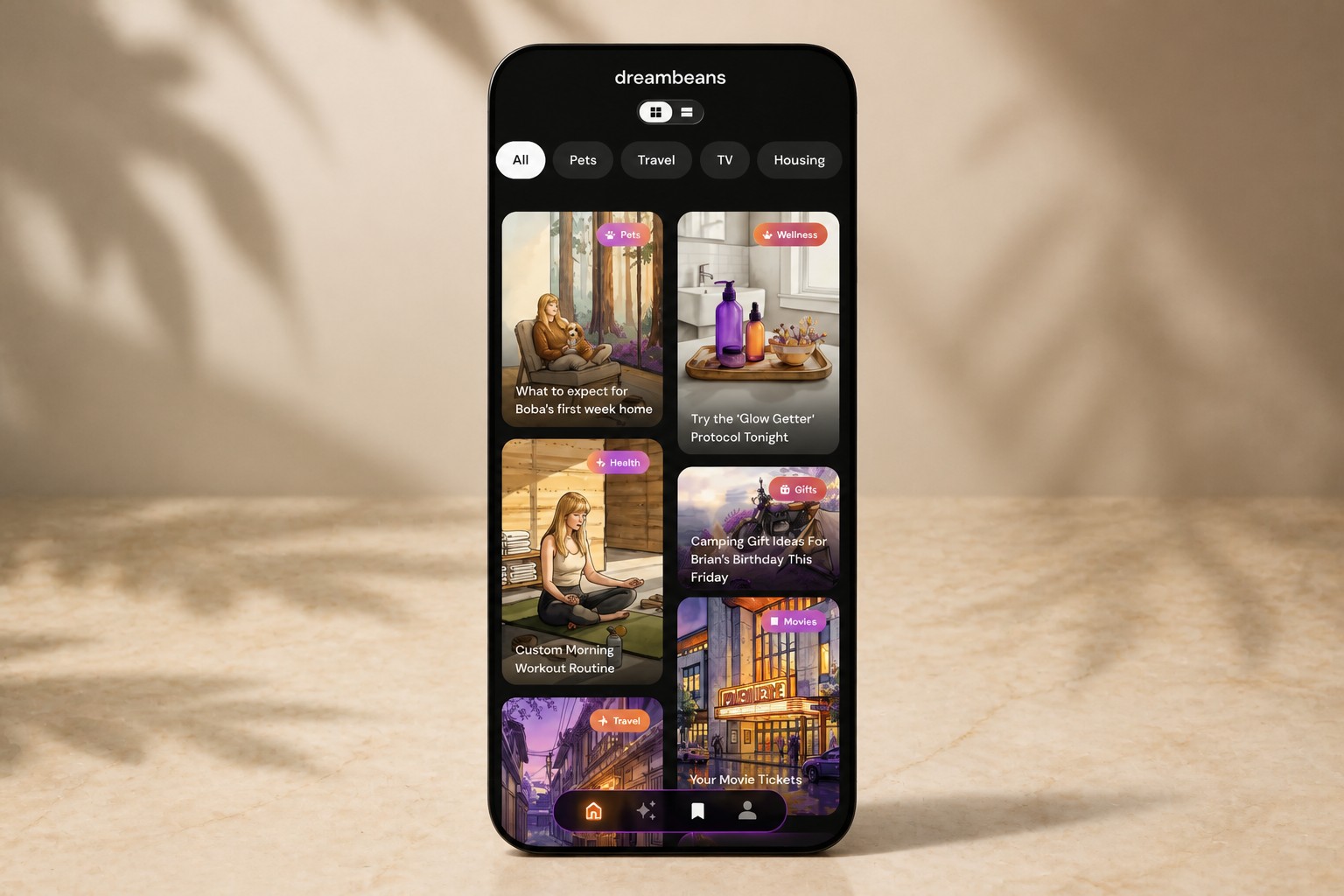
A narrower app in a crowded field
Google introduced Dreambeans in June. It draws on connected services including Calendar, Gemini, Gmail, Photos, Search and YouTube to create personalized stories in advance. The stories originally used static AI-generated images; Google recently added the option to animate illustrations in some of them with its Veo video-generation model.
India is the app’s first international market. Google product manager Gözde Öznur said at a press briefing that the company chose the country because of strong local interest and the broad use of Google services there. She pointed to the number of people who use Gemini, Gmail and Google Photos together.
The download figures suggest Dreambeans is still a small, specialized product. Sensor Tower, which provided its estimates to TechCrunch, says the app has been downloaded nearly 55,000 times in the U.S. since June. About 63% of those downloads came in September, when Google opened it to all eligible U.S. users aged 18 and older. Downloads then fell 84% in October, to about 5,500.
In its first 30 days after becoming broadly available to eligible U.S. users, Dreambeans drew about 29,000 downloads. Sensor Tower estimates for other apps’ first 30 days were substantially higher:
Those comparisons have limits: the other apps handle a wide range of requests, while Dreambeans is built around personal stories. Still, its smaller reach makes India more than a routine expansion. The new market gives Google a chance to see whether a narrower use case travels.
One language at a time
Dreambeans supports many widely used Indian languages, but users can choose only one language for a story. The app can draw on Google services containing information in different languages, Öznur said, but it cannot yet produce stories that mix them.
That is a meaningful constraint in a country where many people switch between languages, often blending Hindi and English in speech. A personalized story that can draw on multilingual data but cannot reflect multilingual speech may feel less personal than its premise suggests.
The personal-data bargain
Dreambeans uses Google’s Personal Intelligence technology to access connected services and personalize its stories. Those accounts can contain sensitive information, even if users are interested in the resulting content.
Users choose which Google services to connect and can disconnect them at any time, Öznur said. They can delete Dreambeans data in the app; information deleted from connected services is also removed from Dreambeans’ personalization system. Users can ask the app to avoid subjects such as work, and only the account owner can see the stories. Dreambeans is available only to personal Gmail account holders, not business users.
There is also a less technical risk: a story could surface a person or event that causes distress. Öznur acknowledged that Dreambeans might create a story about someone who has died. Users can ask it to stop showing certain subjects, a control she compared with Google Photos tools for limiting which memories appear.
I think the central test in India is not whether Google can generate stories from more account data; it is whether users will want that data turned into a product they did not ask to prompt. The announcement says users can control connections and topics, but it does not say how often those controls will be needed—or whether a single-language story can feel personal enough to justify the access.
Öznur said Google is exploring ways to make Dreambeans more useful for taking action: not only creating stories and recommendations, but helping users follow them. That would raise the stakes. A product that turns private data into entertainment asks for trust; one that also guides what users do with that data will have to earn more of it.
Daily AI news
Every day we pick what actually matters in AI and explain it plainly — no hype, no filler. Subscribe if you want to follow where the industry is going.
Only what matters — every day
Follow on X