
A test beyond the training set
The approach uses a low-cost portable probe swept across the abdomen in a standard pattern. Instead of asking a novice operator to locate fetal anatomy and take precise measurements, the AI estimates gestational age from the resulting scan.
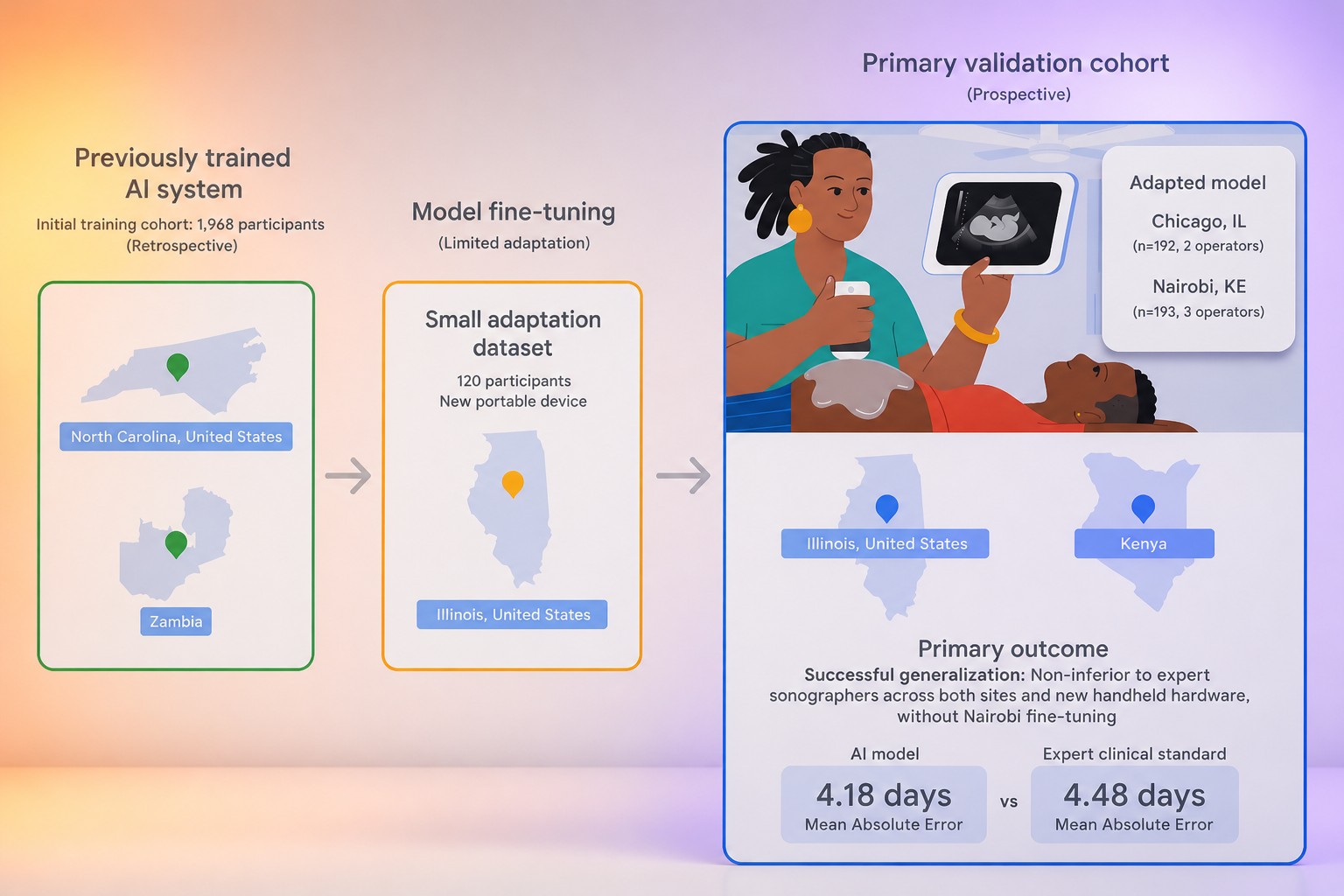
The prospective study, published in JAMA Network Open, moved beyond testing on new patients from the retrospective cohort used to train the original model. Researchers assessed it in working clinics, with novice operators and Clarius C3 portable scanners—equipment unfamiliar to the model.
The system had been trained on ultrasound data from 1,968 participants in North Carolina and Zambia, collected using Sonosite, GE and Butterfly Networks probes. Researchers then fine-tuned it using a pilot set of 120 participants in Chicago, about 6% of the original training set. That step adapted the model to the new equipment and extended its estimates beyond 36 weeks.
The prospective evaluation included 192 participants in Chicago and 193 in Nairobi. Nairobi data were not used for fine-tuning, making that clinic an independent external test.
The clinics differed in when patients first sought prenatal care, how many routine scans they received and how gestational age was usually determined. The study also included multiple pregnancies, which can make tracking and measurement harder for both human operators and automated systems.
What the error rate does—and does not—show
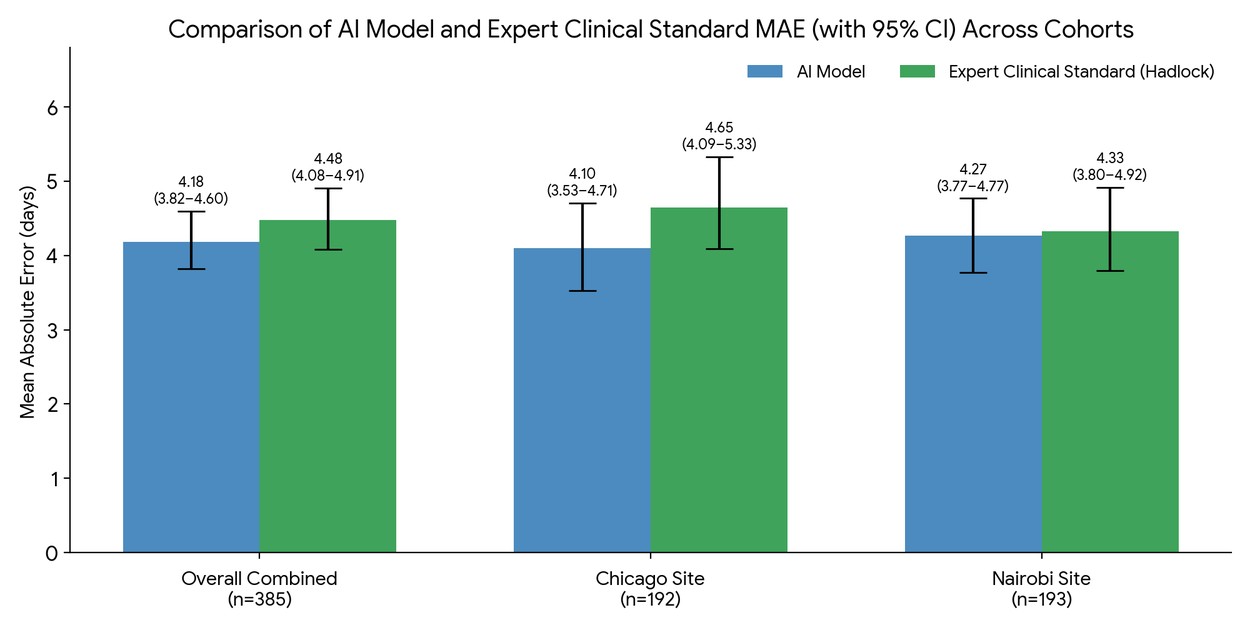
Across the 385 participants in the main analysis, between 16 and 36 weeks of pregnancy, the model’s mean absolute error was 4.18 days. That met the study’s criterion for non-inferiority to the clinical standard: expert sonographers’ measurements and formulas produced an error of 4.48 days.
Performance was similar across the two sites. The fine-tuned model’s error was 4.10 days in Chicago and 4.27 days in Nairobi, where it had not been adapted using local data. In the researchers’ analyses, it also outperformed conventional biometric formulas at estimated fetal weights above the 90th percentile.
The comparison is useful, but it is not a comparison with no care. The clinical standard requires an expert to find specific fetal views and take precise biometric measurements; the proposed system instead aims to make a different kind of scan useful when that expertise is unavailable. The study shows that the AI can estimate gestational age from those scans under the tested conditions. It does not establish how much the approach will improve access or outcomes in routine use.
Source: research.google
Deployment is part of the test
The researchers also observed how the system fit into everyday clinic workflows. For consecutive examinations, spare batteries proved more practical than docking stations that required the device to be plugged in for charging. They point to clinician and patient trust as another implementation challenge, and suggest that confidence estimates could help the system reject low-quality scans and show clinicians how reliable a result is.
I think the more consequential question is what happens after a promising accuracy result: whether minimally trained workers can produce scans that the model can use reliably, and whether clinics can act on its estimates. The study’s two-site design is a meaningful step toward testing that, especially with Nairobi kept outside the fine-tuning process. But an error rate near the expert benchmark is evidence about estimation, not yet evidence that the service can be delivered widely.
Google’s work in clinics is part of its broader effort to expand access to healthcare, and the authors say they hope further research will help improve clinical care and availability. The case for this approach rests on a specific possibility: shifting some of the expertise needed for prenatal screening from the person holding the probe into the system interpreting the scan. Until that shift works reliably in routine care, the gap between a successful test and accessible care remains the hard part.
Source: research.google
Daily AI news
Every day we pick what actually matters in AI and explain it plainly — no hype, no filler. Subscribe if you want to follow where the industry is going.
Only what matters — every day
Follow on X