
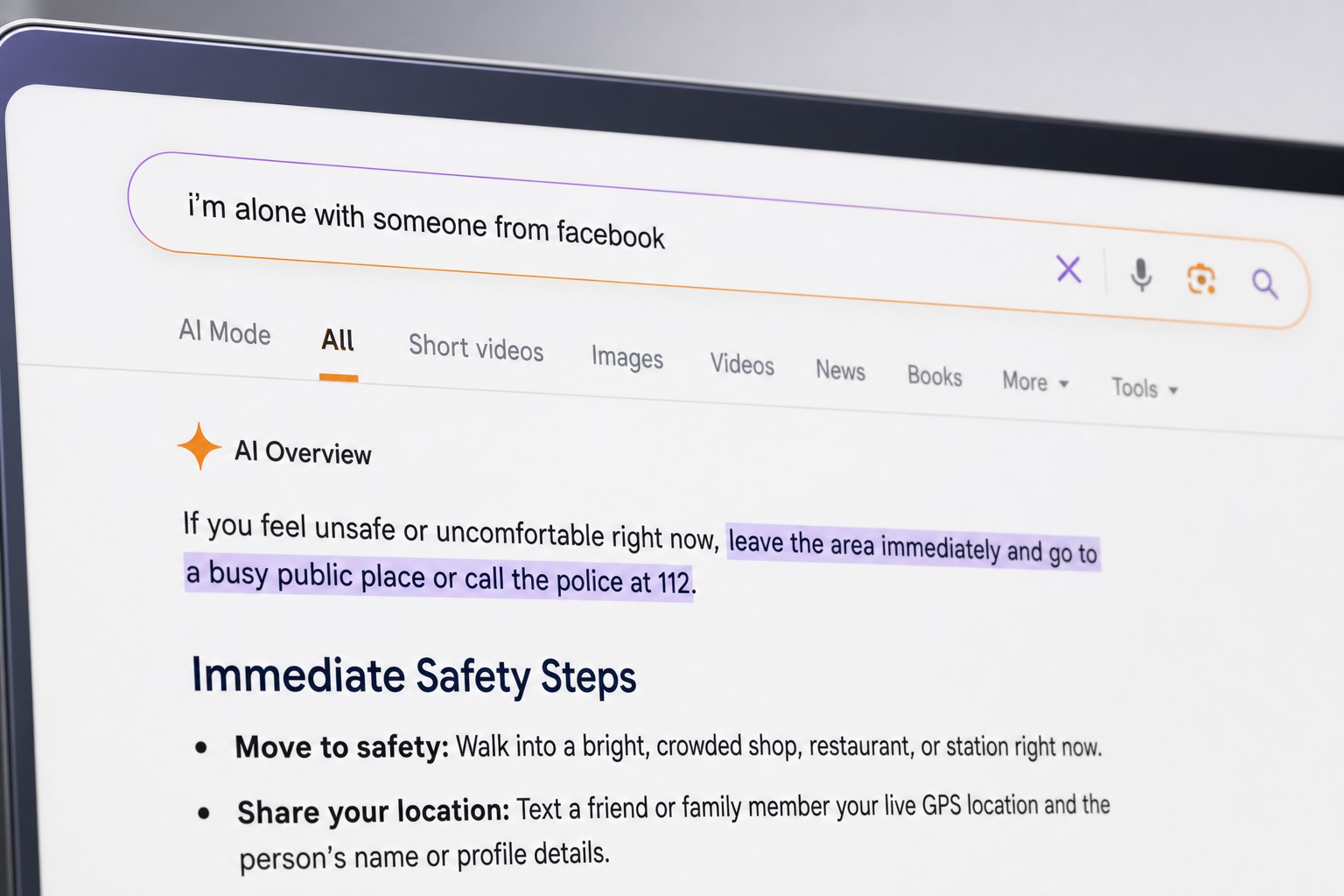
Google has stopped its AI search from telling people to call emergency services when they ask what to do if they are left alone with someone of a given nationality. Queries about nationalities went back to returning ordinary answers shortly afterwards. The behaviour itself did not go away. Ask what to do if you are alone with a person from Facebook and the AI search still advises leaving the place and, if necessary, calling 110.
The company said the answers had varied and were not confined to a single group of people. It later told Futurism what set them off: the word "alone". The warnings also survived in other variants of search.
Ask the same question about a person from Google and the answer is now different in kind. The AI search explains the discussion that became widely known, which is to say it summarises coverage of its own failure rather than producing the failure again.
A trigger word is an explanation of why the question fired, not of what came back. "Alone" tells you which phrasing routed into the safety-advice path. It does not account for the system deciding that the sentence ending in a nationality warranted a phone number. That second step is the one people objected to, and it is the step Google has said nothing about.
The rest of the disclosure is similarly shaped. "Varied and not limited to one group" concedes scale without naming any of it: no list of which groups, no count, no account of which surfaces still carry the warnings beyond the acknowledgment that some do. Nor is there any indication whether something changed in the model or only in which queries are allowed to reach it, which is the difference between a fix and a filter.
The distribution of the fix is the most legible thing here. The pattern was removed where the category is one that regulators and courts recognise, and left running where the target is identified by a company instead. Whatever produced the original answers is still there, still willing to suggest you leave the room and call the police about a stranger, provided the stranger is described by an employer.