
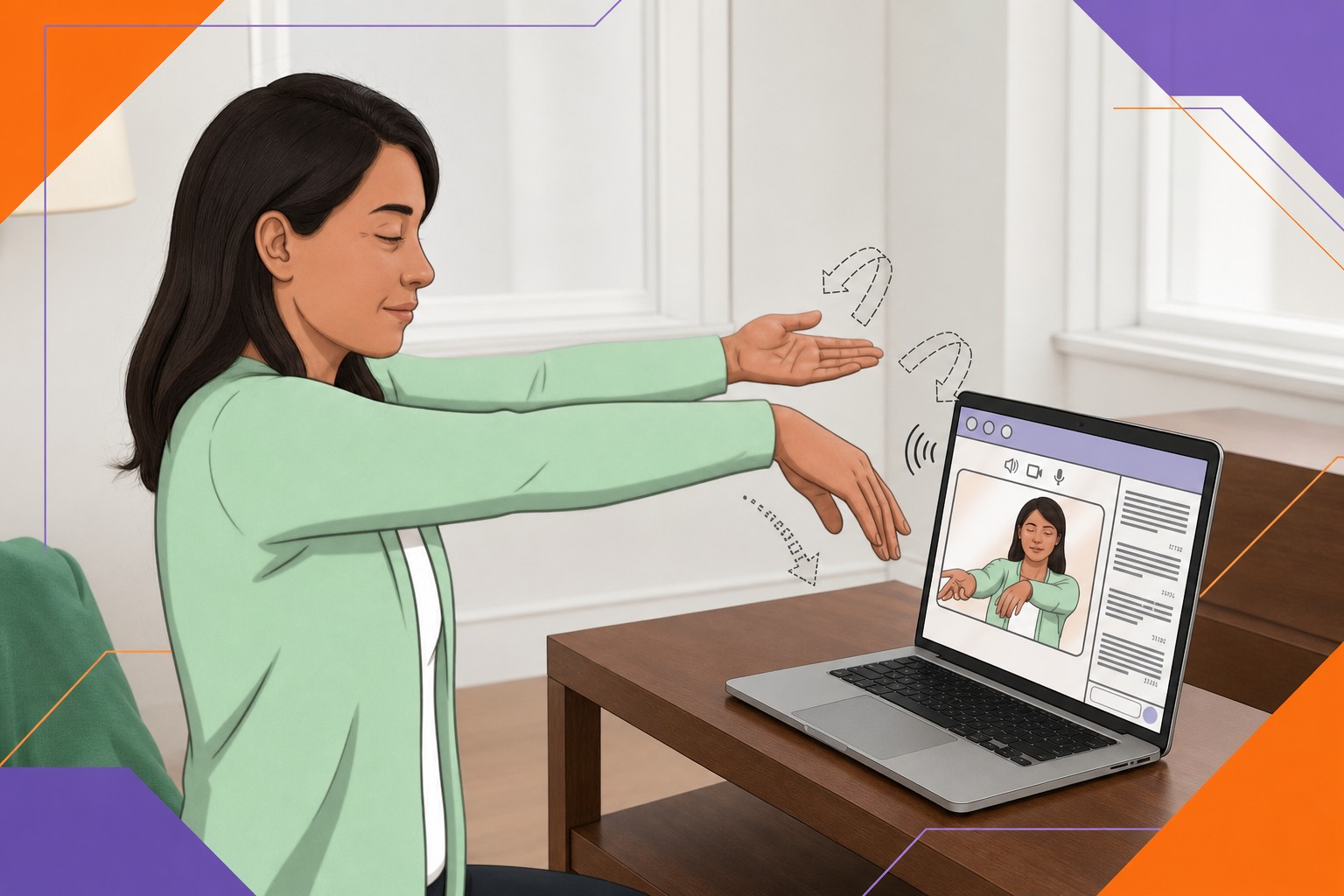
Google has put its medical AI on a video call. In a study titled "Towards expert-level medical AI for real-time video consultations," a joint Google Research and Google DeepMind team introduced AMIE (Video), a configuration of its Articulate Medical Intelligence Explorer built on Gemini and Project Astra that runs synchronous clinical video visits, reads non-verbal cues, and talks a patient through a virtual physical exam while reasoning about the diagnosis at the same time. Across 100 scenarios, 300 consultations and a group of 30 board-certified general practitioners, Google calls it the first evaluation of an AI system reaching specialist-level results in real-time clinical video consultations.
The result that stands out is not the one about diagnosis. On core clinical competencies — history-taking completeness, diagnostic accuracy, appropriateness of management, communication quality — AMIE (Video) was rated by expert graders at the level of general practitioners, and matched or in some cases exceeded AMIE (Text) on the same measures. But on observing physical signs and conducting the examination, it scored significantly higher on average than both the GPs and the text system. It identified physical findings more often and directed the patient actors through virtual examinations itself.
That is worth sitting with. A system with no hands outscored doctors at physical examination. What it actually won at is attention and instruction — telling someone how to hold themselves in front of a camera, then looking carefully at what came back.
Everything AMIE had done before ran through text. Earlier work put it at physician level in text-based diagnostic dialogue and had it helping clinicians build differential diagnoses; later versions moved past diagnosis into treatment and long-term disease management. It was tested at specialist level in oncology, cardiology and ophthalmology, and on multimodal reasoning over images and clinical documents. All of it in simulation, with patient actors. In parallel, Google began moving the research toward the clinic: a physician oversight system, a feasibility study with Beth Israel Deaconess Medical Center, and a nationwide randomized trial with Included Health.
Text throws away most of what a consultation is. A doctor watches a gait, notices discomfort, hears the breathing, explains how to perform a movement during the exam. A text interface forces the patient to convert complex physical symptoms into words, which loses diagnostic information and penalizes anyone with low digital or health literacy. A text system also cannot observe visual and auditory signs on its own, or walk a patient through the actions that narrow a differential.
The engineering problem in closing that gap is time. A video consultation demands responses at conversational speed while clinical reasoning runs and visual and audio streams are processed continuously. A single agent cannot do all of it at once: deep reasoning takes time, and pauses in conversation erode trust and break rapport. AMIE (Video) splits the work across three specialized agents running in parallel, asynchronously, so that perception and reasoning do not stall the dialogue. Automated evaluations showed each of the three agents contributing to clinical metrics — history-taking completeness, reasoning quality, treatment recommendations — and to conversational ones, including patient-centered communication and response latency.
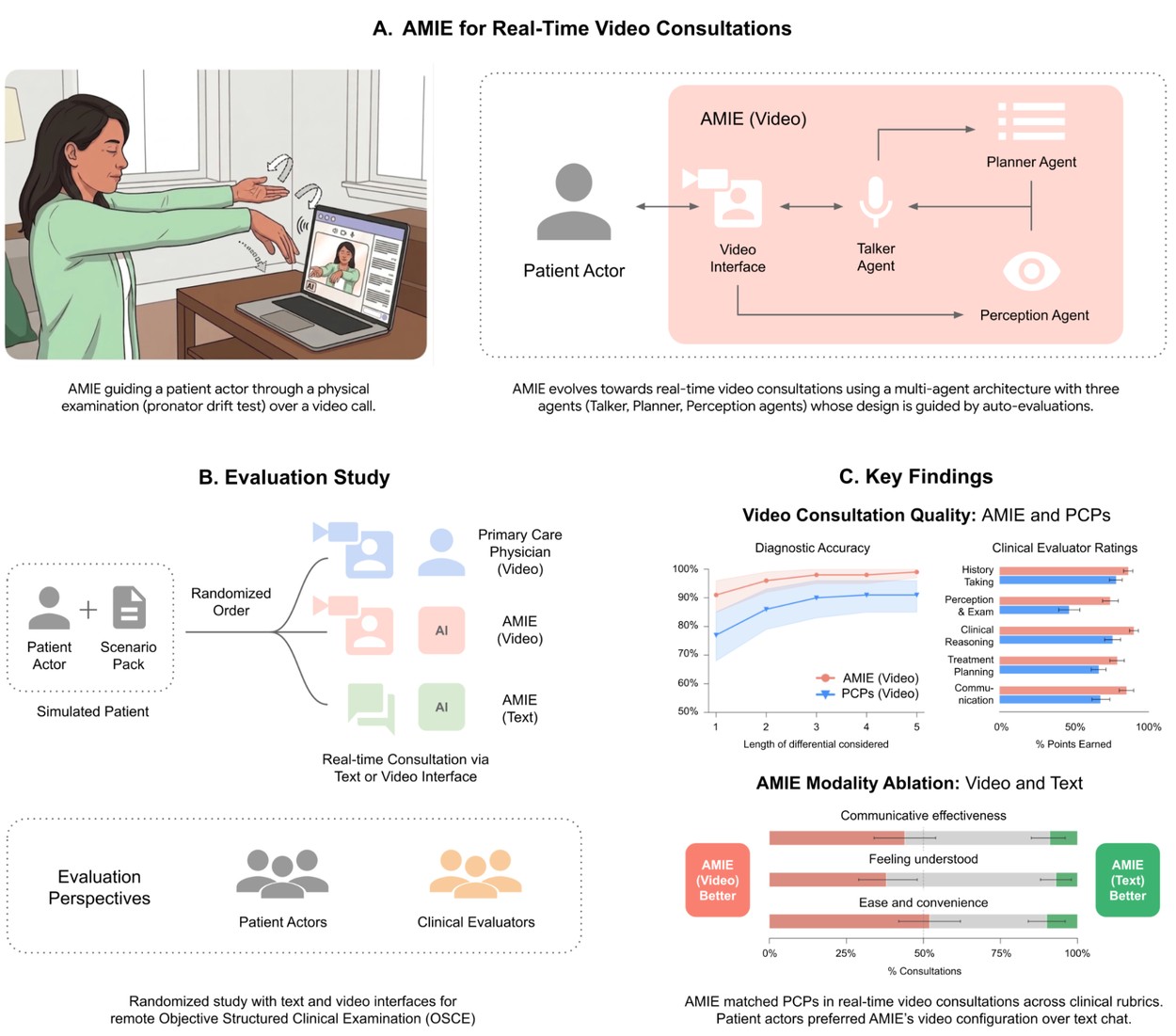
Note what that architecture concedes: latency is now a clinical variable, not a UX preference. Google built a three-agent system because a two-second silence costs something measurable in how a patient rates the encounter.
To evaluate perception and reasoning at scale, the researchers derived a taxonomy of audiovisual clinical competencies from the medical literature — non-verbal visual cues, auditory signals, and physical examination maneuvers relevant to telemedicine — and built an automated test suite on top of it. It combined single-shot audiovisual probes of individual skills, such as identifying which side of the body is affected or recognizing signs of respiratory distress, with multi-turn simulated audio consultations that scored the whole conversation and injected visual cues as text descriptions. In one Parkinson's scenario, the simulator might relay that the patient is holding a sheet of paper up to the camera covered in very small, cramped handwriting. These checks let the team iterate on the architecture and map the system's failures before any human grader was involved.
The full evaluation was a large randomized study in the format of an objective structured clinical examination, run through a synchronous video consultation interface. It covered 100 clinical scenarios across five body systems: cardiovascular and respiratory; abdominal; head, eyes, ears, nose and throat; neurological and psychiatric; and musculoskeletal. Fifteen trained patient actors conducted 300 standardized consultations across three study arms. An independent panel of 20 experienced general practitioners graded every consultation using validated clinical rating scales and detailed criteria written separately for each scenario.
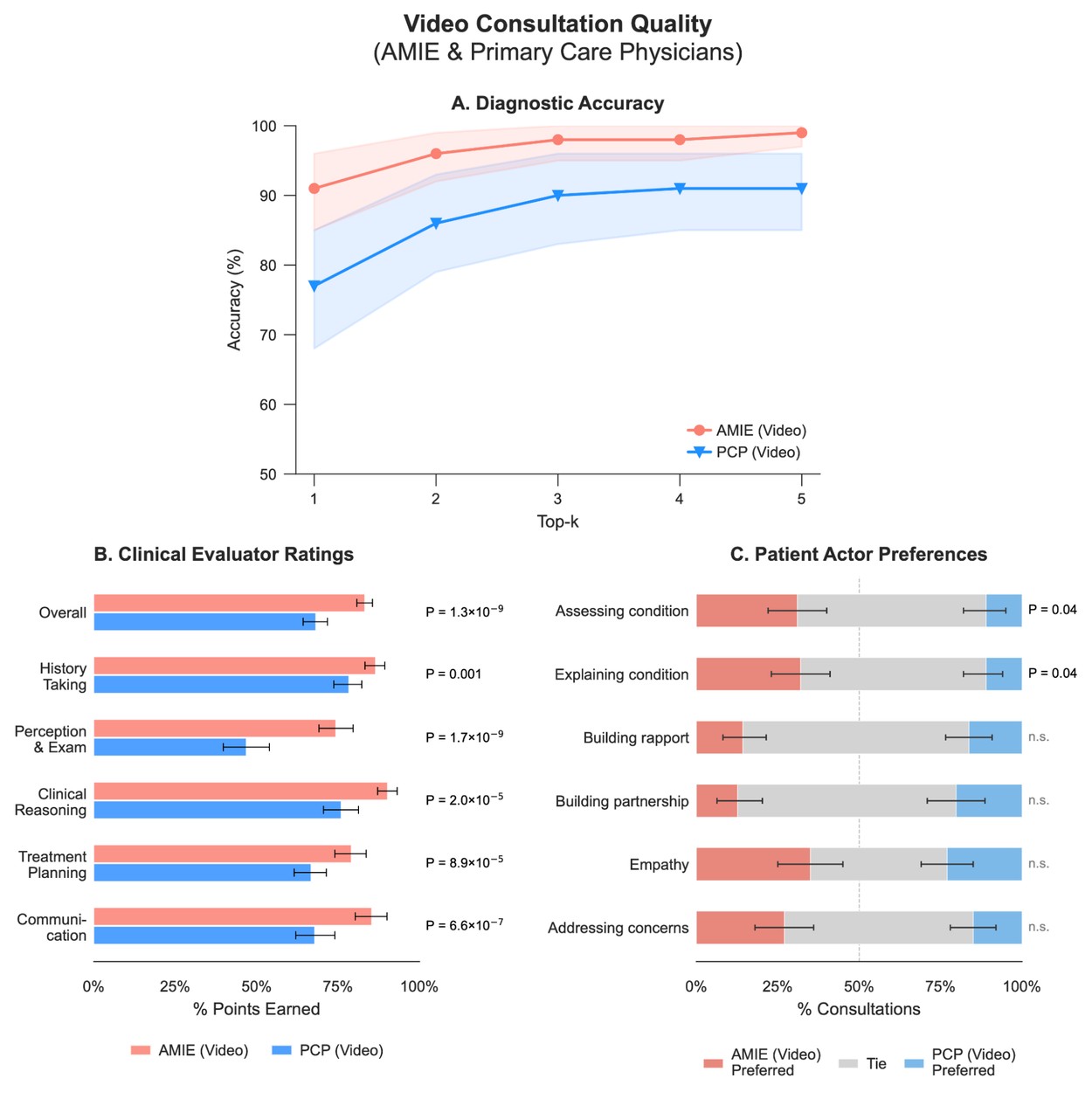
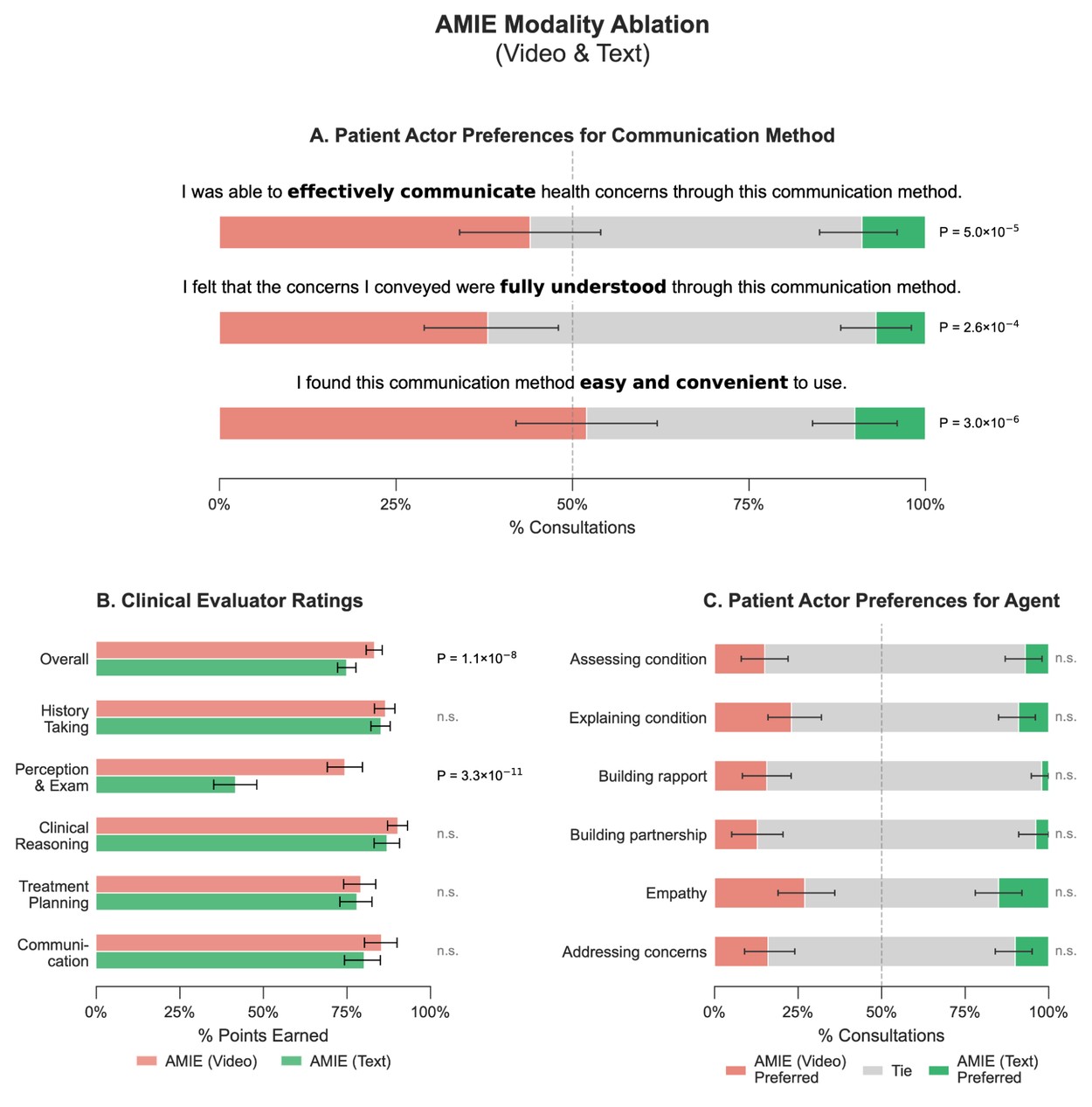
Patient actors preferred the video format outright. They rated the synchronous video interface significantly more convenient and effective for describing health problems than text messaging. On empathy, rapport and confidence in the care being provided, AMIE (Video) again scored more favorably than both the GPs and the text system.
I would not read the empathy scores as a finding about medicine. An actor rating warmth in a scripted encounter is rating conversational manner, and a system with no schedule, no queue behind the door and no fatigue is structurally well placed to win that comparison. The perception and examination scores are the substantive claim, and they are the ones the study's own limitations section quietly undercuts.
Here is the part that deserves more attention than it will get. The scenario set was restricted to conditions that can be credibly acted — and Google states plainly that this excluded important clinical cases where audiovisual perception matters most for diagnosis. So the system's largest measured advantage, perception and physical examination, was established on the subset of cases that deliberately omits its hardest and most valuable tests. Nothing in the write-up estimates how much of the gap that leaves open. Everything also ran in simulation, with professional actors rather than people seeking care for their own illnesses, and even well-trained actors cannot reproduce the messiness and unpredictability of real encounters. Additional automated checks turned up individual perception and reasoning errors, and AMIE (Video) still suffers occasional technical failures that break the flow of conversation — some of which, given Project Astra's prototype status, may be system-level rather than medical.
Google is explicit that no conclusion about practical benefit is available until the results are reproduced with real patients and real clinical conditions. It has already started: the Beth Israel Deaconess feasibility study produced early safety and benefit data for text-based AMIE in clinical practice, and the ongoing nationwide randomized trial with Included Health is testing AI use in real virtual care. Before deployment, the system needs real patients, a case set that extends past what can be performed, and robust safety mechanisms.
The claim that the transition from text to audiovisual medical AI can be made at specialist quality now rests on a study designed to exclude the cases that would test it hardest. The next trial either closes that hole or the examination result never meant what the numbers suggested.