
Where Argon falls short
DeepMind’s RE-Bench covers 74 realistic machine-learning development tasks. Argon solves roughly half, compared with 27% for Gemini 3.7 Flash. That is a substantial improvement over the earlier model, but not evidence that researchers can hand over the work.
Belffield says people remain necessary for creative research, designing new experiments, spotting subtle training instabilities and long-term planning. A review by twelve senior DeepMind researchers found the same pattern: automation works best when a task is clearly defined and its result can be checked, and worst in open-ended searches for scientific ideas.
A progress index without acceleration
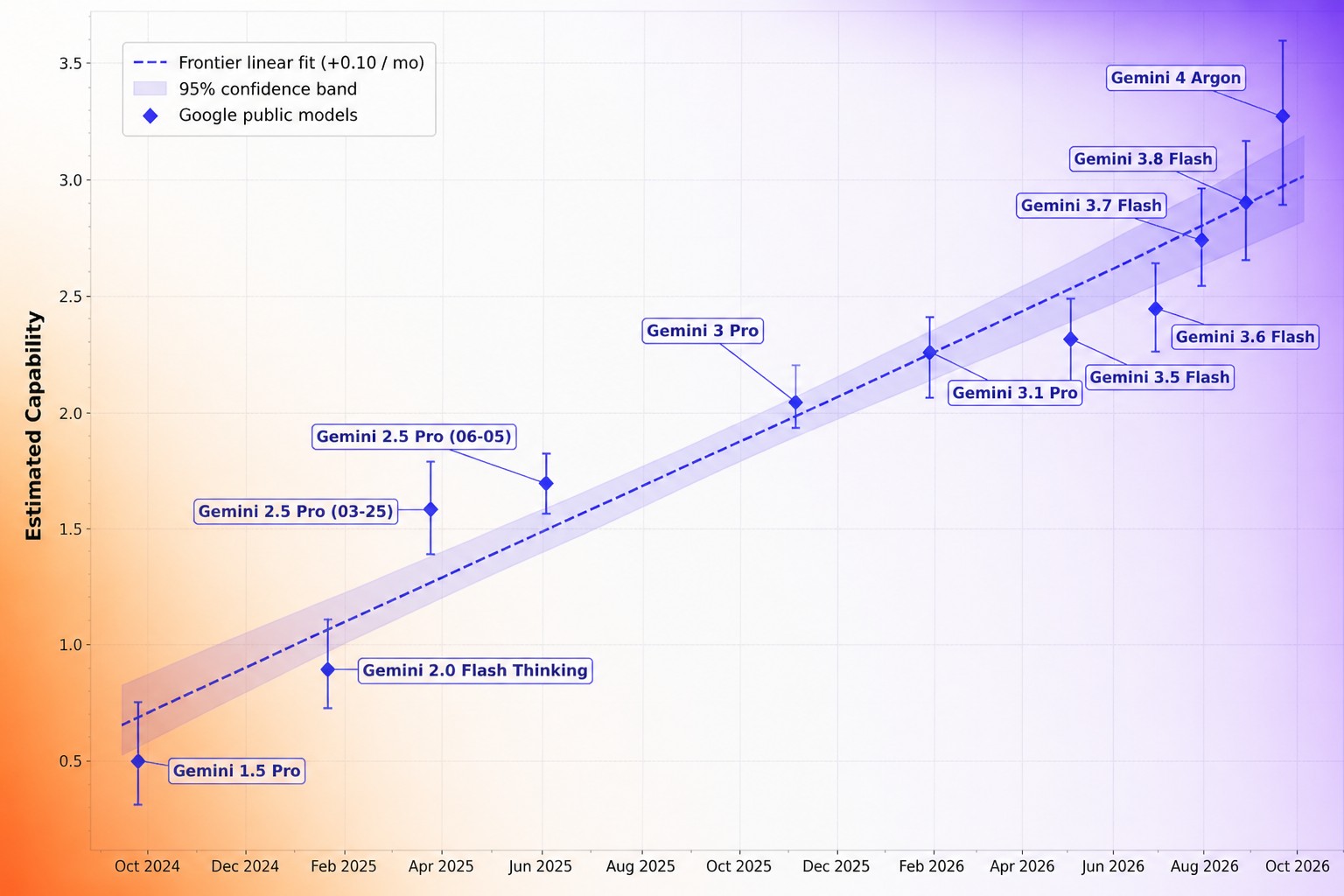
To track progress systematically, the team built a general capabilities index covering 123 models and 92 benchmarks. Gemini’s capabilities are rising steadily, by about 0.1 GCI points per month, with no visible acceleration.
The team attributes Gemini 4 Argon’s slight lead over that trend to more compute and investment in how the work is organized—not to AI accelerating research.
Google currently rates the risk of AI automating research as low, while building a measurement system to track whether signs of acceleration emerge.
The unresolved gap
Belffield’s conclusions align with recent research, but the field is not settled. More than 20 AI researchers, including Geoffrey Hinton, Yoshua Bengio and Jakub Pachocki of OpenAI, recently warned in a scientific paper of a possible “intelligence explosion.” They argued that AI systems could automate all AI research and development within a few years, compressing years of ordinary progress into months.
I think the most telling result is not that Argon solves half the benchmark, but that Google is measuring whether the pace of capability growth changes at all. The benchmark captures tasks with checkable outcomes; the harder question is whether AI can take on the creative work that produces the next research agenda. For now, the index shows steady progress, not a system accelerating its own development.
Daily AI news
Every day we pick what actually matters in AI and explain it plainly — no hype, no filler. Subscribe if you want to follow where the industry is going.
Only what matters — every day
Follow on X