
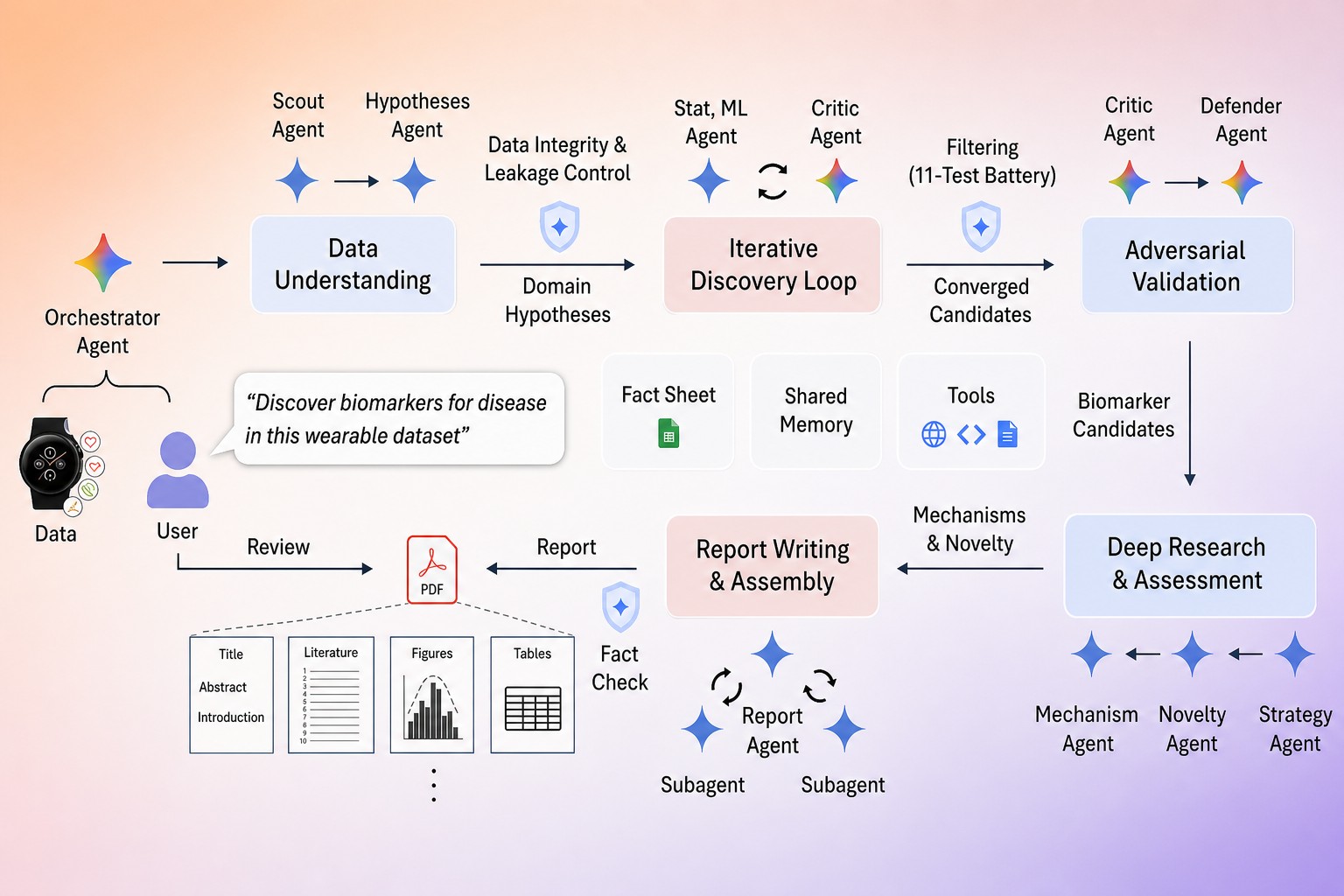
Researchers at Google Research have built an agent system that takes raw wearable-sensor data and ranks candidate digital biomarkers out of it, and the design choice that matters is what they refused to let the language model do. Statistics stay deterministic; the model proposes hypotheses and explains them. Run across three cohorts totalling 9,279 participant observations, the system produced 41 candidate digital biomarkers for mental health and 25 for metabolic outcomes, recovered known clinical signals, and improved downstream prediction when its features were added to demographics.
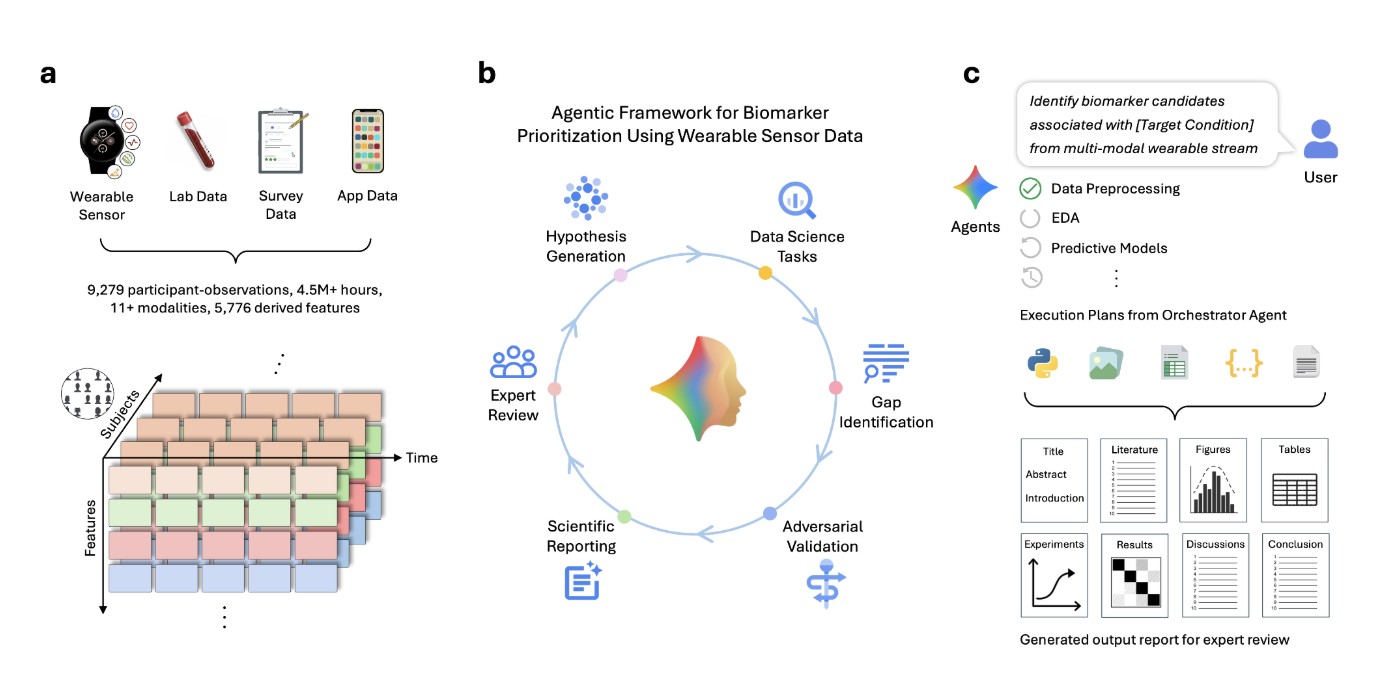
Conceptual diagram illustrating the cyclical process of AI-driven biomarker discovery from wearable device data and clinical data
Source: research.google
The problem it is aimed at is not data scarcity. Wearables already collect physiological signals continuously, at population scale — heart-rate dynamics, sleep parameters and more — and those signals can register early changes in the body before symptoms appear. The bottleneck is no longer collection but conversion: turning those streams into reliable, clinically meaningful biomarkers.
Existing language-model systems automate individual steps of scientific work and tend to do badly on physiological time series. They optimise for predictive quality and can let statistical correctness slip, which produces spurious correlations, data leakage and unstable features. That failure mode is the reason the architecture here is built the way it is.
The system treats biomarker selection as a repeating, human-supervised research cycle: hypothesis generation, parallel statistical analysis, model training, adversarial checking and a search for confirmation in the literature. Six stages map onto the usual biomarker prioritisation loop. An orchestrator agent converts a natural-language research question into an execution plan and directs specialised agents — scouts, critics, defenders and mechanism specialists — that work against shared pipeline state. A shared memory, a structured fact sheet and a single tool set keep every action traceable. Deterministic computation handles the numerical analysis; generative reasoning is confined to forming and interpreting hypotheses.
Take a worked example. Asked which wearable features relate to depression severity, the system examined the DWB dataset and proposed features describing the variability of sleep timing. The link between sleep-duration variability and PHQ-8 severity came out at ρ = 0.252. The pipeline then checked the result for robustness, data leakage, consistency across subgroups and alternative explanations, and only then presented it as a literature-grounded hypothesis about circadian instability, for a human to judge. Safety machinery separates feature construction from the target signal, and every candidate must survive an adversarial filter of 11 tests.
The system was applied independently to three large cohorts in mental health and metabolic disease: DWB, GLOBEM and WEAR-ME. It did not restrict itself to existing variables. In mental health it singled out sleep-duration variability and sleep-onset-time variability as the most prominent correlates of depression severity. In the metabolic domain it constructed a cardiovascular fitness index — step count divided by resting heart rate — which turned out to be a non-invasive correlate of insulin resistance, and which connects to earlier work on glucose regulation and cardiometabolic fitness.
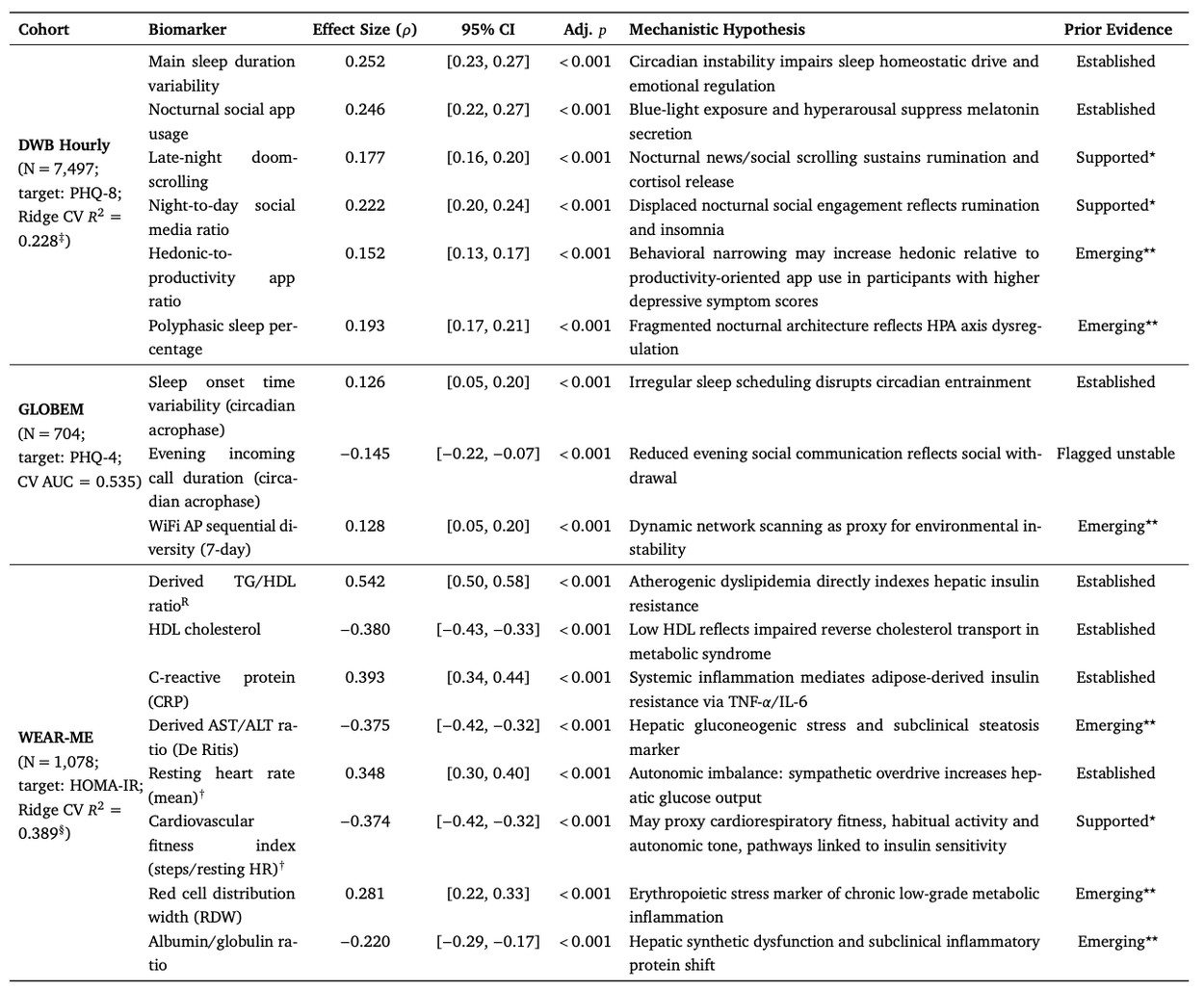
Data table with biomarker candidates, effect sizes, adjusted p-values and mechanistic hypotheses across three cohorts
Source: research.google
The reporting in that table is unusually careful about what it is not claiming. Spearman's ρ gives direction and strength, the 95 percent confidence interval gives the uncertainty, the adjusted p-value accounts for multiple comparisons, and the mechanistic explanation is flagged as a literature-based hypothesis that does not establish causation. A separate column reports the strength of prior scientific evidence, not clinical validation in this study; its asterisks mark confidence levels, not significance codes. "Established" means a substantial body of supporting publications. "Supported" means the physiological axis is studied but the digital way of measuring it was proposed recently. "Promising" means prior evidence is thin and holdout testing is needed. R marks a candidate rejected by the construct-overlap filter, † marks a feature derived from wearable data, and "Unstable" marks a candidate whose estimated direction flipped on the holdout set.
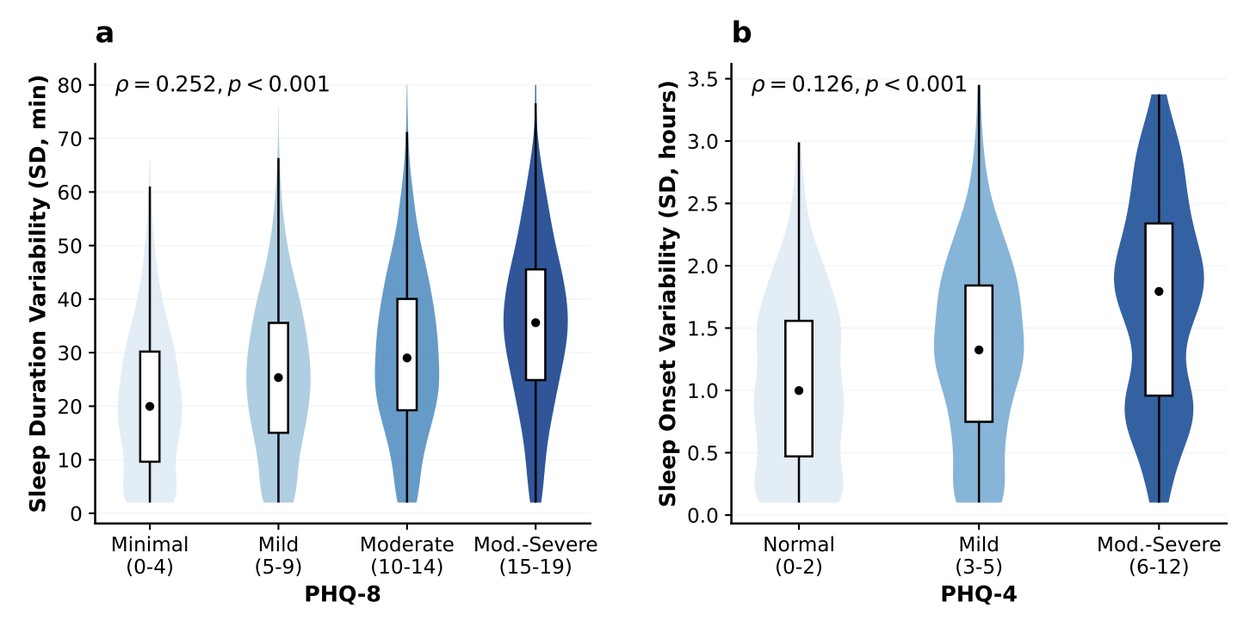
Two violin plots showing sleep duration and sleep onset time variability across groups of increasing depression severity
Source: research.google
Across the two depression datasets, the system picked different ways of measuring a closely related construct — circadian instability. Variability rose between symptom-severity groups in both cohorts. But because the cohorts, endpoints and feature definitions differed and no identical candidate reappeared, the authors read this as preliminary convergence at the level of the construct, not as direct replication of a finding. The results are for generating hypotheses, not for proving causation.
Effect sizes landed at the moderate values typical of digital phenotyping from passive data collection. Adding the system's features to demographic variables improved prediction by ΔR² = 0.040 for depression and 0.021 for insulin resistance.
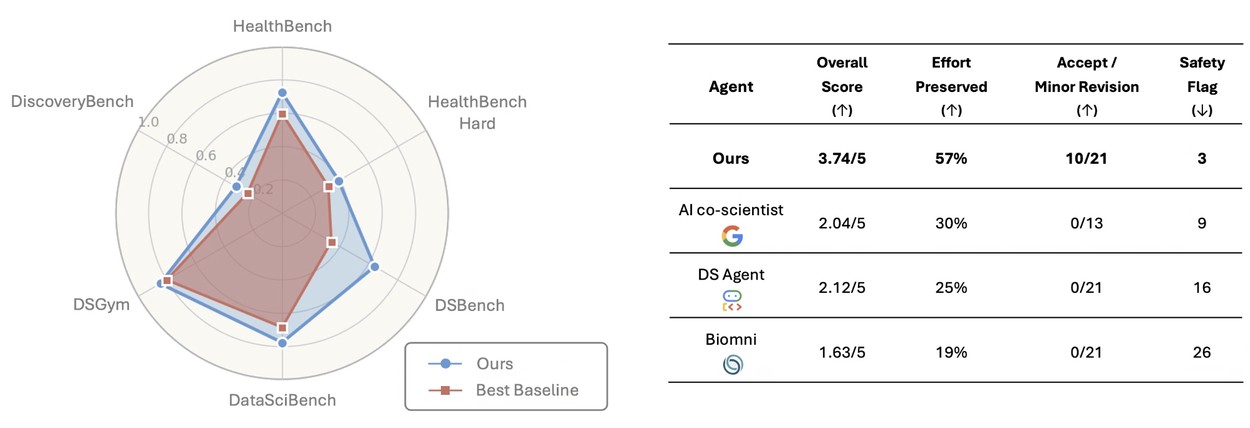
Radar chart and table comparing the proposed AI agent's performance with baseline methods across several data science benchmarks
Source: research.google
The team also put the system through data-analysis and healthcare benchmarks against the strongest baseline for each, and then ran a blind evaluation: 15 experts in medicine, biomedical data analysis, machine learning, bioinformatics and digital health scored the written reports. The comparison set was three current research systems — Google DeepMind's AI Scientist, Biomni, and a data analysis agent from Google's ADK. The biomarker system, Biomni and the data analysis agent were assessed together across 21 sessions, with another 13 sessions devoted to the biomarker system alone under the same criteria.
It took the highest mean score on all seven quality dimensions. On a simulated editorial scale, it was the only system to draw recommendations other than reject: 2 accept, 8 minor revision, 8 major revision, 3 reject. Experts kept 56.9 percent of the content of its manuscripts on average, against 18.8 to 30.4 percent for the baselines, and ranked it first in 9 of 13 sessions with four systems.
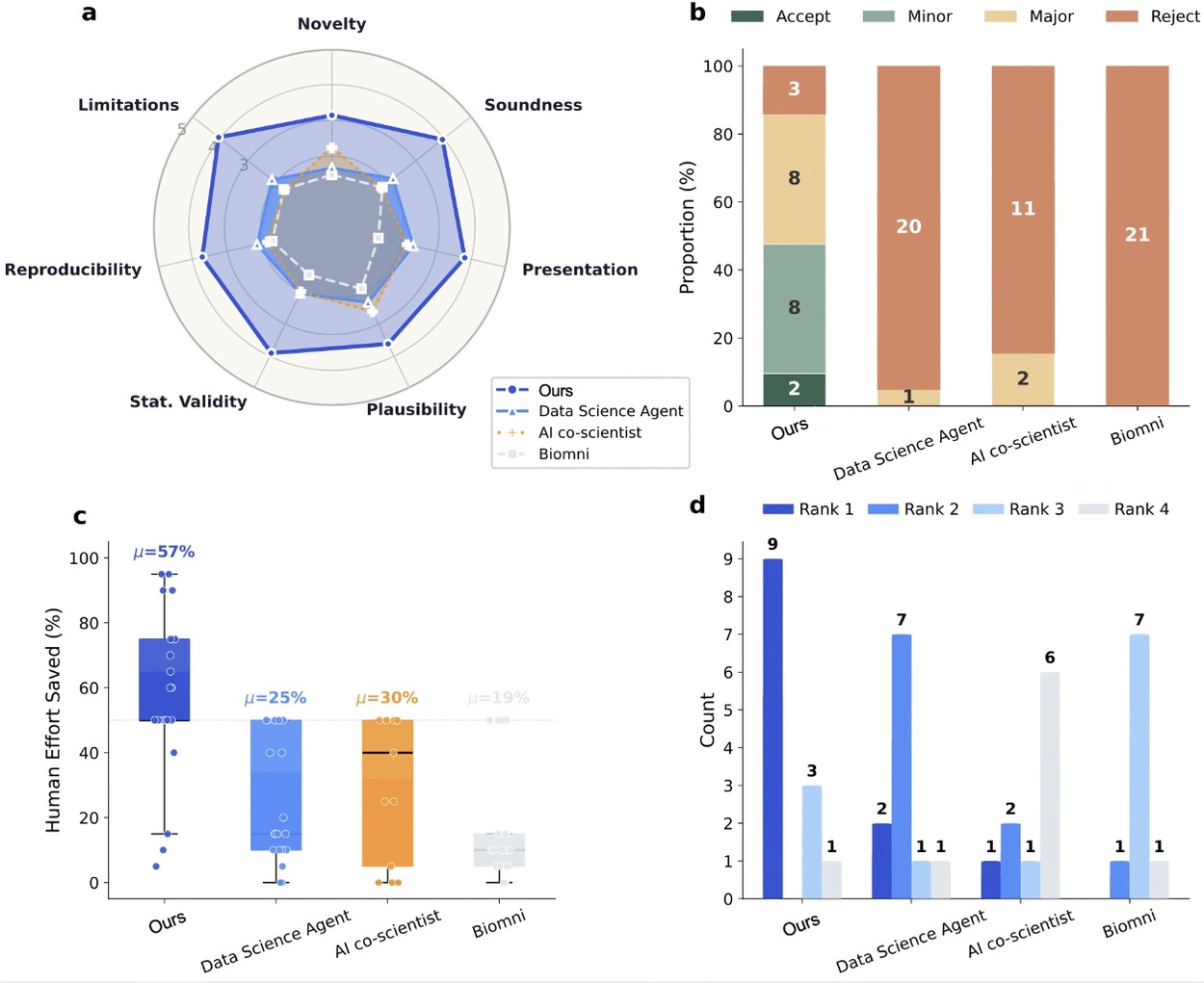
Four charts evaluating different AI agents on report quality, share of retained results, labour saved and task ranking
Source: research.google
The work was done by Yubin Kim, Hamid Palangi and Daniel McDuff of Google Research, with Kim, an MIT doctoral student, leading the project during an internship at Google under McDuff and Palangi. The authors credit co-authors and colleagues at Google Research, Google DeepMind and academic institutions.
Here is where I would push back on the framing. The headline number is 41 candidates, but the number that describes the system's actual capability is 56.9 percent — expert reviewers cut away more than two-fifths of the best manuscripts it wrote. And ρ = 0.252, ΔR² = 0.040: these are real signals and small ones, and the paper is honest that they are typical for the field. What has been demonstrated is not a discovery engine. It is a discipline engine — a pipeline whose distinguishing feature is how aggressively it attacks its own outputs before a human sees them. That is a genuinely useful thing to have built, and it is a smaller claim than the candidate count implies.
Two things the write-up is quiet about. The taxonomy includes an "Unstable" label for candidates that flipped direction on the holdout set, and an R label for candidates the construct-overlap filter killed — but the counts behind those labels are not given, which is exactly the number that would tell you how noisy the 41 and the 25 really are. And the 9,279 observations are reported as a total across three cohorts, not broken out, so the cohort a given finding actually rests on stays unclear. Neither omission is fatal; both are the sort of thing a reviewer would ask for first.
The deeper limitation is structural, and the authors come close to naming it themselves: the prior-evidence column measures literature, not clinics. Nothing here has been validated prospectively on a patient. Which sets up the uncomfortable arithmetic of automated science. If a pipeline like this can reliably produce dozens of defensible, pre-filtered candidates from a dataset in a session, the scarce resource stops being the hypothesis and becomes the study that tests it — and prospective validation does not get faster because the agents upstream got better.