
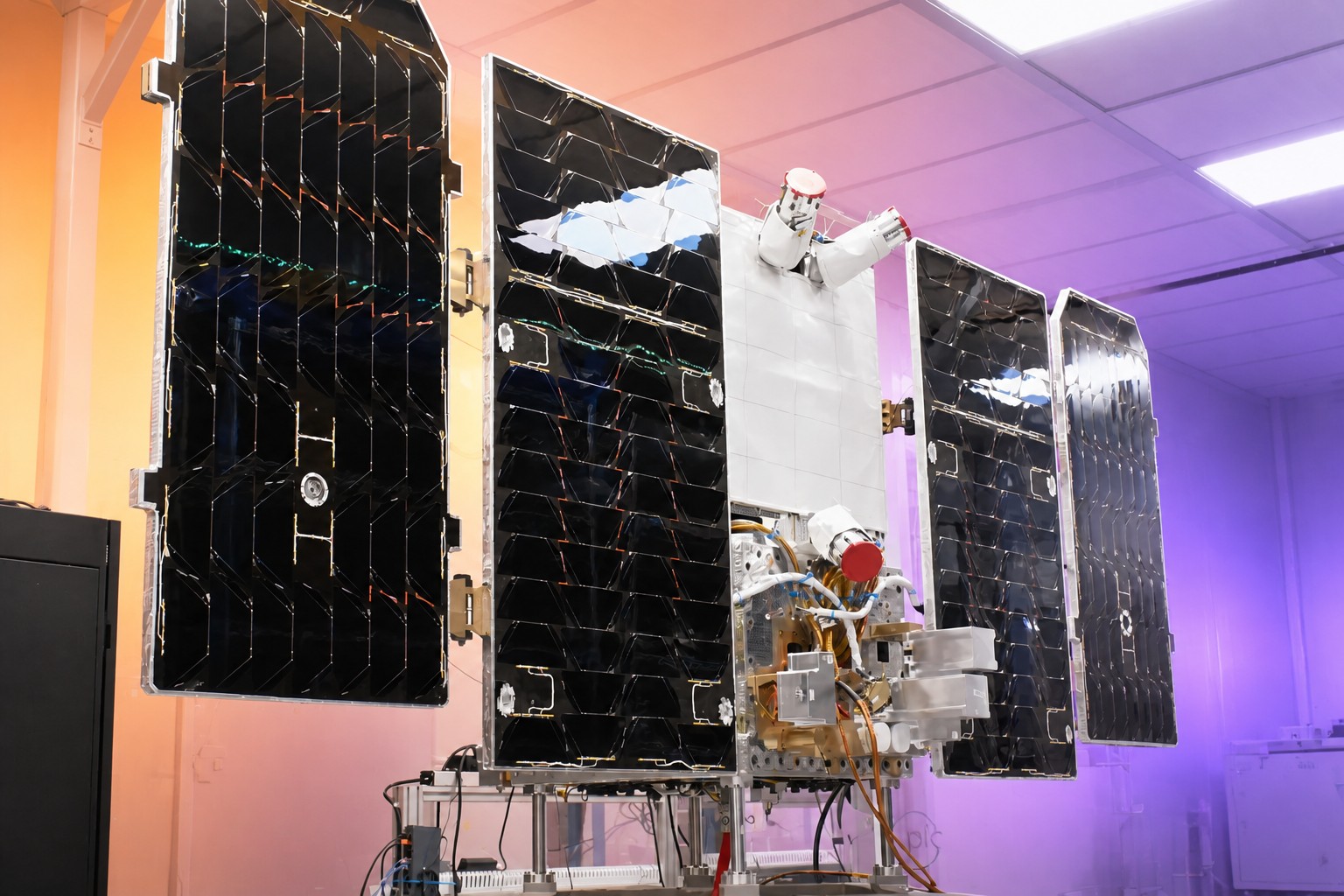
The system Google is testing
“We’ve tested chips on Earth, but nothing compares to testing them in real conditions,” said Travis Beals, head of Google’s Suncatcher project.
Once operational, the satellite will run its TPU for 15 minutes at a time to avoid overloading its power and thermal-management systems. The current spacecraft uses a standard Planet Labs platform. Google is also preparing a demonstration planned for next year: two satellites designed for more demanding computation and heavier loads, which will try to communicate over laser links.
Google’s longer-term design is a close-flying network of 81 satellites processing workloads in parallel. For large jobs spread across multiple racks, the bandwidth and latency between TPUs matter. The system is being designed not just for today’s workloads, but for those expected within the next five years.
Other space-computing and AI payloads are also riding SpaceX rockets. The company launches more than 100 payloads to orbit, including missions from Satlyt and Cowboy Space Company. Google’s stated ambition, Beals says, is a “long-term, ambitious task”: building infrastructure for future computing and AI workloads.
The launch rate is the hard part
Google published the peer-reviewed version of its technical paper on orbital data centers on Thursday. The paper, which will appear in Joule, is among the most detailed analyses yet of how computing capacity could be delivered to orbit. Its authors stress that they are not evaluating the project’s economic viability; their work instead shows how Google models the prospect of cheaper launches.
The estimate rests on a steep price decline. Google’s authors consider it realistic that SpaceX could bring launch costs to about $200 per kilogram by 2035. They estimate that since Falcon 1, the company has cut costs by roughly 20% a year through accumulated experience.
To extend that decline, the paper calculates, Starship would need to put 370,000 metric tons of payload into orbit. At 200 metric tons per flight, that means about 1,800 launches over the next ten years, or an average of 180 a year.
Starship has not flown more than five times in any year so far. SpaceX is counting on a much higher cadence. Elon Musk has suggested that Starship could launch every hour in 2029, though his predictions have not always come true.
Google is also a major SpaceX investor, and, like other companies building data centers, it is relying on the rocket maker. My read is that the paper’s most consequential number is not the projected launch price but the flight rate required to reach it. Google’s architecture depends on launch becoming routine at a scale Starship has not yet approached.
What the radiation tests establish
The revised study also finds that the chips are likely to withstand space radiation. Google had to expose them to particle-beam radiation a second time after discovering that the original test configuration shielded them better than they would be on a satellite. The repeat tests produced slightly more logic-circuit errors, but Google still believes the chips can handle large inference workloads during a satellite’s five-year service life.
Beals said the error rate during ordinary inference is very low—about one error per million operations. Even that rate, however, already gets in the way of large-scale training, where thousands of chips work for months.
What I’d want to know is how much the 15-minute operating window and the radiation-related errors constrain real workloads once multiple satellites are working together. The paper makes a case for orbital inference; its own caveats leave open how far that case extends to more demanding computation.
Daily AI news
Every day we pick what actually matters in AI and explain it plainly — no hype, no filler. Subscribe if you want to follow where the industry is going.
Only what matters — every day
Follow on X