
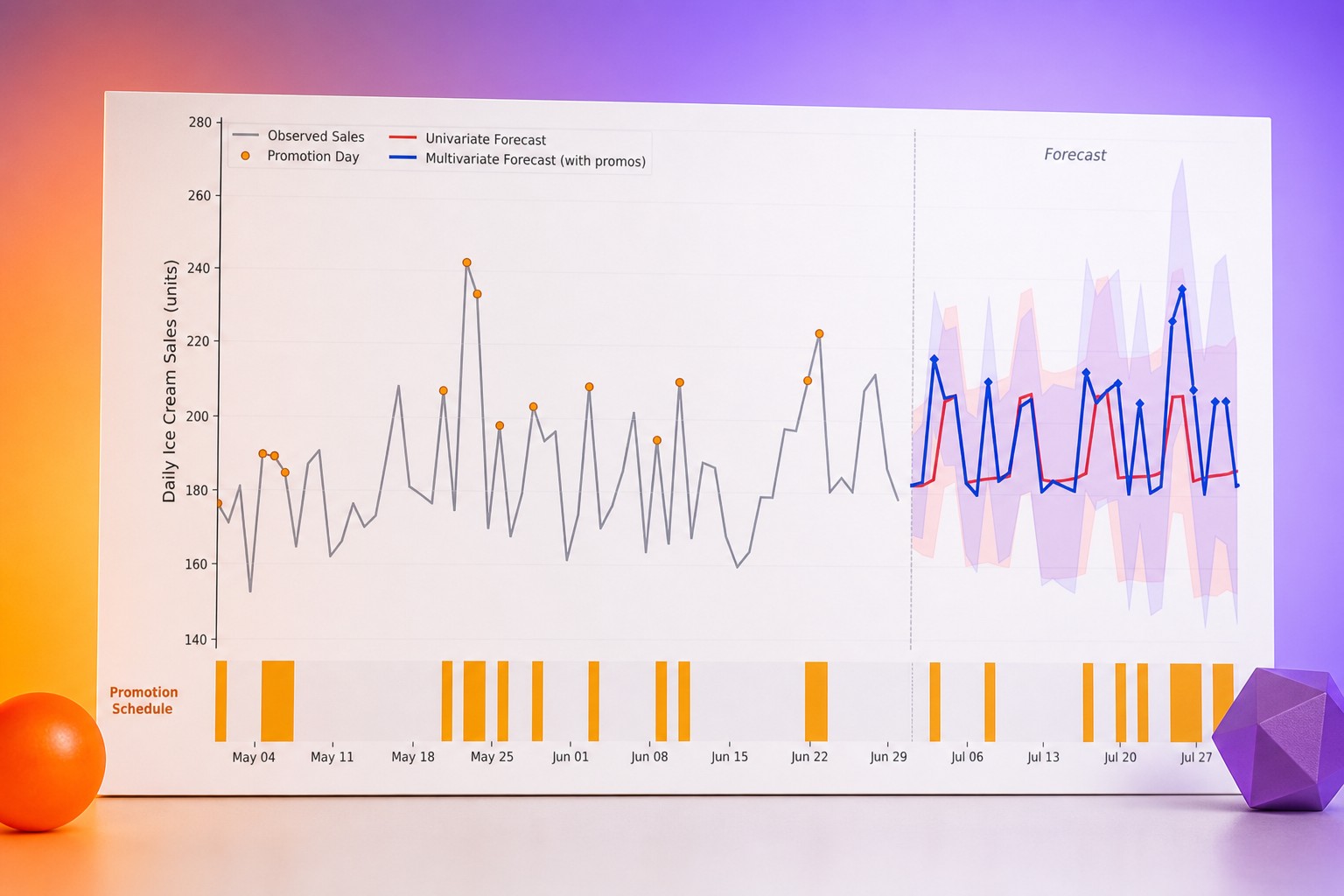
Google has released TimesFM-3, the first version of its time-series foundation model trained from the start for multivariate forecasting. It predicts several jointly moving series at once, accounts for the dependencies between them, and takes in outside variables — promotion calendars, weather forecasts, holidays — without task-specific fine-tuning. Every earlier model in the line, up to TimesFM-2.5 in September 2025, read one series at a time. The model is on GitHub and Hugging Face now; BigQuery integration is expected in the coming weeks.
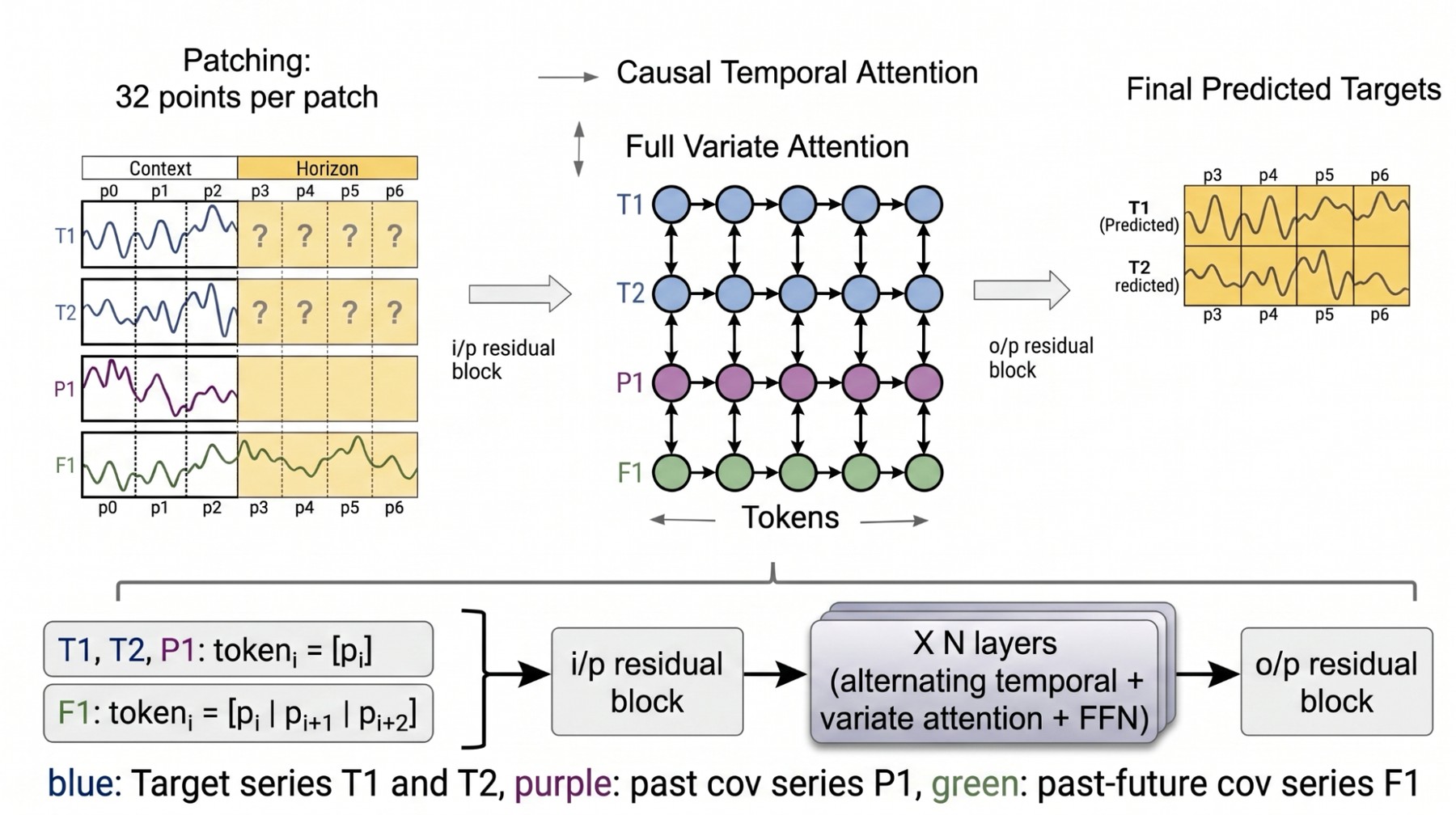
Diagram of the TimesFM-3 architecture, showing how time series are split into patches, the transformer layers, and the multivariate forecasting output
Source: research.google
The univariate limit was the awkward part of the product. Since the first TimesFM shipped in 2024, the model family has been put to work in retail, finance, systems monitoring, manufacturing, healthcare and the natural sciences — domains where almost nothing depends on its own history alone. Forecasting ice cream sales is the canonical example: the sales history is worth less than the sales of cones and syrup beside it, foot traffic in the store, and the things already known about the future, such as the weather forecast, a promotion or a holiday.
TimesFM-3 keeps the decoder-only transformer of previous versions. Consecutive values of a series are grouped into patches of 32 time steps, and each series is normalized separately, which is what lets indicators on wildly different scales sit in the same model. For the target series and for covariates known only in the past, one token is built directly from one patch. For covariates known in both past and future, the model uses a look-ahead strategy: already-known future values are appended to the current patch, so the model can see signals that have not happened yet. The tokens pass through an input residual block into the main transformer stack, which operates as a two-dimensional grid — alternating layers switch between attention over time and attention across series.
The second change is about how the forecast is produced. Earlier versions generated one patch at a time, which raised latency, accumulated error and burned more compute. TimesFM-3 masks consecutive patches and produces the entire horizon in a single forward pass: masked future tokens are appended to the observed context, target series and past-only covariates are masked because their future values are unknown, and covariates available in past and future — holiday dates, scheduled events — stay visible. The alternating attention layers fill every masked patch at once, with no sequential prediction loop.
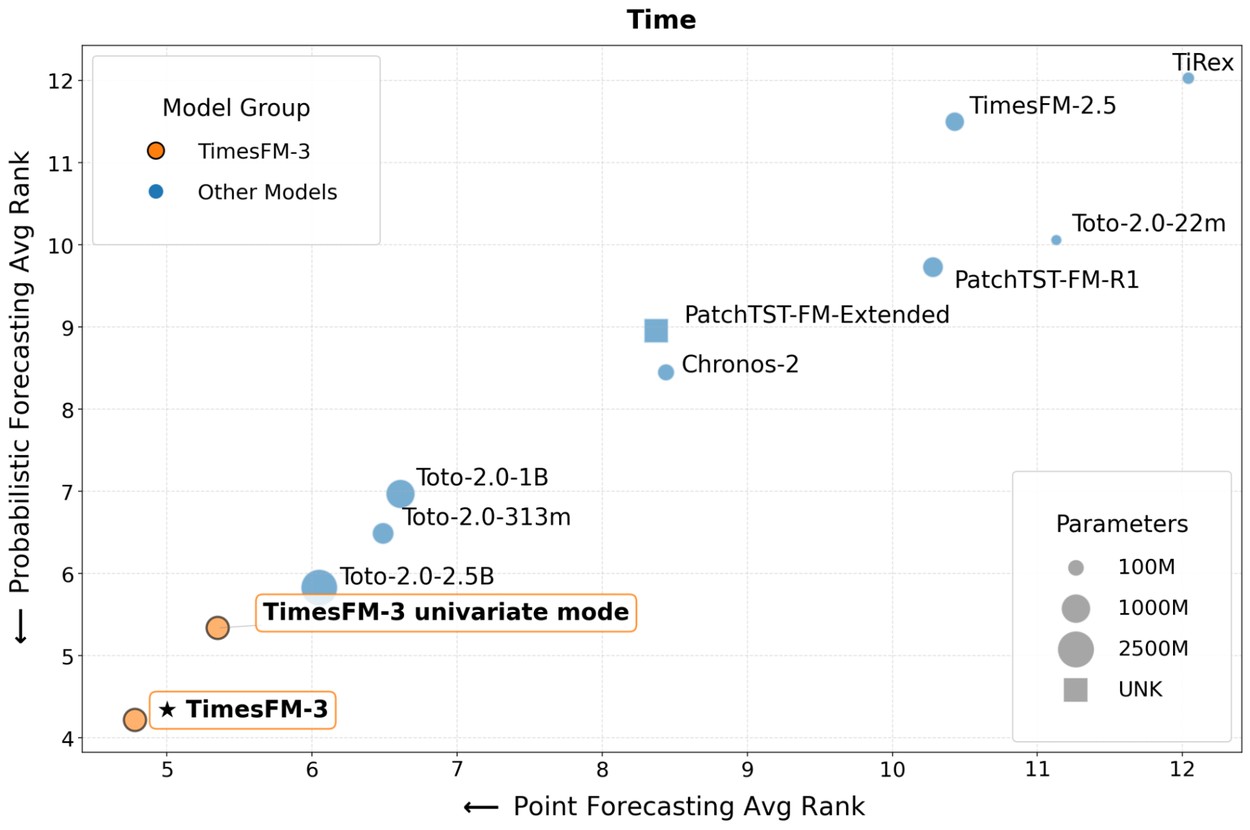
Inference time and efficiency comparison, showing TimesFM-3's speed and latency across different forecasting horizons
Source: research.google
For each target series at each step the model emits nine quantiles, from the 10th to the 90th percentile, which is what turns a line on a chart into a statement about uncertainty. The whole thing is 330 million parameters, trained on a corpus of more than 1 trillion time points.
Google's illustration is a retail chain planning next month's promotions. A univariate model sees only sales history and continues the observed weekly cycle; it does not know which days are promotion days. In multivariate mode TimesFM-3 receives the promotion schedule as a covariate known in past and future, estimates from history how promotions relate to sales, and carries that relationship onto future dates. The forecast then shows roughly 20% higher sales on each promotion day, with the amber blocks in the covariate marking the promotions: the blue TimesFM-3 line reacts to them, the red univariate line does not. Across a month that is a materially better revenue forecast.
On benchmarks, TimesFM-3 was tested on three public forecasting suites — Gift-Eval, FEV-Bench and Time — and took the best average rank among pretrained models on both point and probabilistic metrics on all three. The comparison set included current models with multivariate support, Chronos-2 and the Toto 2.0 family, along with TimesFM-2.5.
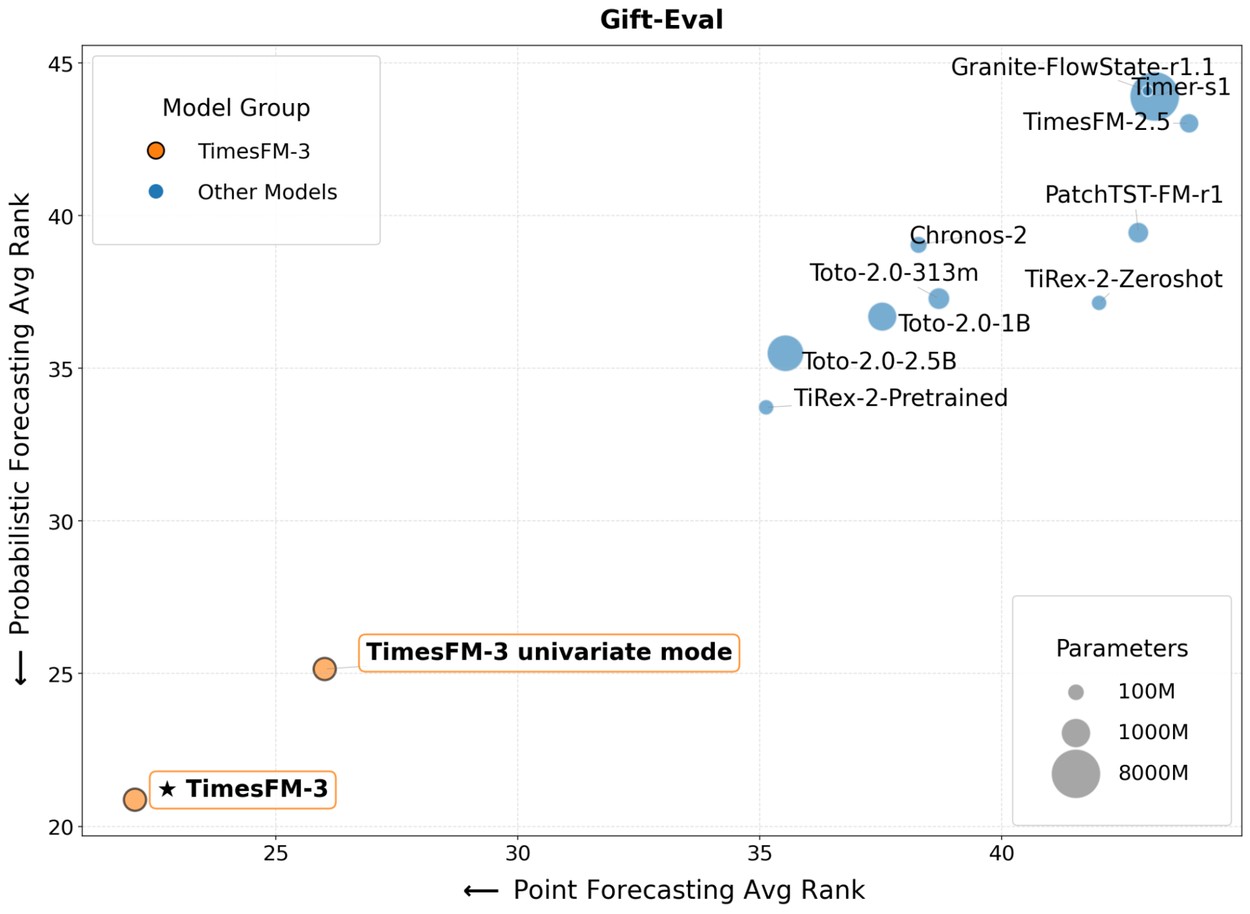
Benchmark chart comparing TimesFM-3 with leading forecasting models on GIFT-Eval
Source: research.google
The charts show the model in two modes. In univariate mode it runs without covariates or cross-series information, handling each target series separately like a conventional model — and in that mode it already matches or beats the models it is compared against. In full multivariate mode it adds the relationships between series and the available covariates on top.
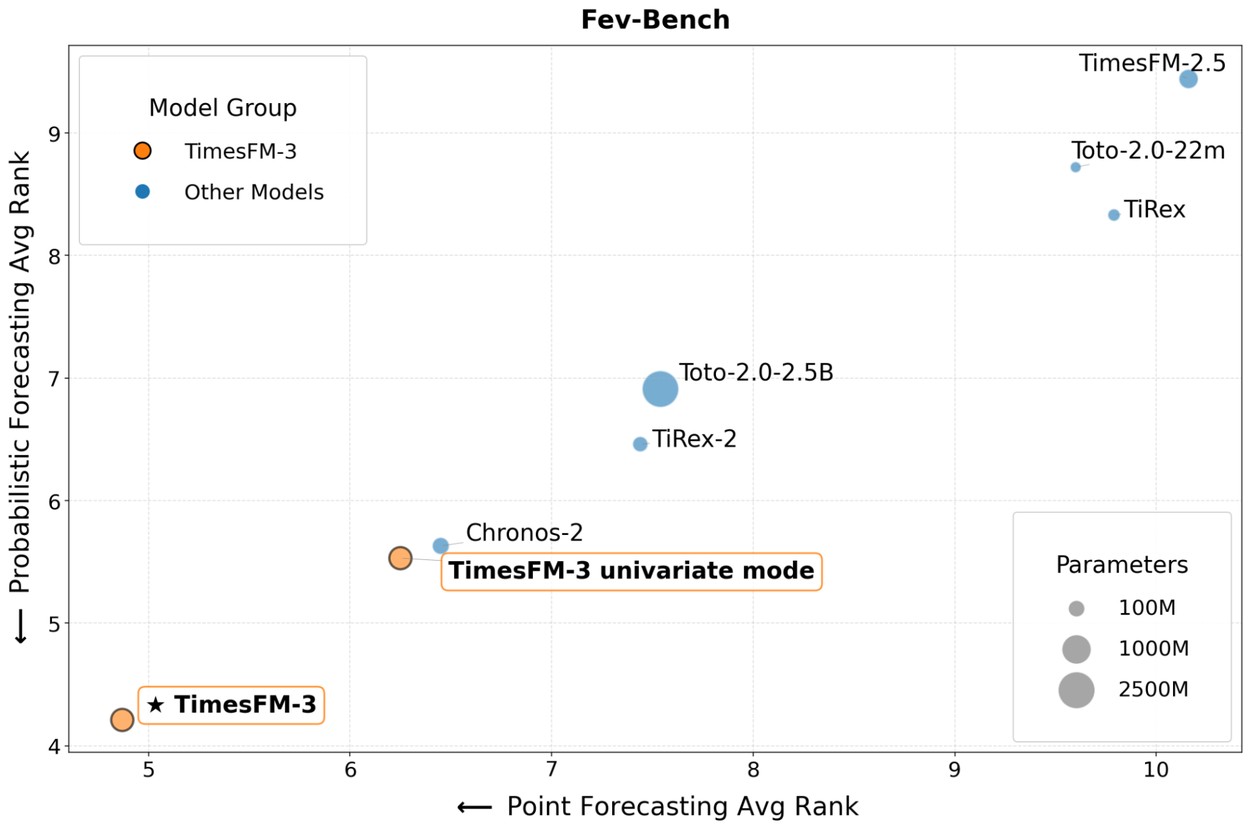
Benchmark chart showing TimesFM-3's forecasting accuracy on the multivariate FEV-Bench datasets
Source: research.google
Read the claim carefully, though. "Best average rank" is a statement about ordering, not about distance: it says TimesFM-3 usually finishes first among pretrained models, not by how much. The more interesting result is the univariate one. A model that holds its own without covariates is a model whose gains come from the training corpus and the single-pass decoding, not only from the new multivariate machinery — which matters, because the multivariate mode only pays off for teams that actually have clean covariate data and know which future values they genuinely know in advance. The 20% promotion lift, meanwhile, is a demonstration of the mechanism, not a measured accuracy figure.
The distribution detail is the one worth watching. TimesFM-3 is on GitHub and Hugging Face, which reaches people who already build forecasting systems; the BigQuery integration, due in the coming weeks, reaches everyone else. Google is already pointing users at TimesFM-2.5 for univariate work and at the AI.FORECAST command in BigQuery, which requires no machine learning knowledge at all. The project was built with Yichen Zhou, Petros Mol, Abhimanyu Das and Samet Oymak.
Time-series forecasting has been the last large area of applied machine learning where small, hand-tuned statistical models still beat general ones, and where the expertise lived with the analyst rather than the model. A 330-million-parameter model that arrives untuned and ranks first on three public benchmarks does not remove that expertise; it moves the question from which model to fit to which covariates you can honestly claim to know about next month.