
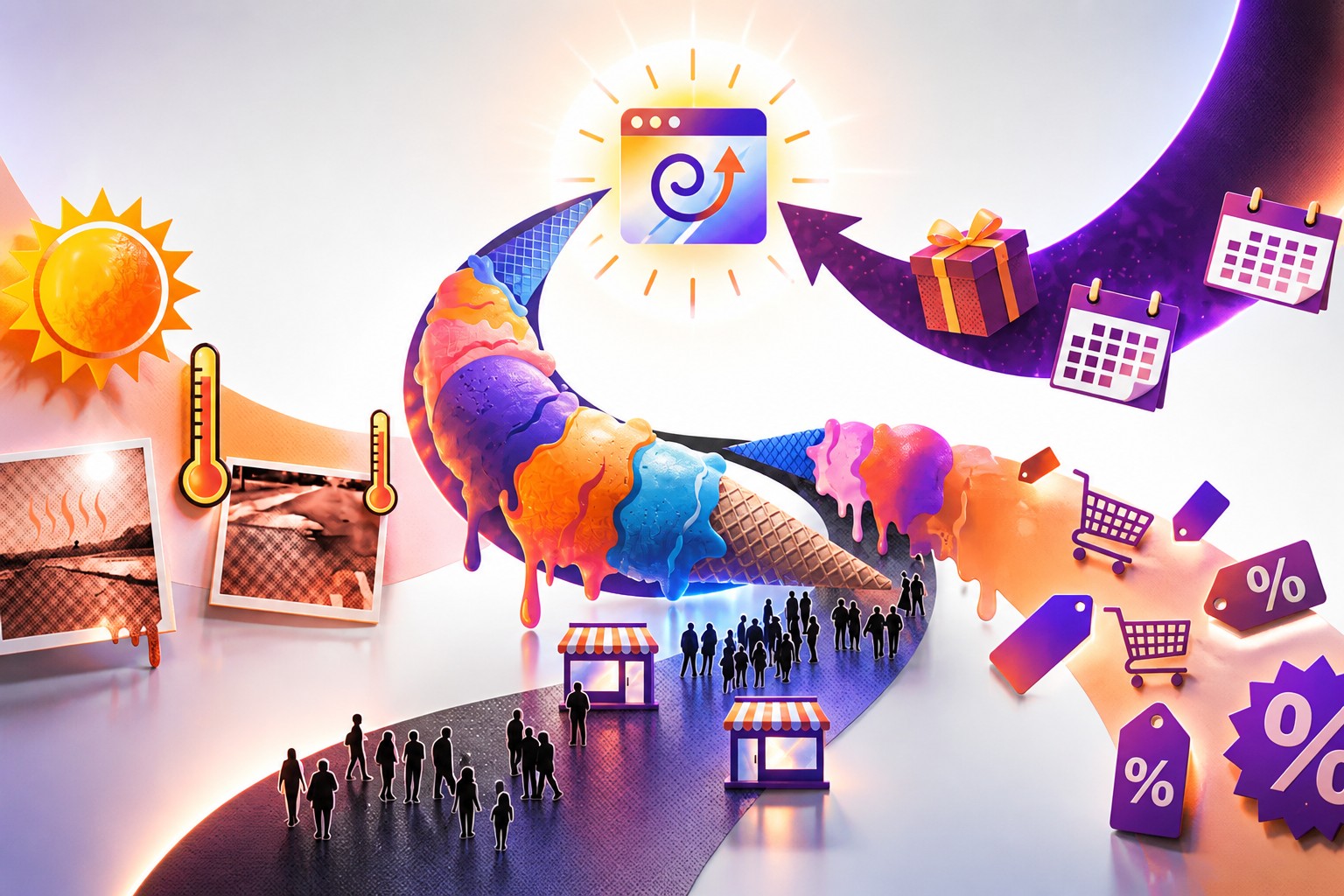
Google has released TimesFM-3, the first model in its time-series forecasting family that can read more than one variable at a time. Every previous version, up to TimesFM-2.5 in September 2025, handled a single series in isolation. The new model is a 330-million-parameter Transformer trained on real and synthetic series totaling more than a trillion data points, and it accepts related series, history-only factors and events known in advance — a promotion calendar, a weather forecast. Google says it finished first on the Gift-Eval, FEV-Bench and Time benchmarks among pretrained forecasting models, on both point accuracy and uncertainty calibration. It is on GitHub and Hugging Face now, with BigQuery promised in the coming weeks.
The example Google uses is a retail chain estimating future ice cream sales. Real forecasting rarely runs on one variable: cone and syrup sales matter, so does past foot traffic, so do weather, discount campaigns and holidays. That is the gap the multivariate support is meant to close, and it is worth being precise about how long it stayed open — the family launched in 2024, and for two years the answer to "what about the other columns" was that there were no other columns.
Architecturally TimesFM-3 stays with the Transformer design of earlier versions. It packs 32 consecutive data points into a single block and normalizes each series to a common scale, so quantities with very different magnitudes can be compared directly. It then processes the data in two alternating directions. Along the time axis it looks for patterns inside a single series, using only past values so that information about the future cannot leak into the calculation. Across series, it compares every variable at the same instant and learns the relationships between them — how a discount on one product moves sales of another.
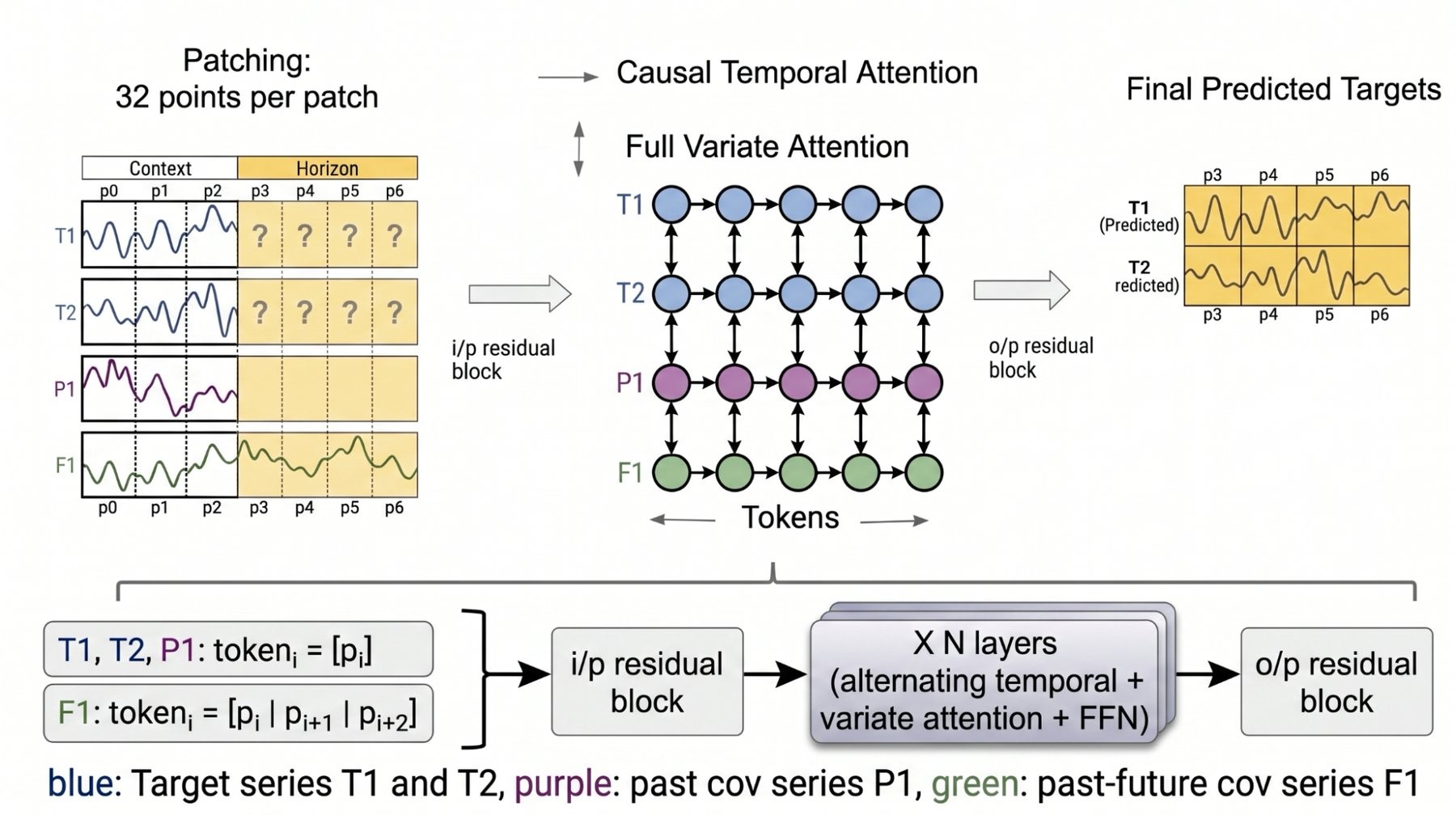
Blue marks the target series, purple a variable known only from historical data, and green a known future event whose tokens already include the upcoming updates
Source: the-decoder.com
Three kinds of side information are supported: several related variables at once, such as sales of different ice cream flavors; factors known only for the past, such as historical store traffic; and events known ahead of time, such as scheduled discounts or a weather forecast. As in earlier models of the family, TimesFM-3 transfers to new tasks with no additional training. Instead of one point estimate, it emits nine values per time step, which is how it expresses the range of possible outcomes and the uncertainty around them.
The other change is how the forecast is produced. Earlier versions built it block by block. Google says that approach was slow, computationally expensive, and prone to accumulating error, since each result depended on the one before it. TimesFM-3 marks every future time step as empty and fills them all in a single pass.
The ice cream case shows what the extra inputs buy. A model with access only to sales history continues the usual weekly pattern and never sees the promotions coming. Given the discount schedule, TimesFM-3 uses past data to estimate the effect on demand and forecasts roughly 20% more units sold on each promotion day.
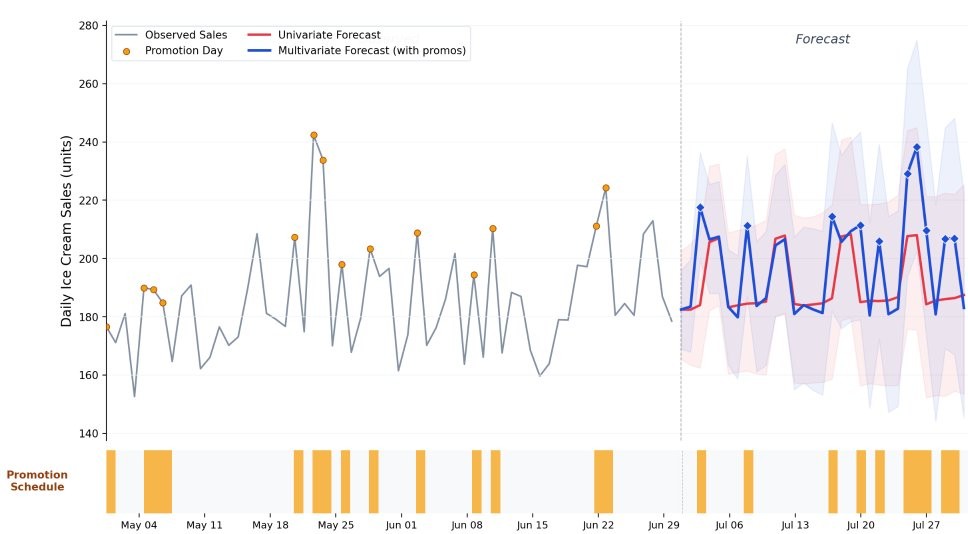
The blue forecast accounts for the discount schedule and expects roughly 20 percent higher sales on the promotion days marked in orange, while the red forecast simply continues the usual weekly pattern
Source: the-decoder.com
On Gift-Eval, FEV-Bench and Time, Google reports TimesFM-3 in first place among all pretrained forecasting models, on point accuracy and on uncertainty calibration. The competitors it names are Amazon's Chronos-2, the Toto-2.0 family, and its own TimesFM-2.5.
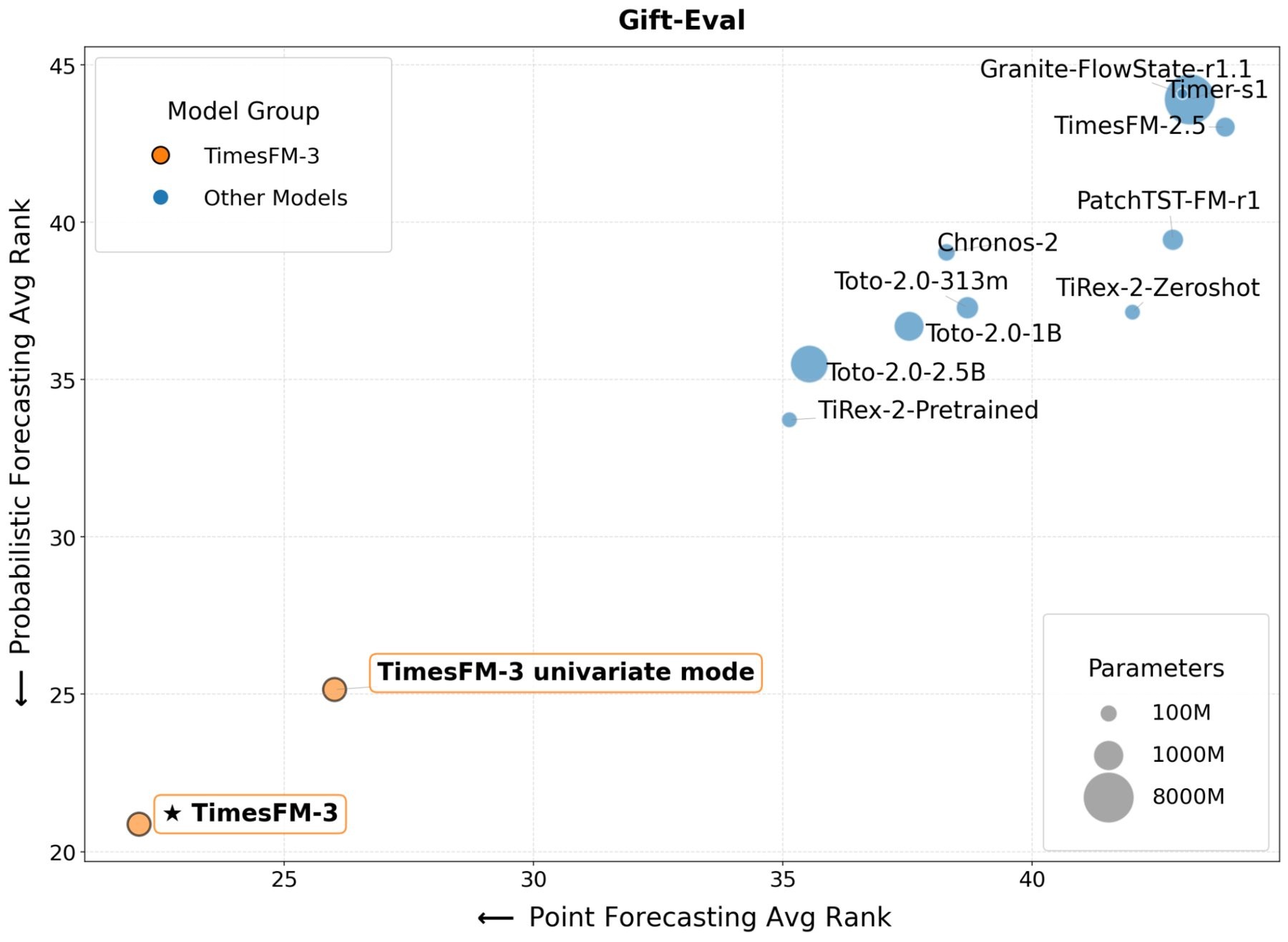
Bottom left is better. TimesFM-3 leads Gift-Eval by a wide margin, even when restricted to a single variable
Source: the-decoder.com
Even restricted to one variable, TimesFM-3 matches or beats the other models. Adding side information widens the gap.
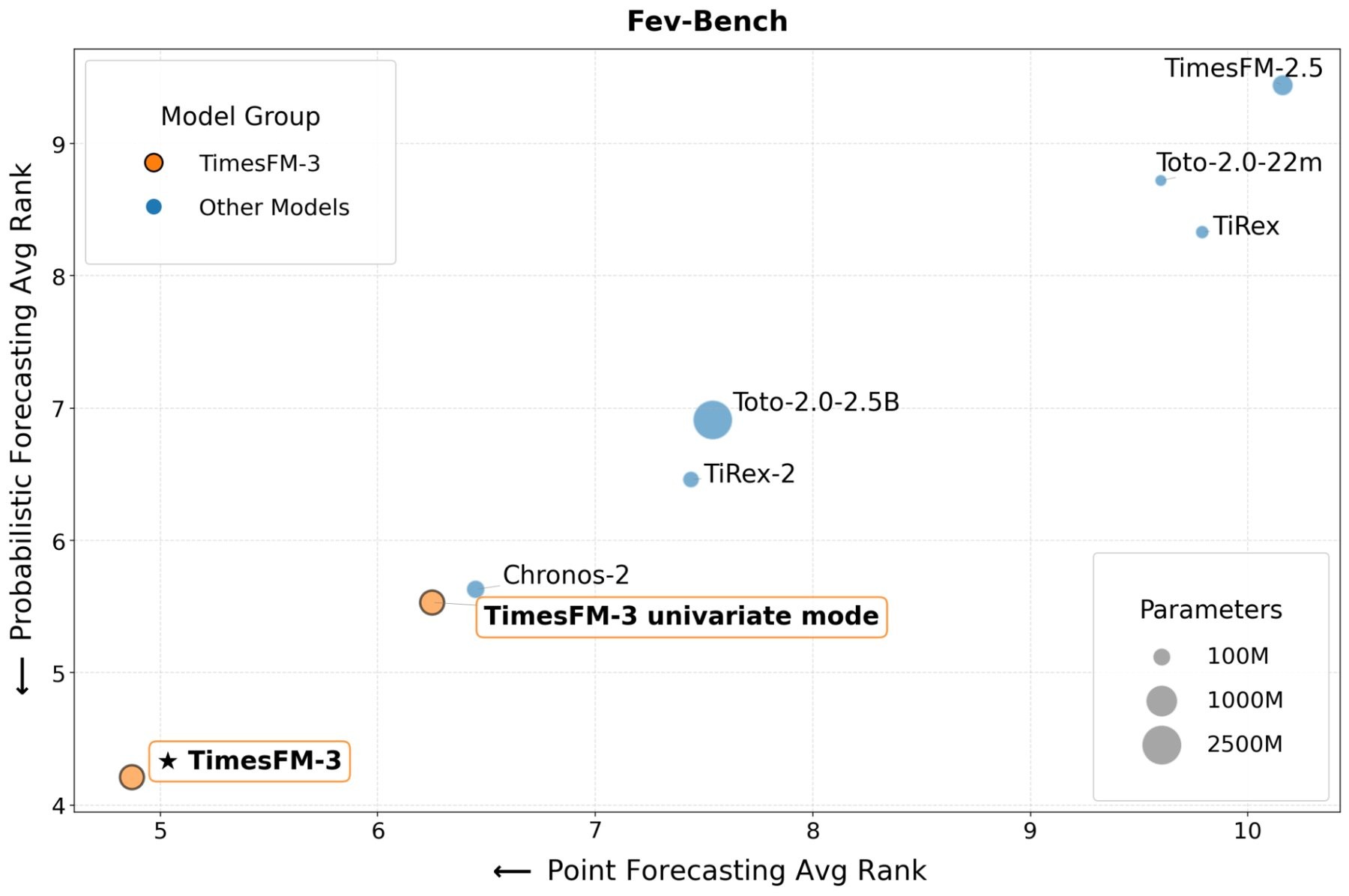
TimesFM-3 also takes first place on FEV-Bench. Amazon's Chronos-2 comes close to TimesFM-3's univariate mode, but falls well short of the full version
Source: the-decoder.com
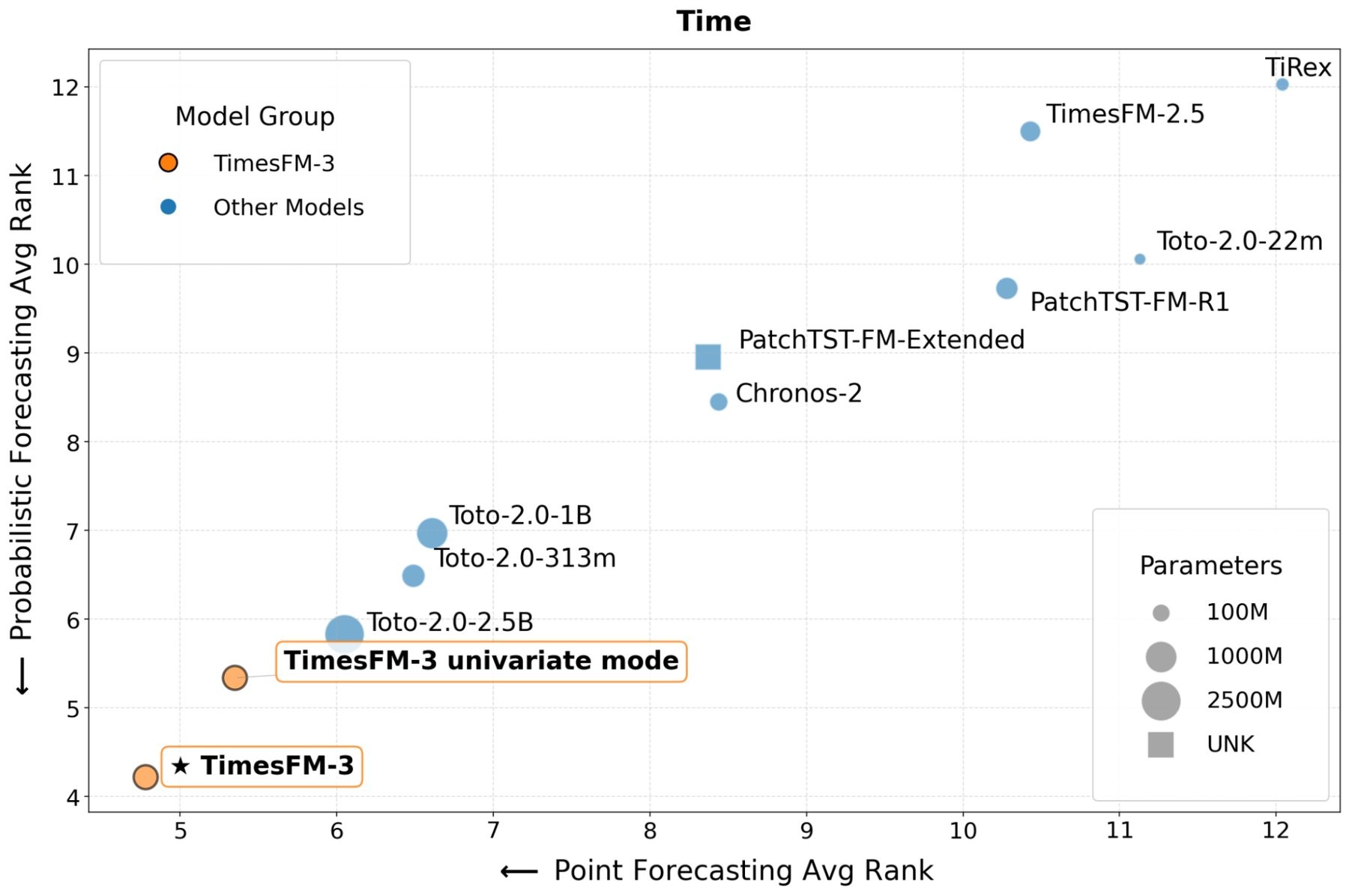
On the Time benchmark TimesFM-3 leads again, followed by the Toto-2.0 family. Its predecessor TimesFM-2.5 trails the rest by a wide margin
Source: the-decoder.com
Two numbers deserve more attention than the benchmark table. The first is 330 million parameters — small, and deliberately so. While language models spent the same period climbing into the hundreds of billions, forecasting stayed in a size range that runs anywhere, which is the entire commercial logic of putting it inside BigQuery rather than behind a metered endpoint. The second is the trillion-plus training points, which is what makes the zero-shot claim work: the model is not fitted to your data, it is fitted to enough other people's data to recognize the shape of yours.
That is also where the announcement is quiet. Every competitor Google names — Chronos-2, Toto-2.0, TimesFM-2.5 — is another pretrained foundation model. The comparison a retail planning team would actually run is different: this model, out of the box, against a conventional forecasting model fitted to that team's own history, which is the incumbent it would replace and the one with a decade of tuning behind it. First place among foundation models establishes that Google is ahead of Amazon. It does not by itself establish that a chain should retire the model it already has. Since its 2024 launch Google says the family has been deployed in retail, finance, industry, healthcare and research, so the internal answer presumably exists; it is not in this release.
Google is pushing the same bet outside time series. In early August, Google DeepMind released WeatherNext Cyclones, an open-source system for forecasting tropical cyclones that predicts storm track and intensity roughly a day further ahead than leading operational models.
The BigQuery line is where this stops being a benchmark story. AI.FORECAST today runs TimesFM-2.5 on one variable at a time; when it switches, multivariate forecasting becomes a SQL command sitting next to the sales table, priced like a query rather than a project. At that point the question is not whether a foundation model beats a bespoke one on Gift-Eval, but whether it beats one badly enough to justify the team that maintains the bespoke one.