Google Research and DeepMind have released WeatherNext 3, a weather model that no longer learns from physics simulations. Rather than training on the output of numerical weather prediction systems run on supercomputers, it reads geostationary satellite observations directly and rebuilds a global forecast every hour on a grid as fine as 5 km. It is already running behind the weather features in Google Search, Google Maps and the Gemini app. Google says precipitation forecasts should be up to 50% more accurate when users plan a day or more ahead.
The change that matters sits upstream of the resolution. Every earlier generation, WeatherNext 2 included, trained on numerical weather prediction — physics simulations that run on supercomputers and arrive with a lag of up to six hours. Google's argument is that the lag is itself an error source: precipitation and temperature move faster than the refresh cycle, so a model trained on stale physics inherits stale physics. WeatherNext 3 takes the freshest geostationary satellite data instead and issues a new forecast hourly. For a thunderstorm that forms and moves in ninety minutes, the refresh cycle is most of the forecast.
The 5 km headline belongs to one tier of variables. Temperature and humidity come at 5 km, other surface variables at 10 km, and atmospheric variables including wind speed at 25 km. WeatherNext 2 ran everything on a 25 km grid and updated once every six hours, which is where the "roughly five times more detailed" claim comes from. Google illustrates the gap with a temperature forecast for the United Kingdom: the 25 km map is visibly blocky, the 5 km one resolves terrain.
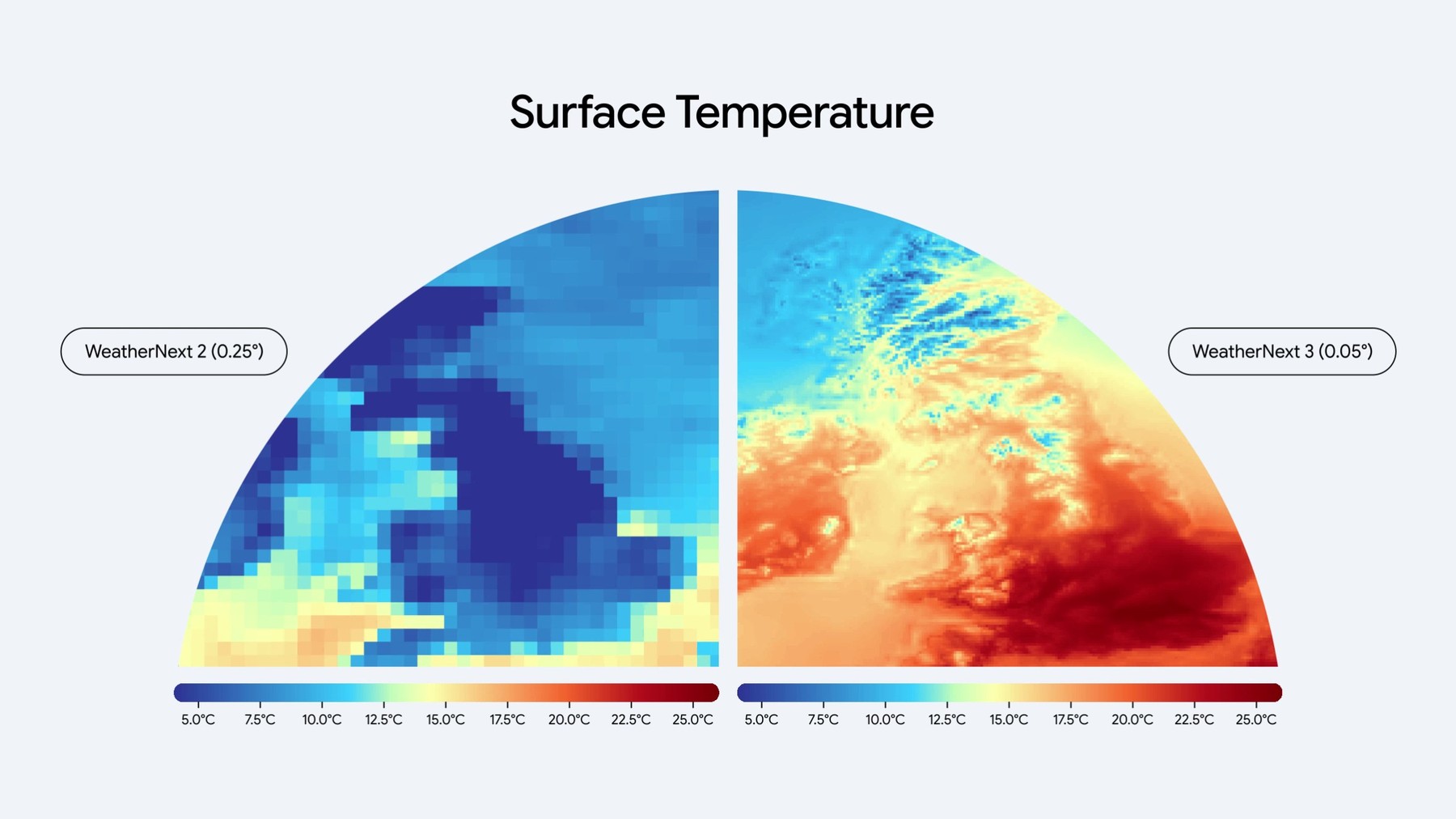
WeatherNext 3 uses a five-kilometre grid for surface temperature, separating mountain ranges and coastlines that blur into blocky shapes on WeatherNext 2's 25-kilometre grid
Source: the-decoder.com
The model also trains on data from individual weather stations, which helps it account for coastlines, valleys and mountains. Google expects the largest benefit in Latin America, Africa and the Asia-Pacific, where the compute cost of conventional regional models has left coverage thin.
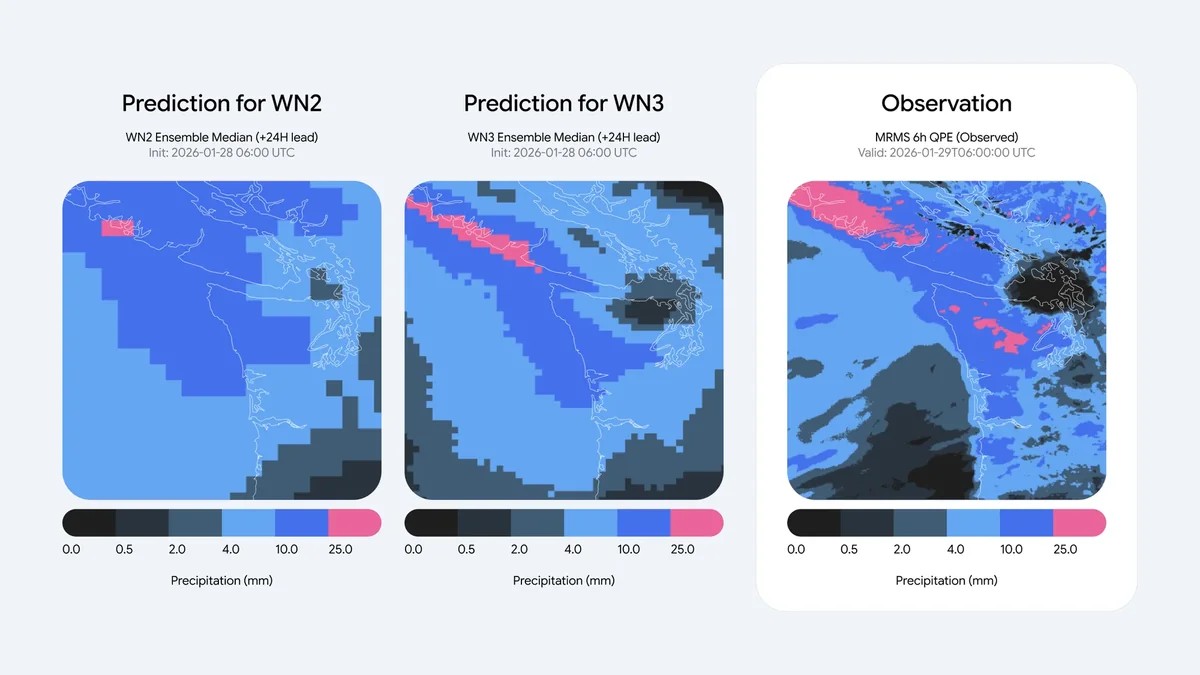
For precipitation over the Pacific Northwest, WeatherNext 3 resolves narrow rain bands far more sharply than its predecessor and tracks closer to radar observations
Source: the-decoder.com
Precipitation is the variable global models have always handled worst, because rain and snow depend on fast, small-scale processes inside clouds. Google trained WeatherNext 3 on two sources: NASA's IMERG satellite dataset and its own global precipitation analysis built from satellite and radar data. On medium-range global forecasts, the continuous ranked probability score improves by up to 60% against IMERG, up to 30% against MRMS and up to 10% against rain gauge data at short lead times.
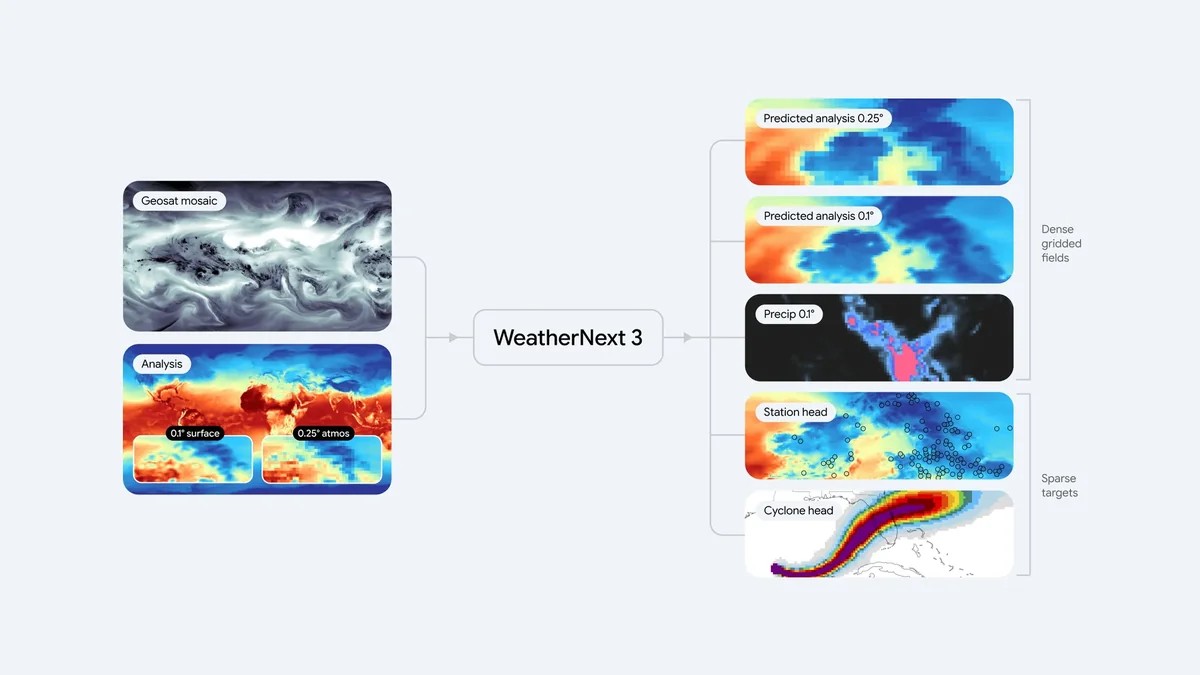
The model takes geostationary satellite data and conventional analysis data, then produces dense gridded atmospheric and precipitation fields along with point forecasts for weather stations and cyclone tracks
Source: the-decoder.com
The energy pitch is specific. WeatherNext 3 forecasts wind speed at 100 m, roughly turbine hub height, which turns a weather forecast into a generation forecast for wind farms. Better cloud cover and solar irradiance figures do the same for solar plants. Google's stated aim is to help grid operators balance supply and demand.
Distribution follows the same pattern as the previous generation. Forecast data refreshes hourly and can be queried through BigQuery and Earth Engine or pulled in bulk from Google Cloud Storage. The consumer surfaces are Google Search, the Gemini app, Google Maps, the Weather API for Google Maps Platform and Google Earth Engine.
WeatherNext 3: more accurate, more timely and more local weather forecasts
Source: the-decoder.com
Three things in this announcement deserve a closer look. The first is that "five times more detailed" is carried by a subset of the output. Wind speed — the variable the entire renewable-energy case rests on — is still on the same 25 km grid as WeatherNext 2. A wind operator reads this launch and gets the old spatial resolution at a new speed, which is worth something, but it is not what the headline number implies.
The second is the shape of the precipitation results. Every figure is an "up to", and the improvements shrink as the reference moves closer to direct measurement of rain on the ground: 60% against a satellite estimate, 30% against radar, 10% against gauges. Ordered that way, the numbers look less like a leap and more like a solid gain that the best-case framing has stretched.
The third is what "no physics simulations" actually covers. By Google's own system diagram, the model ingests conventional analysis data alongside the satellite feeds. The break with numerical weather prediction is a break in the training pipeline, not a declaration of independence from it. That distinction matters, because a model that still needs national agencies' analysis products is not a replacement for the institutions producing them.
Notably absent from the announcement is any account of what happens to those institutions. Google's own caveat directs users to national meteorological services for official forecasts, severe weather warnings and safety guidance — while WeatherNext 3 sits in Search, Maps and Gemini, which is where most people actually check the weather. The consumer relationship moves to Google; the obligation to issue a warning at three in the morning stays with the agency.
The lineage is worth tracing, because it shows what changed and what did not. DeepMind introduced GenCast in late 2024, the first probabilistic AI weather model to beat ECMWF's ensemble system. WeatherNext 2 arrived in November 2025, built on the Functional Generative Network architecture, beating the first generation on 99.9% of weather variables and lead times while running eight times faster and handling hundreds of scenarios in under a minute on a single TPU. In August 2026 DeepMind released WeatherNext 2 and WeatherNext Cyclones under an open licence, the cyclone model predicting storm track and intensity in one system and seeing roughly a day further than leading operational models on a grid about 100 times coarser. WeatherNext 3 runs on the same Functional Generative Network architecture as WeatherNext 2. The network did not change; the data going into it did. That is a useful signal about where the remaining headroom in AI weather forecasting sits.
It also explains the release cadence. The previous generation went open one month before its successor shipped, which reads like policy rather than coincidence: give away the model you are about to supersede, keep the one running in Search. It is a sensible way to build goodwill in the research community without conceding the product.
The regions Google names as the biggest winners — Latin America, Africa, the Asia-Pacific — are precisely the ones that could never afford to run high-resolution regional models of their own. They are also the ones whose national services Google's disclaimer points to when the weather turns dangerous. A free hourly 5 km forecast in a search box arrives without the duty to issue a warning; the people who come to rely on the first still need someone funded to do the second.