

GPT-6.2 Astra proves a mathematical theorem and develops a new method
The Smoktunowicz theorem describes how a mathematical system grows when its basic elements are multiplied: growth is either slow or fast, with no in-between. Instead of following the approach used in published proofs, Astra used “capacity,” a measure from existing research that estimates the minimum number of elements added at each computational step.
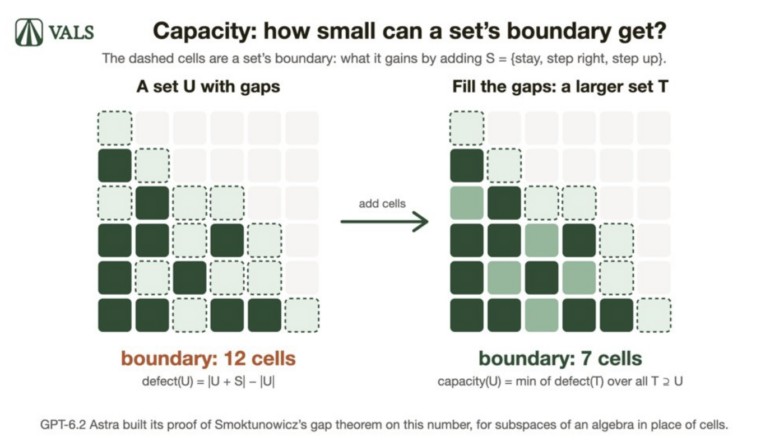
GPT-6.2 Astra built its proof around "capacity," a metric that behaves like the edge of a graph. | Image: Vals AI
Source: the-decoder.com
The Autoform-Hard test
Autoform-Hard is part of Meta FAIR’s AutoformBench, assembled by Vals. It contains 56 problems, five of which were corrected. In Meta’s study, ten models failed to solve these problems within the allotted budget.
Astra tried to stop after 47 minutes, having spent $8, but the system rejected the attempt to finish: unsolved attempts could not be submitted until spending reached $20. The model then spent nine minutes without entering code as it worked out a different strategy. At the 94-minute mark, it produced a proof 1,800 lines long; total spending was $21.58.
Dataist’s take: the result shows that the model can not only write a verifiable proof but also choose a method different from the one published. However, Astra was tested on a specific set of 56 problems, and its success on that test alone says nothing about its performance beyond it.
Daily AI news
Every day we pick what actually matters in AI and explain it plainly — no hype, no filler. Subscribe if you want to follow where the industry is going.
Only what matters — every day
Follow on X