
GPT-6 Astra helps advance a longstanding problem in particle physics
Why the Standard Model is hard to put on a lattice
Physicists use computer lattices to model parts of the Standard Model. This approach has already made it possible, for example, to calculate the proton’s mass from first principles. But applying it to the entire theory had remained out of reach.
The problem involves the weak interaction, which governs some types of radioactive decay. It acts differently on left-handed and right-handed particles. On simple lattices, this asymmetry gives rise to unwanted ghost particles.
Special lattice particles called overlap fermions can help eliminate them. But for more than 25 years, physicists had been unable to set the phase correctly for this approach.
How GPT-6 Astra helped with the proof
Craig, a physicist at the University of California, Santa Barbara and a visiting researcher at OpenAI, proposed correcting the phase by comparing lattices with progressively smaller spacing. He could not prove that the method worked in all the required cases.
GPT-6 Astra turned the idea into a working construction and handled most of the detailed proof. It was checked by lattice field theory experts Maarten Golterman, Andreas Kronfeld, and Yigal Shamir. They raised questions that, Craig says, helped strengthen confidence in the result.
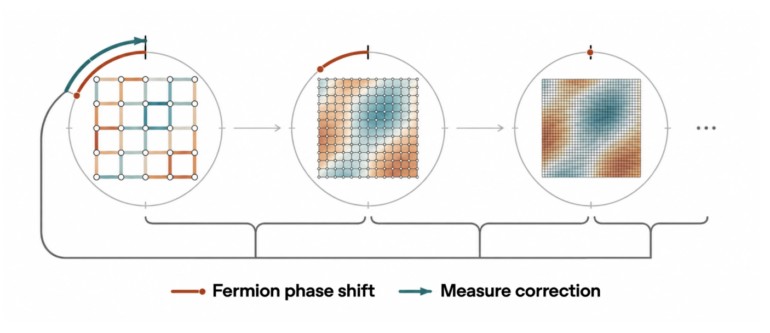
The diagram shows how comparing increasingly finer lattices helps correct the phase shift on the original lattice. | Image: Nathaniel Craig / GPT-6 Astra
Source: the-decoder.com
Craig sees the work as a beginning rather than the end of the research. Much remains to be done before realistic simulations are possible.
Other AI advances in mathematics
The new result comes amid a series of AI advances in mathematics that began in January 2026.
In May, OpenAI’s disproof of the Erdős unit-distance conjecture became the first AI proof deemed worthy of a leading mathematics journal. A few days later, Google DeepMind’s AlphaProof Nexus solved nine of 353 open Erdős problems, spending a few hundred dollars in the process. By October, the system’s results had passed peer review.
The most sweeping claim came in September, when OpenAI presented a 166-page proof for the existence and smoothness of solutions to the Navier–Stokes equations, a Millennium Prize Problem. The Clay Mathematics Institute said the problem appeared to have been solved. The proof is still being checked, and mathematicians question whether OpenAI fully understands its own solution. The mathematics community remains divided on the latest AI advances.
Dataist’s take: GPT-6 Astra’s result shows how AI can contribute to rigorous mathematical proofs, but it does not by itself mean that the full Standard Model can now be realistically simulated on a lattice. Experts checked the proof, but the work continues, and doubts about AI’s understanding of its own solutions remain.
Daily AI news
Every day we pick what actually matters in AI and explain it plainly — no hype, no filler. Subscribe if you want to follow where the industry is going.
Only what matters — every day
Follow on X