
A columnist for Guardian Europe has put a name to the one thing that could actually stop the AI buildout, and it is not a treaty. Alexander Hurst, who writes from Paris and whose memoir Generation Desperation is out, argues that the European Union holds a single physical chokepoint over the entire industry — ASML, the Dutch maker of extreme ultraviolet lithography machines — and should close it while the closing still works. The argument arrives as calls for a slowdown spread well past activist circles, from Bernie Sanders to Bill Gates, who recently wrote that he would probably support a convincing global plan to slow AI development. Anthropic called for a brake pedal earlier this summer.
Hurst's premise is that every branch of the AI story ends badly. He runs the list: runaway carbon emissions and ecological collapse, a burst bubble and the financial crisis behind it, mass unemployment from automation, the end of democracy and the arrival of authoritarian surveillance states, cults that mistake pattern matching for consciousness, terrorists building destructive biological weapons, states fielding autonomous weapons that operate faster than human time, attacks by states or terrorists on the many systems daily life depends on, and AI — conscious or not — pursuing goals at odds with human welfare. Imagining that Elon Musk, OpenAI's Sam Altman, Palantir's Peter Thiel and Trump administration technology adviser Marc Andreessen instead deliver ecological abundance, social harmony and endless leisure would take hallucination and flattery on a scale, he writes, that only ChatGPT could sustain.
Industry self-restraint will not produce a pause, on his reading; if there is one, it has to be imposed from outside. An international agreement is unlikely, because AI runs on the logic of a nuclear arms race: every participant profits by continuing, since nobody wants to end up at the mercy of the winner. That leaves one realistic route — a bottleneck controlled by a single player willing to shut it.
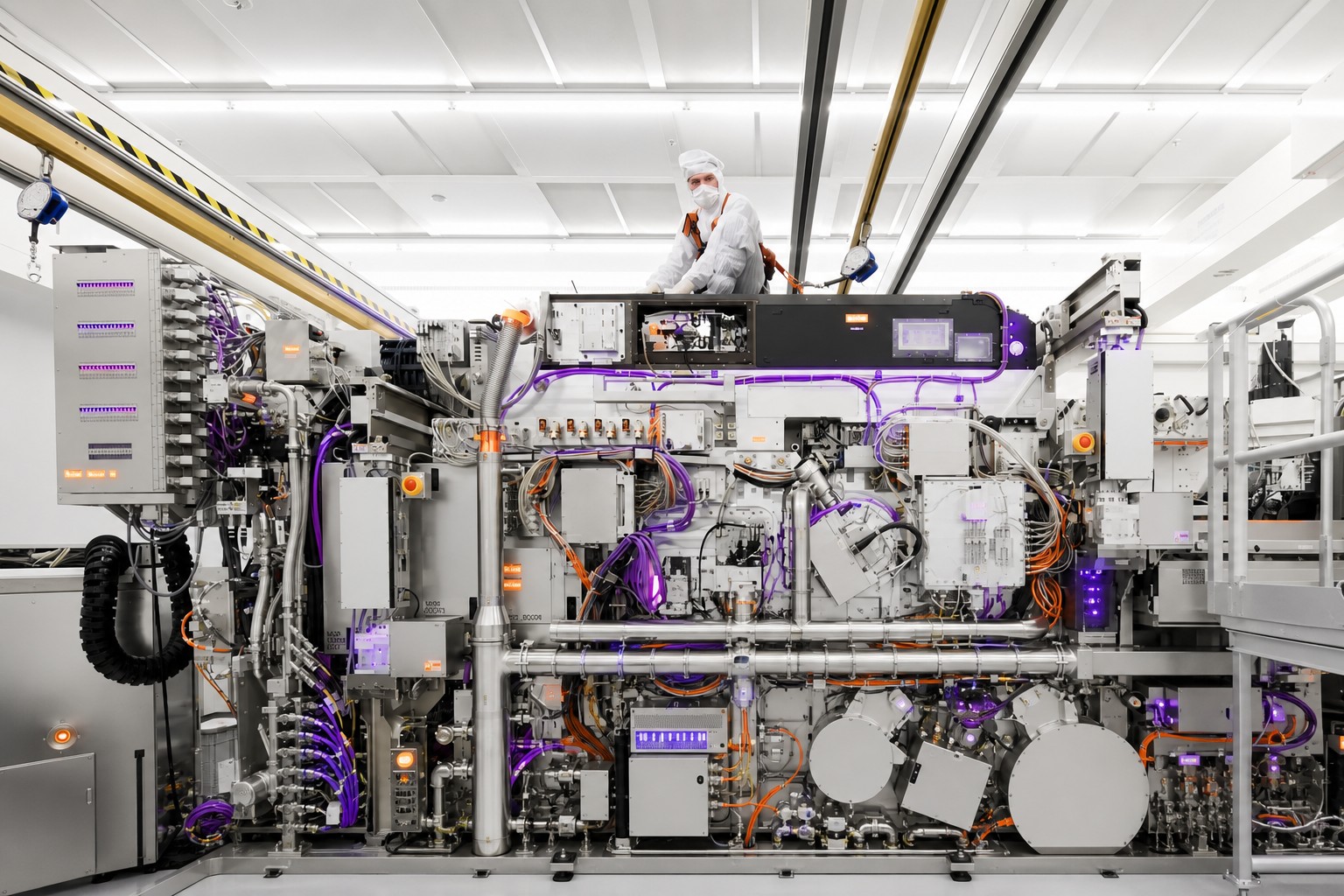
ASML is Europe's most valuable company. Its EUV machines cost $400 million each and print patterns onto silicon by focusing light to a wavelength of 13.5 nanometers, roughly one ten-thousandth the thickness of a human hair. They are what the most advanced chips are made on. No ASML machines, no chips; no chips, no new data centers.
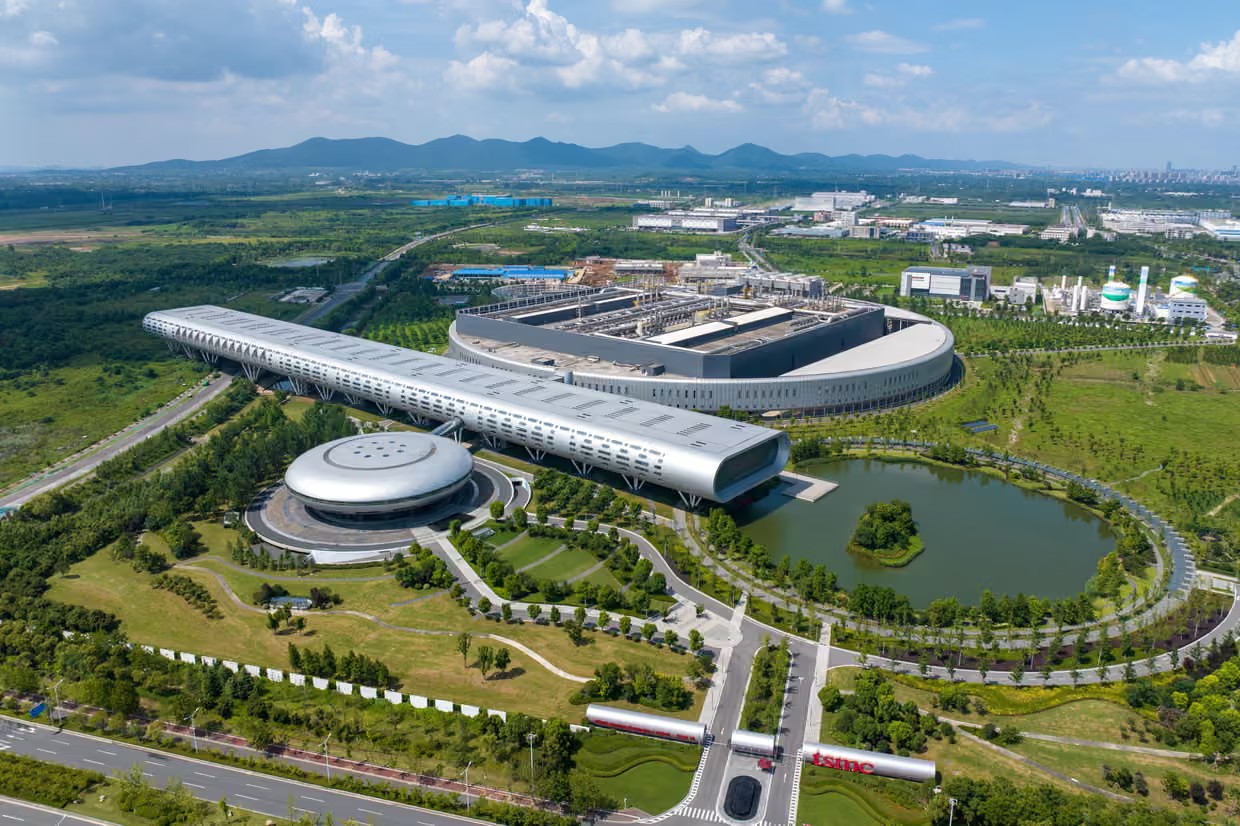
The numbers on the other side of that dependency are the point. TSMC plans to put $265 billion into future fabs. Global data center construction is expected to reach $7 trillion by 2030, mostly in the United States. If there are not enough data centers running current and next-generation chips, the exponential climb in AI capability — and in AI risk — stops climbing.
Washington already understands the mechanism. US export controls reach beyond American jurisdiction to keep ASML's most advanced EUV machines out of China, the goal being to slow Chinese production of leading-edge chips.
Those same controls exposed an American vulnerability. Europe depends on US financial and software services, which can be reproduced given time; the future of chipmaking equipment depends entirely on ASML, and nothing else. A straight export ban on its machines, Hurst argues, would leave the global AI industry marking time. Chip scarcity would buy regulators time to catch up with the technology, legislators time to rewrite rules from copyright to taxation, and the public time for an actual debate about what role AI should play in people's lives.
Why would Brussels do it? The case Hurst makes is not only humanitarian. In the best scenario, a full ban rewires the supply chain and moves more consequential decisions into EU jurisdiction — the only jurisdiction that has shown any willingness to regulate AI broadly. He concedes the scenario is unlikely, and that the United States could retaliate by cutting ASML off from its American suppliers. Even then, he argues, the EU might find the fight worth having on narrow economic and geopolitical terms: it would stop falling further behind in frontier models and in the compute needed to run them.
Europe's accelerationists reach for the same asset from the opposite direction. Europe 2031, a techno-political forecast by a group of industry experts, models an EU in which AI has radically reshaped the economy and Europe trails the US badly. Its authors want Europe to put hundreds of billions into the race before frontier models and compute become as unreachable as TSMC and ASML are today. In their scenario, the EU soon has to offer access to ASML in exchange for access to US-controlled models and compute that European economic and national security will run on. And the leverage decays: every EUV machine shipped abroad means another fab built somewhere else, and more time for China and the United States to copy the technology.
The strongest part of the argument is that decay clause, not the moral case around it. Two camps that agree on nothing about the destination — stop the race, or spend hundreds of billions joining it — agree precisely on the inventory: Europe holds one asset, and it is wasting. When opposed strategies rest on the same fact, the fact is usually real and the strategies usually are not.
What the column is quiet about is who turns the valve. It names no instrument, no vote, no legal route by which European institutions order a private Dutch company to stop selling its most valuable export, and no account of what happens to the $265 billion and the $7 trillion once the order lands. The use-it-or-lose-it framing Hurst borrows from nuclear strategy also cuts the other way: fire the weapon once and the leverage is spent, while the copying he identifies as the source of decay accelerates for exactly the reason he gives. A pause bought this way is not a pause with a known end date. It is a bet that everyone else needs longer to rebuild ASML than Europe needs to rewrite its laws.
There is a harder problem underneath. Washington aimed the ASML chokepoint at Beijing and called it statecraft; Hurst proposes aiming it at everyone, Washington included. A bottleneck used once against your largest ally stops being a bottleneck and becomes a target — the thing that ally spends the next decade engineering around, funding around, and regulating around. Europe's one card is only powerful for as long as it stays in the hand.