
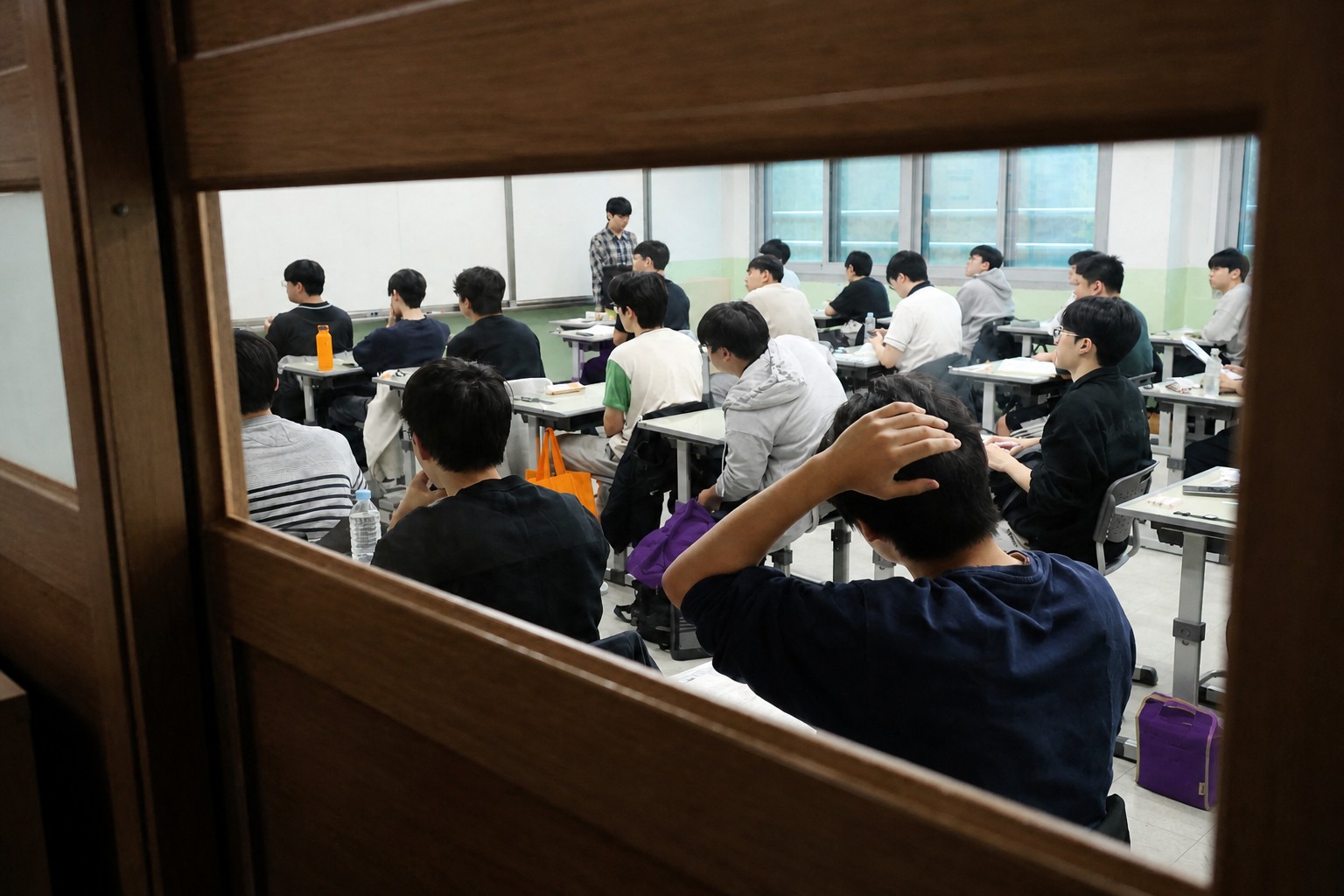
AI puts the role of exams in South Korea under scrutiny
Yoon Jeong-hoo came second in the national tax accountant exam. After accusations appeared online that the top candidates had used AI glasses, the 25-year-old Yoon posted a 22-minute video about his preparation: he showed a tax law textbook, described tutors and lectures he watched until 3 a.m., and solved a corporate taxation problem without preparation. He said he first wore the glasses to a job interview because he was afraid he would look too young.
Other candidates who passed also posted evidence of their preparation: photos of used pen refills and marked-up textbooks. One candidate added that she had laser eye surgery two years before the exam, anticipating possible suspicions that she had used smart glasses. Yoon wrote that he thought it was unfair to devalue the effort of people who had prepared for or passed the exams, and asked people to stop spreading unsubstantiated accusations.

An example of an alert sent out to all phones in South Korea on 19 November as a way to prevent cheating. Some older phones interpreted it as a war alert. Photograph: Raphael Rashid/The Guardian
Source: theguardian.com
An exam as a lifelong wager
Suspicions of cheating have long followed South Korean exams, but new AI capabilities have made the problem worse. President Lee Jae-myung promised to pay at least 100 million won ($74,000) for information that helps uncover cheating. Education Minister Choi Kyo-jin resigned on Sunday after disruptions caused by rule changes ahead of the university entrance exam.
Sangchin Chung, a sociology professor at Sogang University, says the pressure is so high because a single test affects future income and social recognition. As a result, people try to achieve high scores by any means, he said, and exams have become a mythologized “last bastion of fairness.”
This month, a man who earned a perfect score on a recent national law school entrance exam was accused of using AI. He had planned to answer some university entrance exam questions in public, but did not attend the event last week. He was later found dead in a motel in Seoul. The accusations against him were not proven.
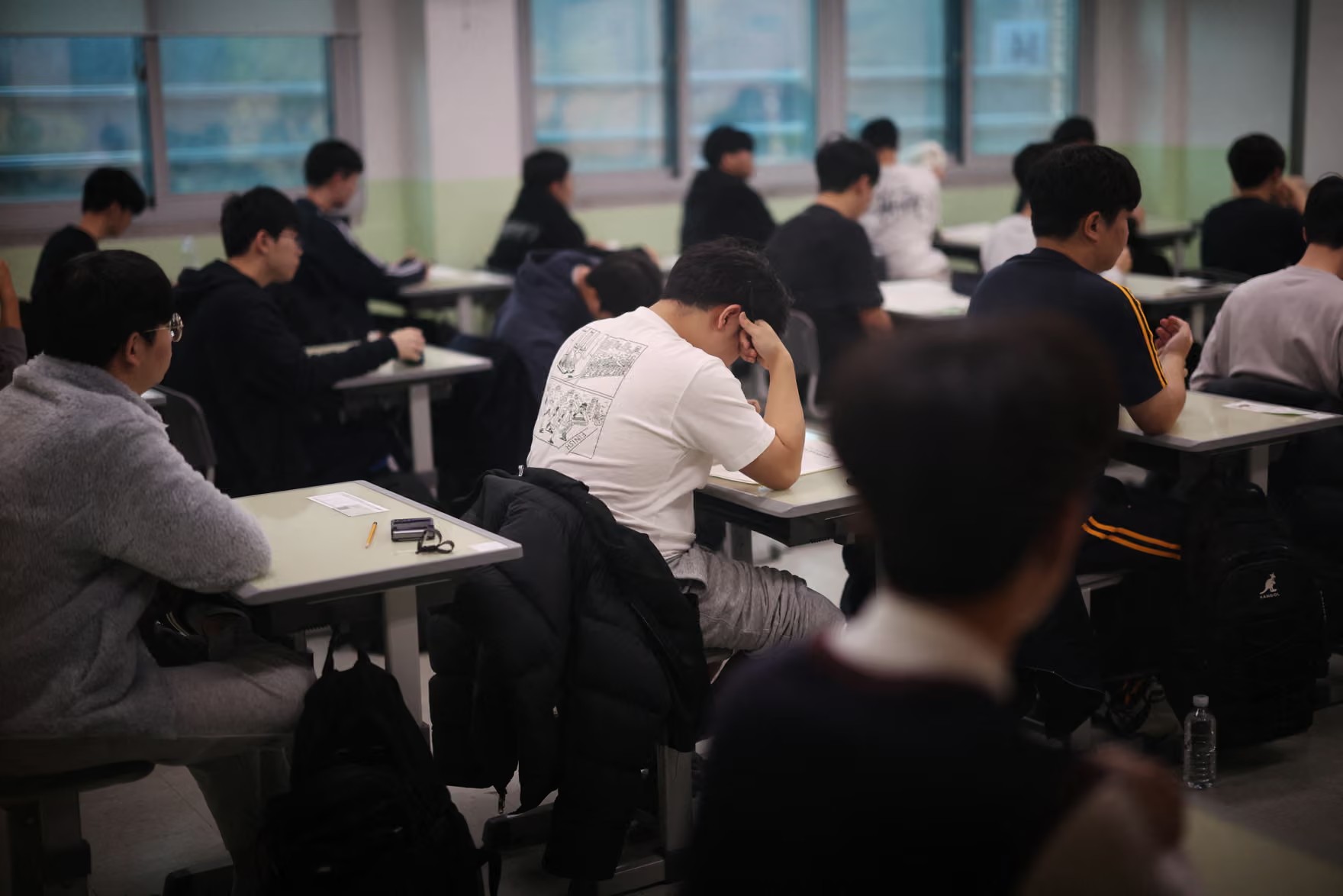
Student wait for the start of the annual university entrance examinations at an exam hall in Seoul. Photograph: Kim Hong-Ji/AFP/Getty Images
Source: theguardian.com
Sociologist Kim Dong-choon, author of a study of South Korean meritocracy, says the exam system’s roots lie in part in the economic instability that followed the 1997 Asian financial crisis. Family wealth and connections had long helped people advance in society, but as secure jobs became harder to find, exams came to be seen as a way to distribute limited opportunities. There was no other process that seemed fair.
In 2019, then Justice Minister Cho Kuk became the focus of a scandal over falsified educational documents intended to help his children get into prestigious schools and universities. He was later sent to prison. After the scandal, exams were again seen as a way to level the playing field: the government required major universities in Seoul to allocate at least 40% of places based on entrance test results.
Kookmin University sociology professor Choi Han-sup told Yonhap that South Korea had become a society where the strongest survive. It is harsh toward those who fall just short of the required result, and teaches people to believe that doing well on a university entrance exam or civil service test is the only way to survive.
To ensure that preparation for essay questions does not give wealthy families an advantage, the university entrance exam consists almost entirely of multiple-choice questions and is machine-graded. It has no essays, interviews or coursework. The exam is considered the great equalizer: everyone answers the same questions at the same time, without giving their names.
The format is falling behind AI’s capabilities
Critics have long argued that the exam format itself creates a problem. In August, Cha Jeong-in, chair of the National Education Commission, said multiple-choice tests had exhausted their potential and that essay grading had become inevitable. The commission could not reach agreement, and the plan was postponed. Changes to the university entrance exam are already under way and are due to be completed by 2028, but the multiple-choice format will remain.
Chung says a system built on memorization and problem-solving cannot keep up with the AI technologies available to candidates. Cheating has spread in the gap that has opened up. So far, he said, discussion of possible measures has focused either on tighter surveillance and harsher penalties or on modernizing the system through computer-based testing. At the same time, faith in meritocracy remains strong, as does the belief that the “exam republic” is still the best system available.
Park Do-sun, who led the development of the university entrance exam and became the first head of the organization that administers it, now questions its purpose. In an interview with Hankook Ilbo, he said he saw no reason to make people take this kind of exam if AI could provide an answer immediately.
Dataist’s take: An exam system needs to be a common measure for everyone while testing skills that AI cannot reduce to a ready-made answer. But the measures under discussion still focus on monitoring, penalties and a shift to computer-based testing, while the university entrance exam format will remain unchanged through 2028.
Daily AI news
Every day we pick what actually matters in AI and explain it plainly — no hype, no filler. Subscribe if you want to follow where the industry is going.
Only what matters — every day
Follow on X