
Robots and rescuers compete to triage casualties
How the competition works
DARPA is holding the Triage Challenge for the third year. Its goal is to test how robots, drones and machine-learning algorithms can help rescuers find casualties and determine the order in which they should receive medical care. The competition continues the agency’s series of large-scale trials designed to accelerate the development and testing of new technologies.
Triage is needed when medical teams are working with limited time and resources. Some casualties need only a tourniquet; others require evacuation and surgery. A third group can wait: their injuries are not life-threatening, or are so severe that helping others would do more good. Amid rubble and confusion, it can be difficult to quickly determine who needs what.
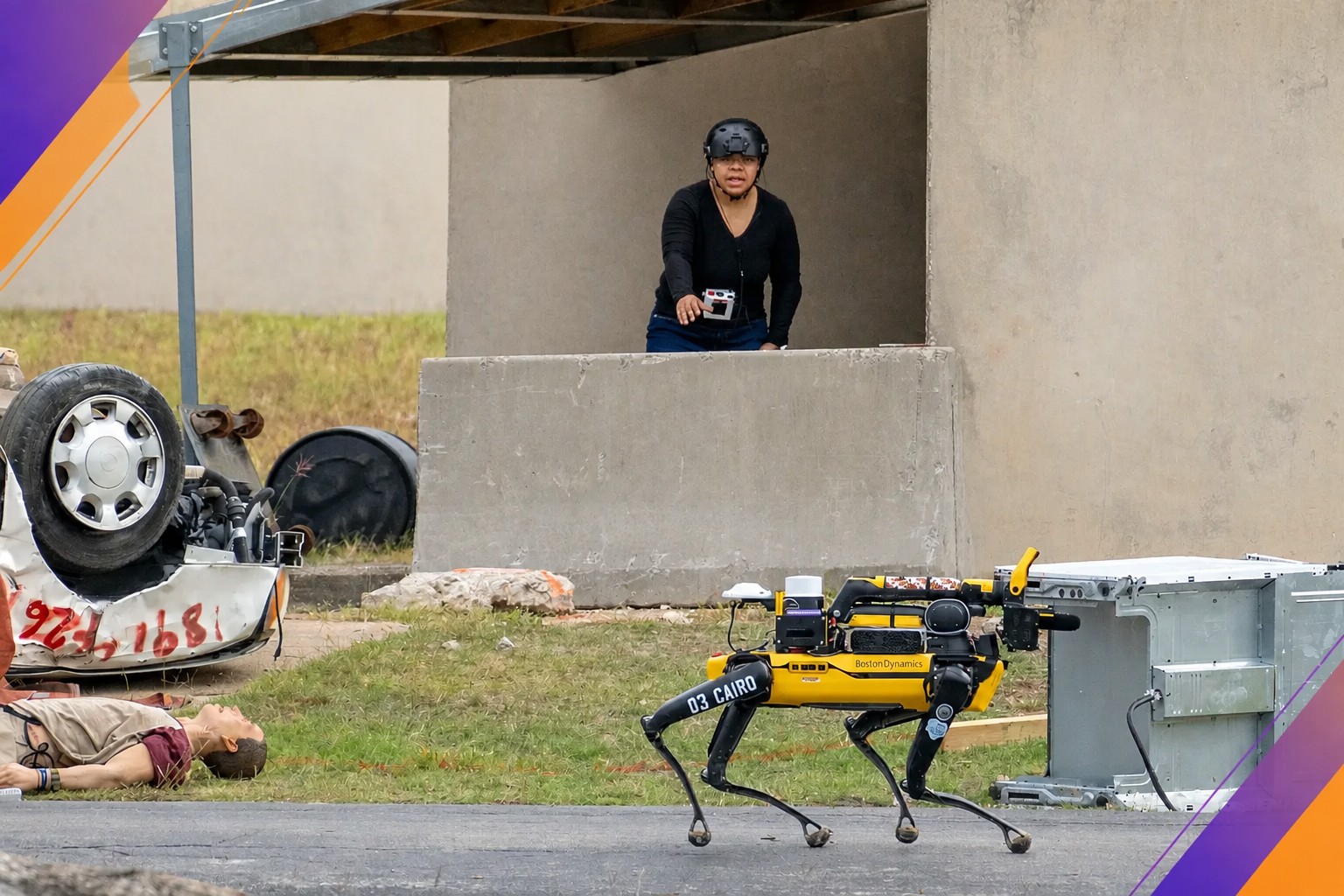
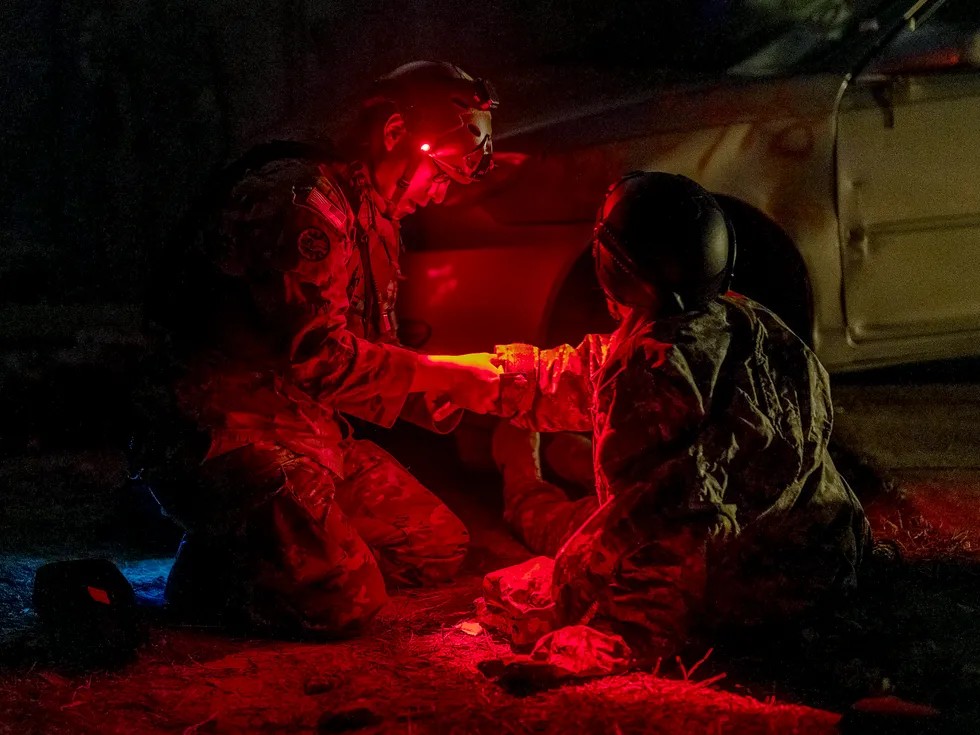
The trials took place in settings resembling real disasters, including a tornado-damaged market and a nighttime attack on a military base. Gabriela Garcia D’Olagaray, associate medical director for emergency preparedness at Massachusetts General Hospital and Brigham and Women’s Hospital in Boston, said searching for people at a disaster site can be dangerous, while deploying a large number of rescuers takes time.
The competition is led by Jeremy Pamplin, an intensive care physician and retired colonel who served in the US Army for 28 years. He took charge of the trials in May 2025. Pamplin wanted technology to reduce the uncertainty medics face after mass-casualty incidents — uncertainty that some of his acquaintances still recall in the middle of the night.
The trials grew more challenging over time. In the first year, teams worked at a site simulating an attack on a convoy, while participants were confined to protective shelters so they would not accidentally collide with robots. In the second year, organizers added a full-size aircraft fuselage and staged a crash with dozens of casualties. They learned to recreate not only the conditions of a disaster but also signs of injury, including warm blood. To find out how blood cools, Pamplin’s team studied it with thermal cameras at a slaughterhouse. During the competition, they simulated the effect by heating water in a coffee maker and pouring it near a body. This let teams detect bleeding even at night.
Source: spectrum.ieee.org
Sam Kolachis, a biomedical engineer at Battelle, a nonprofit applied science and technology organization in Columbus, Ohio, led team DART, short for Drone-Assisted Rapid Triage. He said the organizers kept adding unexpected challenges.
The trials require expertise from different fields, said Derek Paly, a professor of aerospace engineering and head of the RoboScout team at the University of Maryland. Before 2022, his lab knew how to develop autonomous navigation and algorithms but had little knowledge of trauma medicine. Paly brought in emergency medicine specialists. RoboScout placed third in its first year and second last year.
Each year, teams went through four preliminary trials:
The four best teams advanced to the semifinals, where robots worked alongside two medics in simulated emergencies. After four trials involving people and machines, the two highest-scoring teams advanced to the final 25-minute round.
What systems the teams brought
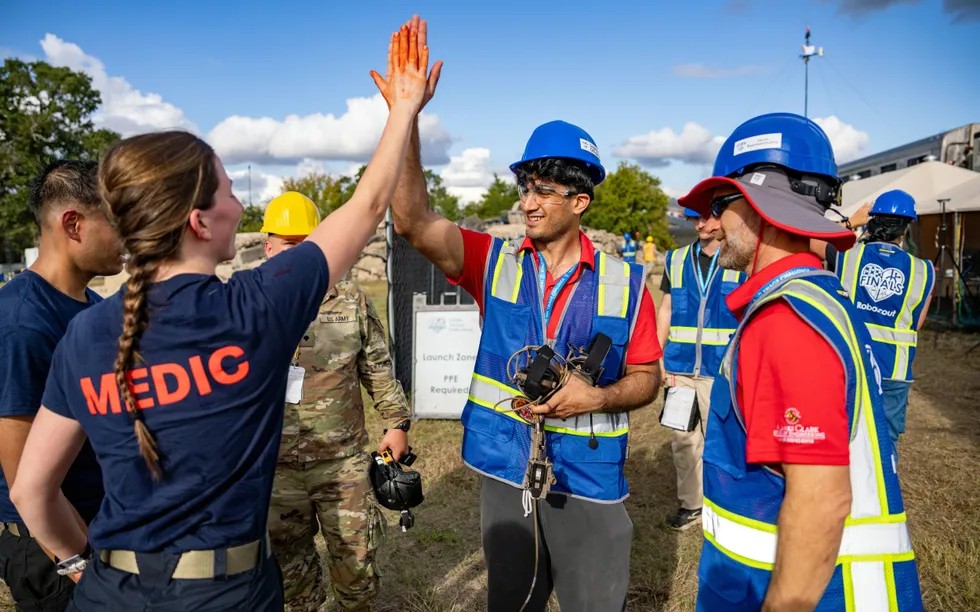
Teams knew almost nothing in advance about the details of the site. A student team from the Delhi Technological University paid for its own trip from India and brought 22 suitcases of homemade drones and wheeled robots. Once they arrived, the students found broken motors and chassis, camera parts and missing propellers. Nishant Chandna of the Unmanned Aerial Systems team said they were assembling their machines right up until the competition began, and considered that part of the challenge.
Most teams used both ground robots and drones. The Indian students equipped their machines with cameras and lidar to search for simulated casualties.
Wheeled robots are stable, cheaper and easier to control than legged ones, but they struggle with stairs, thresholds and rubble. Eric Eaton, a machine-learning specialist and head of the University of Pennsylvania team, said his team started with drones and wheeled robots, then added Boston Dynamics’ four-legged Spot robots. They could climb stairs.
RoboScout focused on assessing the scene from the ground. Its Spot robots, which the team called “dogs,” picked up the cries of casualties and measured vital signs. This is one of the difficult tasks in autonomous triage: millimeter-wave radar detects subtle movements associated with a pulse, while a thermal camera estimates breathing rate from temperature changes near the mouth and nose.
Battelle’s team, by contrast, relied only on drones, including for measuring vital signs. Kolachis said it combined data from thermal, radar and conventional cameras. This approach earned Battelle the win in the competition’s first two years. RoboScout members joked that Battelle’s team promised to bring a ground robot every time, but kept showing up with drones.
Source: spectrum.ieee.org
The final and the results
More than 500 actors played casualties in the final. DARPA selected them to make measuring vital signs more difficult than in previous years. Students raised their pulse and breathing rates by exercising on stationary bikes to simulate shock. Endurance athletes, by contrast, lowered their pulse to portray other conditions, such as an obstructed airway.
In the military-base scenario, soldiers ran across the site to the sound of sirens. Pamplin said some explosions made the medics react: they put people on the ground to protect them from possible impacts.
This time, Battelle did bring a ground robot to measure vital signs remotely, but took second place. The top prize and $1.5 million went to RoboScout from the University of Maryland.
Errors in the competition timer and Wi-Fi delayed RoboScout’s start in the final. The team made up ground in the section where people worked alongside robots. Paly said the team hit its stride at the right moment and that the result felt unreal to him.
Other participants also had to fix technical problems. Carnegie Mellon’s Chiron team ran into a GPS error; after resolving it, they got back into the competition and narrowly missed the final. Students from the Delhi Technological University did not meet the required threshold for autonomous control, but achieved the best result in one of the individual trials and won $300,000.
Peter Fisher, medical director of the trauma department at Washington Regional Medical Center in Fayetteville, Arkansas, noted that during mass-casualty incidents, it is difficult for medics to quickly identify the most seriously injured patients. In trauma care, it is important not only to treat them promptly but also to get them to the right place.
Fisher was also interested in a separate part of the competition, in which two new teams successfully used AI agents to predict who needed urgent care. He suggested that robotics and algorithms could be connected to additional hospital data. Triage algorithms could then recommend where to take casualties, helping prevent individual medical facilities from becoming overwhelmed.
The work will continue after the competition: several participants told IEEE Spectrum they want to apply the algorithms they developed in trauma departments, during regional emergencies and in responses to chemical weapons.
Pamplin wanted to compare robots with medics working without them. In daytime scenarios, teams made up only of people found an average of 50% of the casualties. In one trial at the same site, medics working with robots from Maryland found everyone. In the final, medics provided lifesaving care to 25% of simulated casualties who needed it, while RoboScout did so for 74%.
Dataist’s take: The results show that robots can help with two tasks at once: finding casualties and more quickly identifying who needs help. But the competition took place in simulated conditions, and participants are only planning to bring their algorithms into hospitals and other emergency situations.
Daily AI news
Every day we pick what actually matters in AI and explain it plainly — no hype, no filler. Subscribe if you want to follow where the industry is going.
Only what matters — every day
Follow on X