
From narrow tasks to calls in Gemini
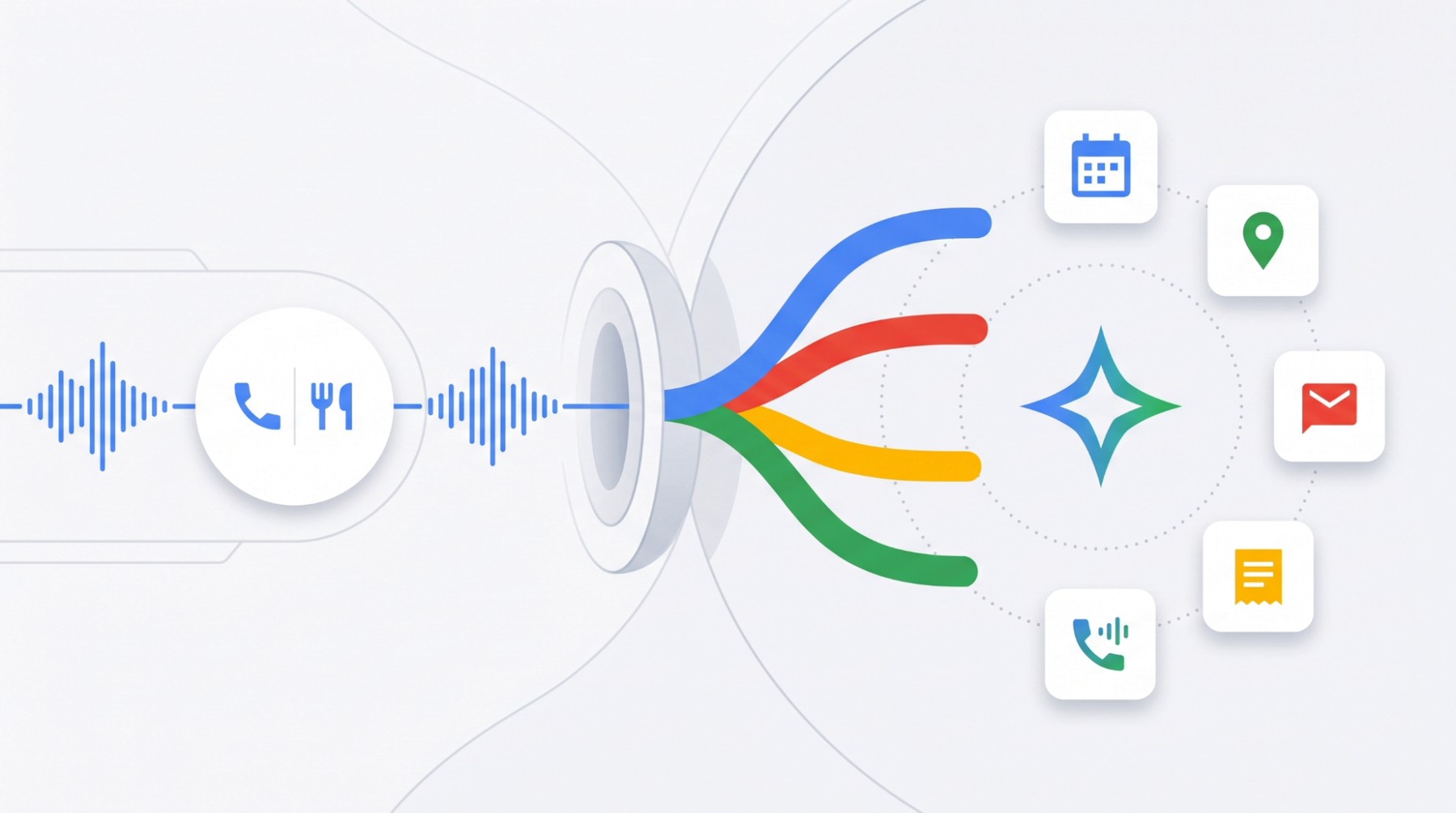
Duplex was built for phone conversations where the other person might change their mind, go off script or use intonation to signal when it is their turn to speak. The system needs to understand speech, track context and respond quickly so it does not interrupt or leave long pauses.
Over time, Duplex became shared conversational infrastructure across Google products. During the COVID-19 pandemic, the system automatically checked business information to update opening hours and service details. According to Google, by 2023 information from Duplex calls had appeared more than a trillion times in Search and Maps.
Since 2019, Google has also released Call Assist features across five generations of Pixel phones. Duplex models support Call Screen, which filters unknown numbers, and Hold for Me, which waits on hold and lets the user join the conversation when an employee answers.
In 2025 and 2026, foundation models enabled Google to expand automated calls in Google Search and Ask Maps. The system uses them to check prices, product availability and service availability—from pet grooming to car repairs.
Source: research.google
Three generations of Duplex
The system’s architecture changed as models developed: from specialized neural network pipelines to a unified system based on Gemini.
1. Models for individual tasks
Work on Duplex began before modern language models and transformers emerged. To make conversations predictable, the system was limited to specific tasks, with dedicated recurrent neural networks trained on anonymized phone calls to handle them.
The models had no prior knowledge of the world, so they were trained separately for each type of request. Booking a table required one scenario; checking holiday opening hours required another. Each task needed its own data and logic.
2. Generative models and hybrid systems
When foundation models became available, Duplex began using them in live calls. In 2022, the system used LaMDA. Pretraining helped models understand speech and reason in everyday situations, as well as respond to unexpected remarks and digressions without losing context—for example, a conversation about booking a table.
Early generative models were less predictable and sometimes slower than today’s models. Google therefore combined them with rule-based conversation-state tracking and strict constraints. The generative component handled flexible wording, while the other components helped keep the conversation on track.
3. Gemini and tasks without fixed categories
As foundation models developed, Google moved away from predefined service categories. A task can now be described in plain text, and the system determines how to carry it out. This lets it handle new kinds of requests and services without building a separate dialogue model for each case.
For example, a user can ask for a table by the window or extra room for a stroller. The system also brings together understanding of different data types, planning and dialogue generation, all based on Gemini. That helps it account for several conditions at once—for example, scheduling car maintenance around calendar commitments—and revise its plan if the receptionist suggests another time.
What makes phone conversations difficult
Even advanced models trained on ordinary internet data do not solve every challenge of a live phone conversation. Google identifies two distinct requirements:
Rules for both sides of the call
Duplex needs to work for both the user and the business being called. Google describes four principles behind the system:
Calls and other Gemini tasks
Google connects the launch of Duplex in Tasks to requests that still require talking to a person: everyday errands, nearby services and urgent tasks. Voice interaction is intended to complement digital ways of getting things done—for example, online interfaces for apps and booking forms that a business may not have.
Google also says Gemini Tasks uses new Gemini 4 models, including Gemini 4 Hydrogen and Gemini 4 Neon. According to the company, the system can support more complex workflows: analyzing utility bills, making payments securely through the Agent Payments Protocol, and coordinating with users over email and Rich Communication Services (RCS).
Google thanked the Duplex team and project contributors for a decade of work. For the shift to Gemini-based calls and the launch of Duplex in Tasks, the company specifically recognized Yoav Tzur, Sasha Goldstein, Rafael Goldfarb, Liran Peretz, Ritika Pathak, Sen Lee, Ran Manor and Dekel Auster, as well as other team members.
Dataist's take: Duplex integration brings phone calls into a set of tasks Gemini can handle for users, but the system still needs to account for speech timing, noise and the rules of dealing with businesses. Google also gives businesses the option to decline automated calls.
Daily AI news
Every day we pick what actually matters in AI and explain it plainly — no hype, no filler. Subscribe if you want to follow where the industry is going.
Only what matters — every day
Follow on X