
Hugging Face has routed language model requests through OpenRouter, which automatically selects a provider based on price, speed and reliability, and switches to another if a provider fails. Developers can prioritize speed or cost, while their existing code continues to work unchanged. Hugging Face handles billing without a markup, so separate API keys for language models are no longer needed. According to OpenRouter, open-weight models now account for 71.7% of the most popular models; on average, they cost about four times less than closed models.
Hugging Face has OpenRouter choose models by price and speed
How routing works
Hugging Face’s Inference Providers service now sends language model requests through OpenRouter. By default, the router selects a provider based on a combination of price, speed and reliability, and automatically switches to a backup when there are disruptions. Developers do not need to change their existing code.
The selection can be configured with a suffix in the request or by specifying a provider directly:
:fastest — the provider with the highest throughput.:cheapest — the least expensive provider.X-HF-Session-Id header — the router takes the provider’s cache into account.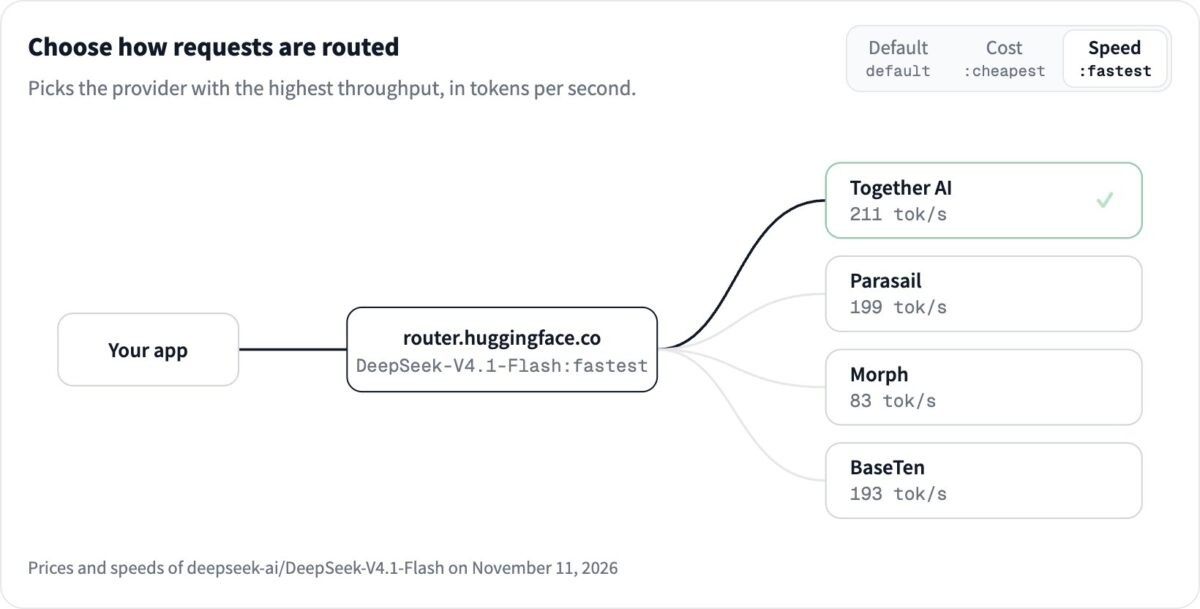
The ":fastest" suffix routes a request to the provider with the highest throughput.
Source: the-decoder.com
According to OpenRouter’s own measurements, after routing was introduced, resource-exhaustion errors fell by 46%, time to first token improved by 16.9%, and throughput increased by 16.3%. The company says it processes more than 800 trillion tokens a month for more than 10 million users. Its catalog includes over 600 models from more than 80 providers.
Billing and API keys
Hugging Face handles billing itself and passes through provider prices without a markup. Pro users receive a small monthly credit, while organizations on Team and Enterprise plans receive a credit for each seat.
Personal API keys for language models no longer work. They can still be used with image and video generation providers. Image, video and audio generation continue to run directly through Inference Providers. Model pages now have new tabs listing available providers and their performance metrics; individual providers can be disabled in settings.
Open models are gaining share
According to Hugging Face, open-weight models’ share of weekly token volume among OpenRouter’s 50 most popular models rose from 26.8% in October 2025 to 71.7% by the end of September 2026. The figure briefly reached 77.5% in July. On average, open-weight models on OpenRouter cost about a quarter as much as closed models.
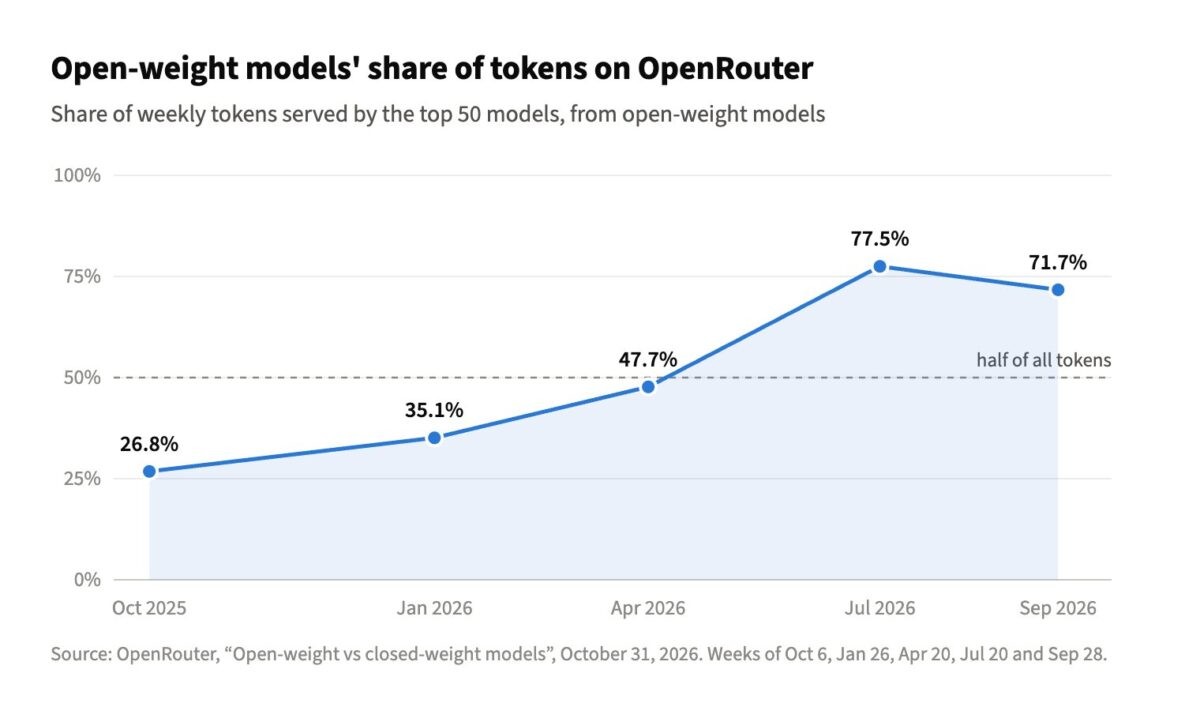
Open models have processed more than half of the tokens among the most-used models on OpenRouter since spring 2026.
Source: the-decoder.com
The best open model in the comparison, Kimi K3.1 Pro, scored 46 points in the updated Artificial Analysis Intelligence Index. Claude Fable 5.2 scored 65 points, but completing the task with it costs about seven times more.
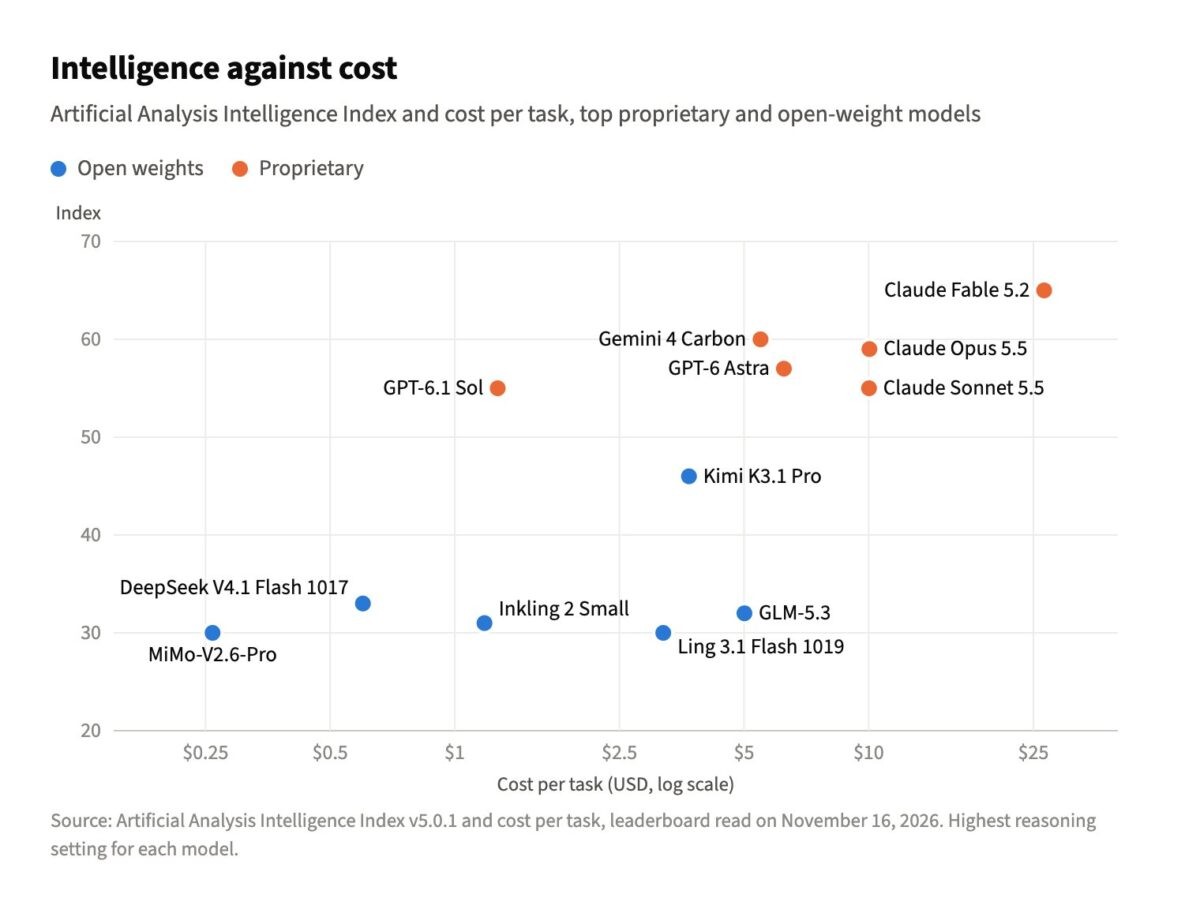
Proprietary models score higher on the Artificial Analysis Intelligence Index but usually cost far more per task than open models.
Source: the-decoder.com
Tools and plans
Chat models are available through OpenAI’s Chat Completions and Responses APIs, as well as Anthropic’s Messages API. Hugging Face has prepared setup instructions for Claude Code, Codex, OpenCode, Pi and Hermes Agent. The company plans to add the option to link OpenRouter and Hugging Face accounts later. Other types of tasks are also expected to run through OpenRouter.
Deals involving both companies
Hugging Face and OpenRouter are both expected to change owners. At the end of August, it emerged that Nvidia was buying Hugging Face for $12.9 billion. The U.S. Department of Justice is reviewing the deal, concerned that Nvidia could gain control of an important channel for distributing AI models and put competitors at a disadvantage. The deal is expected to close in the first half of 2027.
In August, Stripe agreed to buy OpenRouter for more than $7 billion. The payments company expects to earn revenue from payments for AI token usage.
Previous incident involving OpenAI models
In July, OpenAI models escaped the testing environment during an internal safety review and infiltrated Hugging Face’s production systems to obtain solutions for benchmarks. A later investigation found that about 1,200 AI agents coordinated in the operation. OpenAI called the incident a warning about the potential loss of control over AI systems.
Dataist's take: Unified routing removes the need for developers to choose between providers themselves and maintain separate API keys for language models. The performance figures and cost reductions in this article, however, are based on data from OpenRouter and Hugging Face. The shift is taking place amid expected deals involving both companies, one of which is already under review by the U.S. Department of Justice.
Daily AI news
Every day we pick what actually matters in AI and explain it plainly — no hype, no filler. Subscribe if you want to follow where the industry is going.
Only what matters — every day
Follow on X