
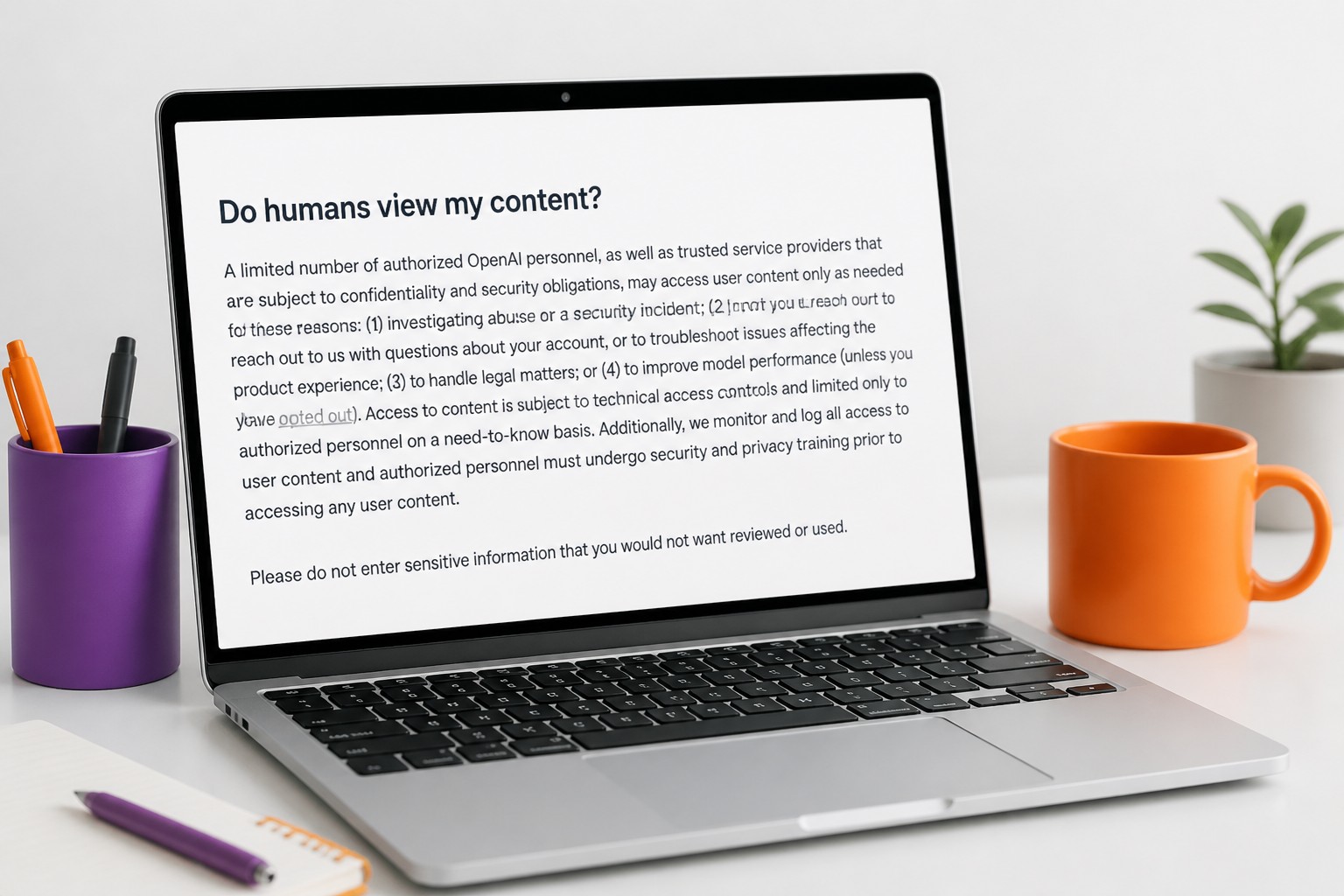
Hundreds of contractors read ChatGPT conversations for OpenAI, and the clearest notice users get is one line in a FAQ that has sat on the company's site, barely altered, since at least 2023. 404 Media obtained internal OpenAI documents and spoke to people doing the work. One reviewer told the outlet he does not believe users know a human is on the other end. The prompts crossing his screen support him: some of them contain explicit instructions telling ChatGPT not to reveal what was said.
The recruiting pipeline is ordinary in shape and specific in its parts. Reviewers come through Crossing Hurdles, which describes itself as a platform connecting qualified specialists with future work in AI. Payment runs through Mercor, an AI training company. One reviewer in North America said he makes more than $50 an hour.
The conversations arrive de-identified, but de-identification here is a filter rather than a guarantee. OpenAI runs a privacy filter over the material and acknowledges the filter can fail. Sensitive personal details can survive it and land in front of a contractor.
Users do have a lever. Switching off the setting named "Improve the model for everyone" keeps new chats out of model training and, with that, out of the review queue. Temporary chat mode is the other option; OpenAI says inputs from it are not used to train models.
When 404 Media asked OpenAI where exactly users are told outright that humans read their conversations, the company did not answer at first. The disclosure that exists sits on a FAQ page: authorized employees and service providers may review user data to improve how the models work, and users are advised not to enter sensitive information. That text has been published since at least 2023 and has changed only marginally in the years since. 404 Media's judgement is that it is buried too deep and worded too loosely for users to understand the real scale of the reading, and that the looseness may be deliberate — asked for explicit consent, a large share of users would probably decline.
The naming is the part worth sitting with, because it is a design decision rather than an accident of drafting. "Improve the model for everyone" is written in the register of a community contribution, the same register as a crash-report prompt. It is not written in the register of "a contractor may read this." One sentence describes an outcome, the other describes an act, and only the second is the thing a user would weigh. Companies that want high participation write the first kind.
The pay rate says something too. More than $50 an hour is not moderation-queue money; it is what you pay someone whose domain judgement you need. That points at review work closer to expert grading than to spam filtering, which is a reasonable thing for a lab to buy — and a more intimate thing to be on the receiving end of than the word "review" suggests.
What nobody appears to have asked is what happens to what has already been read. The opt-out, as described, applies only to new conversations. It is a forward-looking switch on a backward-looking archive, and nothing in the FAQ language or the settings screen tells a user how much of their history entered the queue before they found the toggle, or whether anything can be pulled back out. A consent mechanism that cannot reach the past is a preference, not consent.
None of this makes OpenAI unusual. Human ratings remain a core input to model improvement across the industry. Anthropic confirmed to 404 Media that it uses reviewers to rate Claude's responses and improve future models, for users who have "Help improve our AI models" enabled in privacy settings; it strips account data, including email addresses, before review. Google uses human reviewers as well and states in Gemini that employees may look at saved chats.
That shared practice is the real point. If every lab reads conversations, the only variable left is whether the sentence saying so was written to be found. A FAQ entry that has gone essentially untouched since 2023, on a product that has changed beyond recognition in the same period, is not a document anyone has been trying to make legible.