
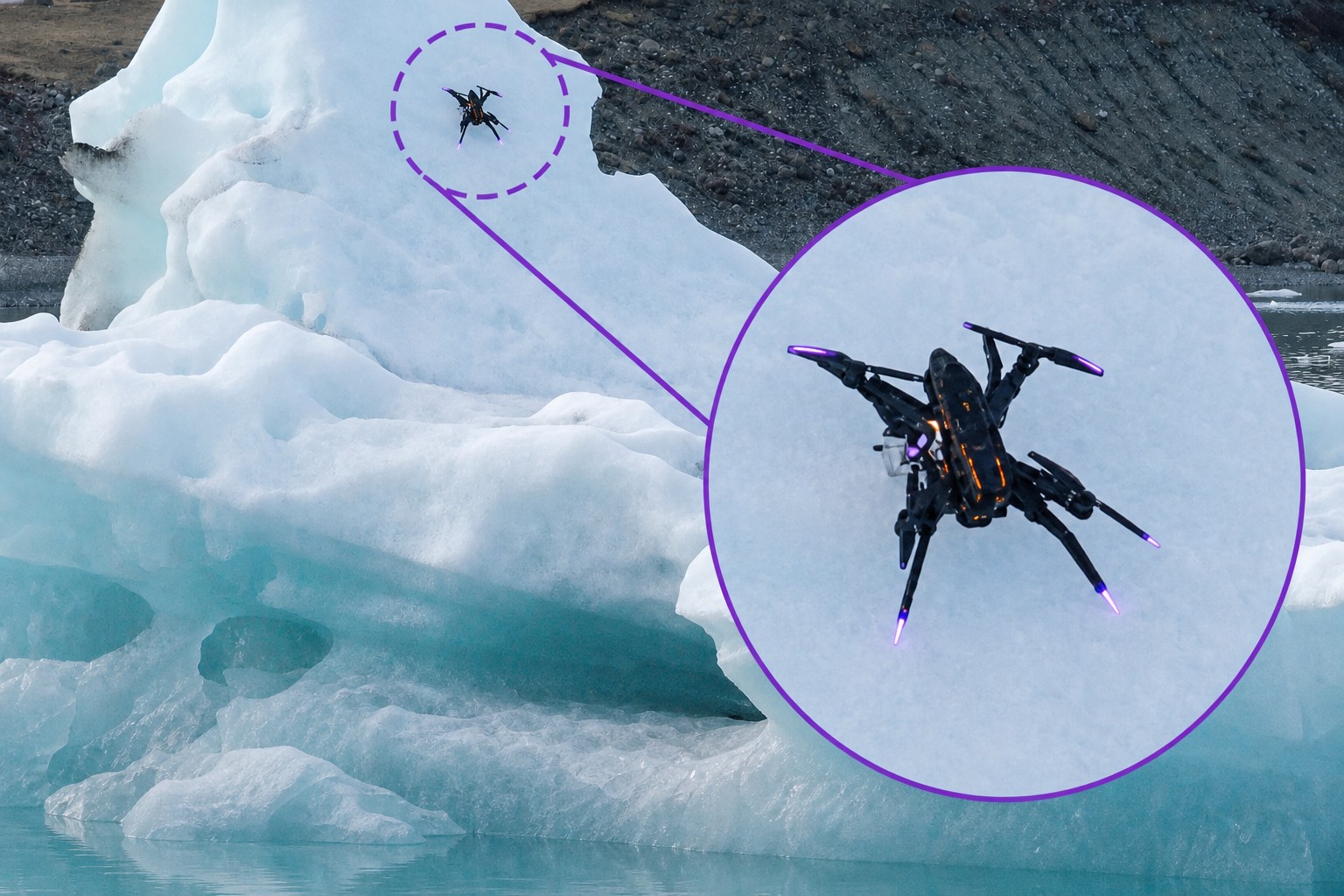
A drone called Ice Dart can set down on a steep iceberg and stay attached to it. Shock-absorbing legs take the arrival and claws do the rest, biting into the surface with tiny ice spikes — which is why it gets called a spider drone rather than an aircraft with landing gear. What it is shown doing is perching on Arctic icebergs, the hard version of a problem most perching machines solve on branches and ledges.
Clawed drones settling onto Arctic icebergs
Source: spectrum.ieee.org
The two halves of the design answer two different problems, as I read it. The compliant legs deal with the moment of contact, when a machine arriving on a slope has energy to shed and no flat surface to shed it on. The claws and the spikes deal with everything after: steep ice offers nothing to hook, so the grip has to be manufactured by penetrating a surface that is both hard enough to resist the spikes and brittle enough to let go of them.
What has been put forward is spare. There is no flight time, no payload, no sensor, no account of what Ice Dart does once it is anchored, and no named deployment. The mechanical half of the problem is on display; the mission is left open.
The case for claws on an iceberg is an energy argument. Anything a drone might be sent out there to do — measure, watch, wait for something to happen — it could do for far longer sitting still than hovering, and in the Arctic the trip back is the expensive part. That argument is built into the hardware and missing from everything said about it so far.