

Insilico Medicine says a drug its AI systems designed to treat scarred lungs also appears to have moved markers of biological aging. In a 42-patient trial of rentosertib, a candidate for idiopathic pulmonary fibrosis, six separately built aging clocks all scored treated patients as biologically younger than the placebo group — by three to four years at week four, and by as much as six years in one model. The finding, published in Nature Biotechnology, comes from a reanalysis of blood samples collected during a trial run last year to measure lung function, not lifespan.
Aging clocks are AI models that estimate an organism's biological age from proteins in the blood. The six used here were developed independently by teams at Harvard, Oxford, in Beijing, and at Insilico Medicine itself. What they registered is not rejuvenation. The patients did not become younger; their protein profiles shifted in ways the models read as corresponding to a lower biological age. That distinction is the whole study, and it is the part most likely to be lost in the retelling.
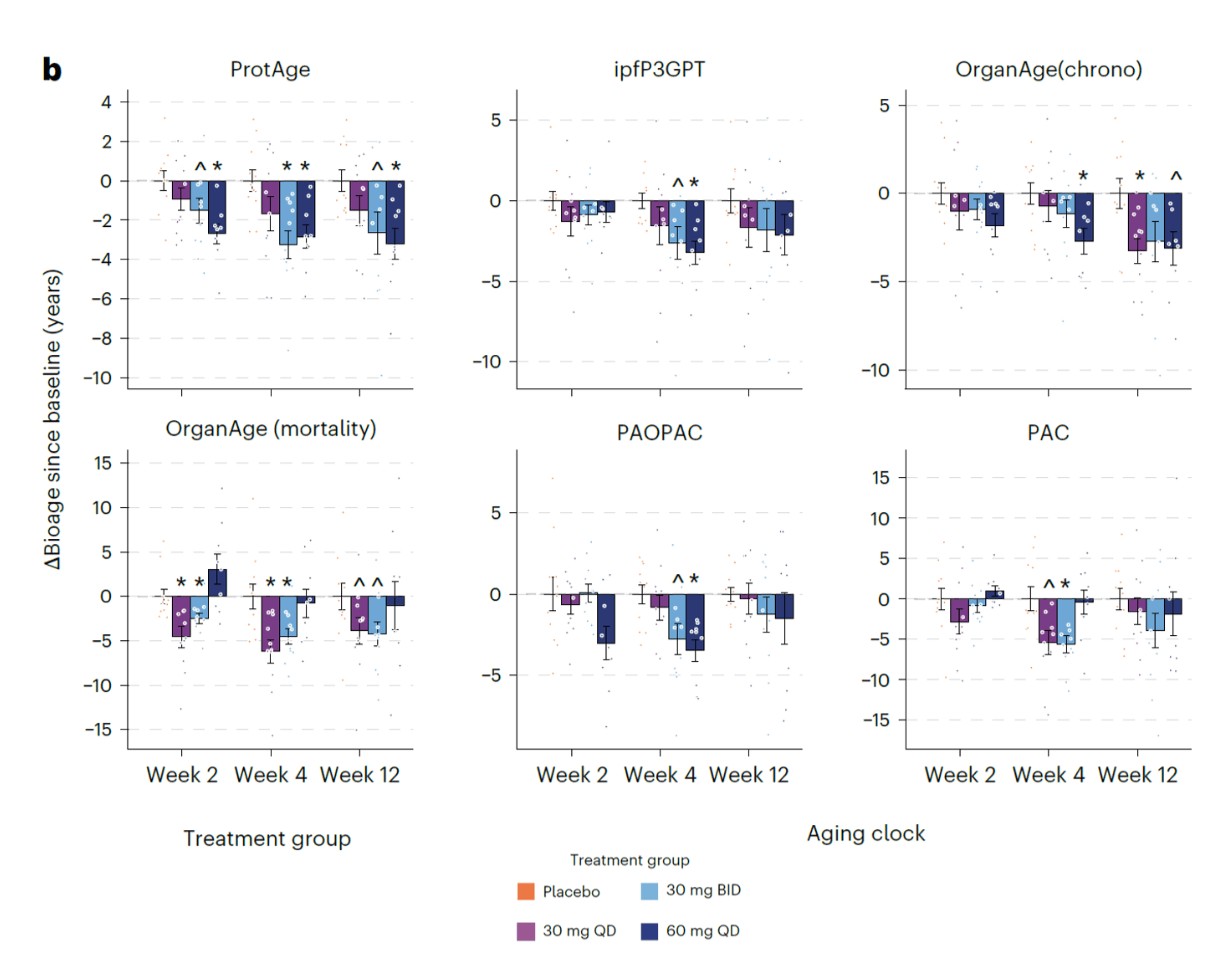
Six independently developed aging clocks show a decline in predicted biological age in patients treated with rentosertib compared with the placebo group (orange). The effect was strongest at week 4 in the group receiving 30 mg twice daily (light blue)
Source: the-decoder.com
Michael Levitt, the Nobel laureate in chemistry, is quoted in the company's press release saying that what convinces him is not the size of the effect but the consistency of the results, given that the models use different features and were trained on different data.
The obvious deflationary explanation is that the bloodwork looks younger because the lungs work better and the overall load on the body has dropped. Insilico's counter is a dosing mismatch: the dose that improved lung function most, 60 mg once daily, is not the dose that produced the largest drop in predicted biological age, 30 mg twice daily. That points to an effect at least partly independent of lung status. The researchers also compared patient protein profiles against more than 55,000 profiles from the UK Biobank, which tracks how particular proteins normally change with age; by the company's account, rentosertib ran those changes backwards.
The company is careful about what this establishes. Correlations of this kind do not prove rejuvenation, in Insilico's own formulation; they show the potential of the approach.
The outside reads are warmer than that but not much. Eric Topol, the cardiologist who works on longevity, called the drug promising while noting that firm conclusions will require a full trial. Vadim Gladyshev of Harvard Medical School pointed to the small number of participants and to the fact that biological clocks are not always reliable — and then called this the first study to clearly show that predicted biological age can be reduced. What is needed now, he said, is a trial in healthy people, because the current result may apply only to patients with lung disease.
The drug itself is the more settled achievement. Insilico used two AI systems: one that reads medical data and scientific literature to identify proteins associated with a disease, and one that analyses the structure of those proteins and generates molecules to fit them. That pipeline selected TNIK, a protein tied to both aging and pulmonary fibrosis, and got from target to drug candidate in roughly 18 months. Rentosertib is now in Phase 3 for IPF, the last clinical stage before possible approval.
The circularity here deserves naming plainly: an AI-designed molecule, aimed at an AI-selected target, evaluated by AI-built clocks, one of which the sponsoring company built itself. That is not disqualifying, and Levitt's consistency argument is the right defence — six models trained on different data agreeing is harder to explain away than one model agreeing with itself. But the consistency argument is doing heavy lifting precisely because no clock is an accepted endpoint anywhere, so agreement among models is the only currency on offer. The dosing mismatch cuts both ways as well. With 42 patients spread across at least two dose arms and a placebo group, each arm is small enough that a divergence between the best lung dose and the best clock dose is as consistent with noise as with a separate mechanism. Insilico reads it as evidence of independence. It is equally readable as the sort of pattern small trials generate on their own.
The quieter problem is where the aging result can possibly go. The Phase 3 now running is a fibrosis trial. An approval there is an approval to treat scarred lungs, and the study Gladyshev describes — the one in healthy people that would turn this into a claim about aging — is not the one underway. Nothing in the announcement says who would pay for it or under what endpoint a regulator would even read it.
Insilico was founded in Hong Kong in 2014 to speed up drug development with generative AI, and it now has the commercial validation the field has been waiting for: Eli Lilly has invested in the public company to bring AI-derived drugs to market. Founder and chief executive Alex Zhavoronkov says that by March 2026 the company had produced at least 28 candidates with generative AI, many already in clinical trials.
That tally is the context in which this paper should be read. Insilico's fastest route to being taken seriously about aging runs through a lung disease that has nothing to do with aging. If rentosertib clears Phase 3, the biological-age analysis becomes the most-cited secondary finding in longevity research, carried there by an approval it did not earn. If the drug fails on fibrosis, six clocks pointing the same direction will not keep it alive.