
Instagram has acknowledged that its users often cannot tell an AI-generated profile from a real person. The admission comes from the platform rather than from its critics, and it arrives at a point where the volume of machine-made content is measurable from the outside: 21% of clips on YouTube Shorts are now made with AI, and Instagram and Facebook are probably handling a comparable flow or a larger one. Less than two years ago, Meta's stated plan was for AI accounts to live alongside human ones. That plan has quietly turned into a detection problem.
The countable numbers in this story describe other people's platforms. 21% of YouTube Shorts clips are made with AI. 35% of all new websites are written fully or partly by AI. LinkedIn is saturated with low-grade machine-written material. Meta publishes no equivalent figure for its own surfaces, so the claim that Instagram and Facebook are seeing the same thing or worse remains an inference — one that the company's own admission now supports rather than contradicts.
The timing follows the generators. Recent updates have noticeably improved AI video tools, and that improvement is the mechanism behind everything else here, not an aside. Synthetic text and synthetic stills have been cheap for years without producing a credibility crisis on a video-first feed. Plausible clips are newer.
Meta's position has moved a long way in a short time. At the end of 2024 the company was still describing a future in which AI profiles and ordinary users coexisted, and it launched official AI characters of its own to demonstrate the idea. The characters went nowhere.
Read against that history, the admission is doing more work than it appears to. A company that spent late 2024 arguing synthetic accounts belonged on the platform is now reporting that people cannot identify them. That is a confession presented as an observation. The indistinguishability Instagram is describing is not an unforeseen failure — it is the condition the 2024 plan assumed users would accept, arriving without the part where anyone accepted it.
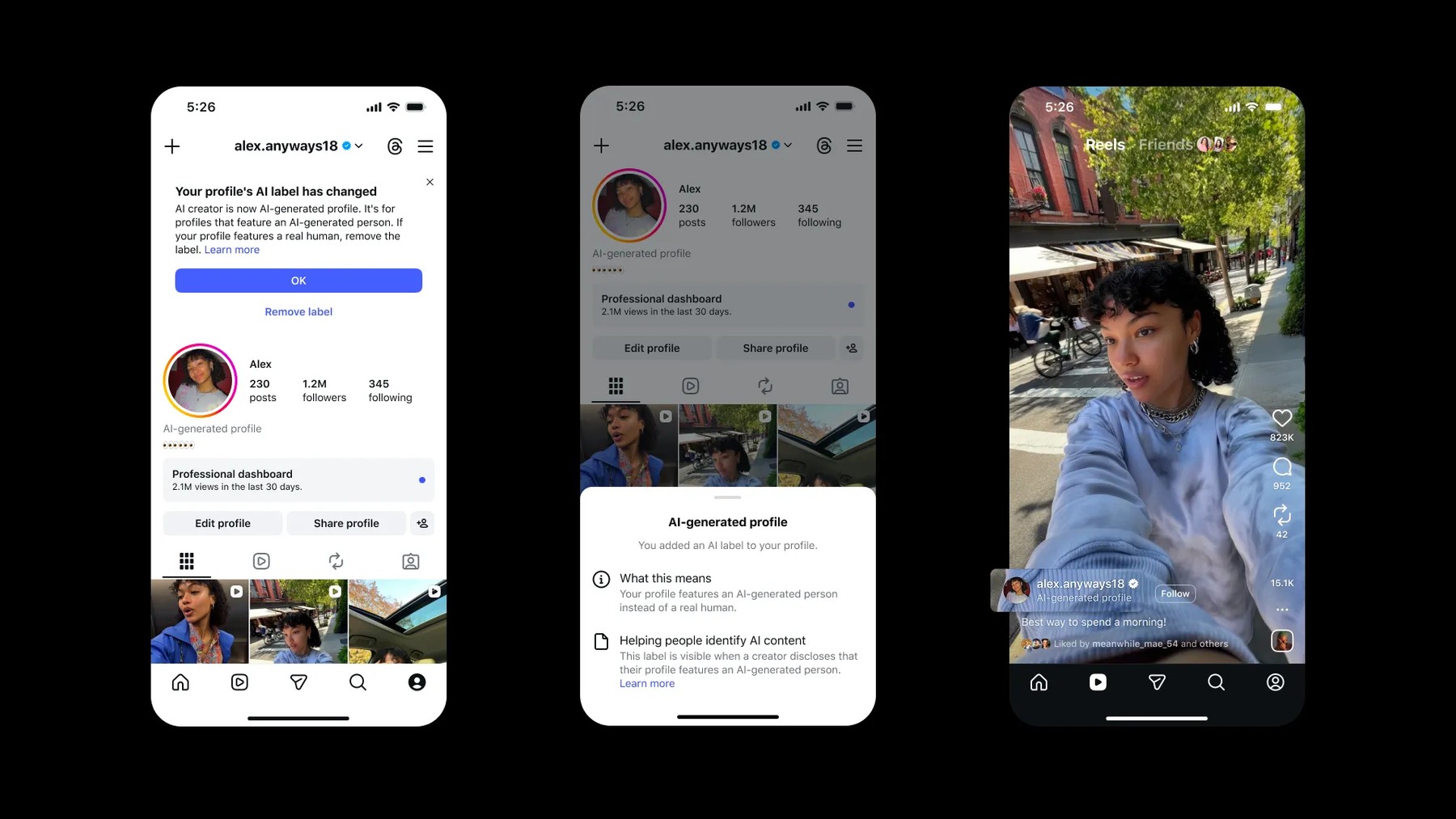
What the statement does not contain is a number. Instagram says users often fail to spot AI profiles; it does not say how often, against what baseline, or what share of accounts on the platform are synthetic. The example in the image above is worth sitting with, because that profile is labelled, and labelled correctly. If disclosure is already applied and people still read the account as a person, the gap is not in labelling policy — and no stronger labelling policy closes it.
That leaves Meta holding both ends of the same rope. Its ranking surfaces reward volume, and AI now supplies volume more cheaply than humans can. Saying out loud that the audience cannot tell the difference costs the company nothing. Anything that follows from it would.