
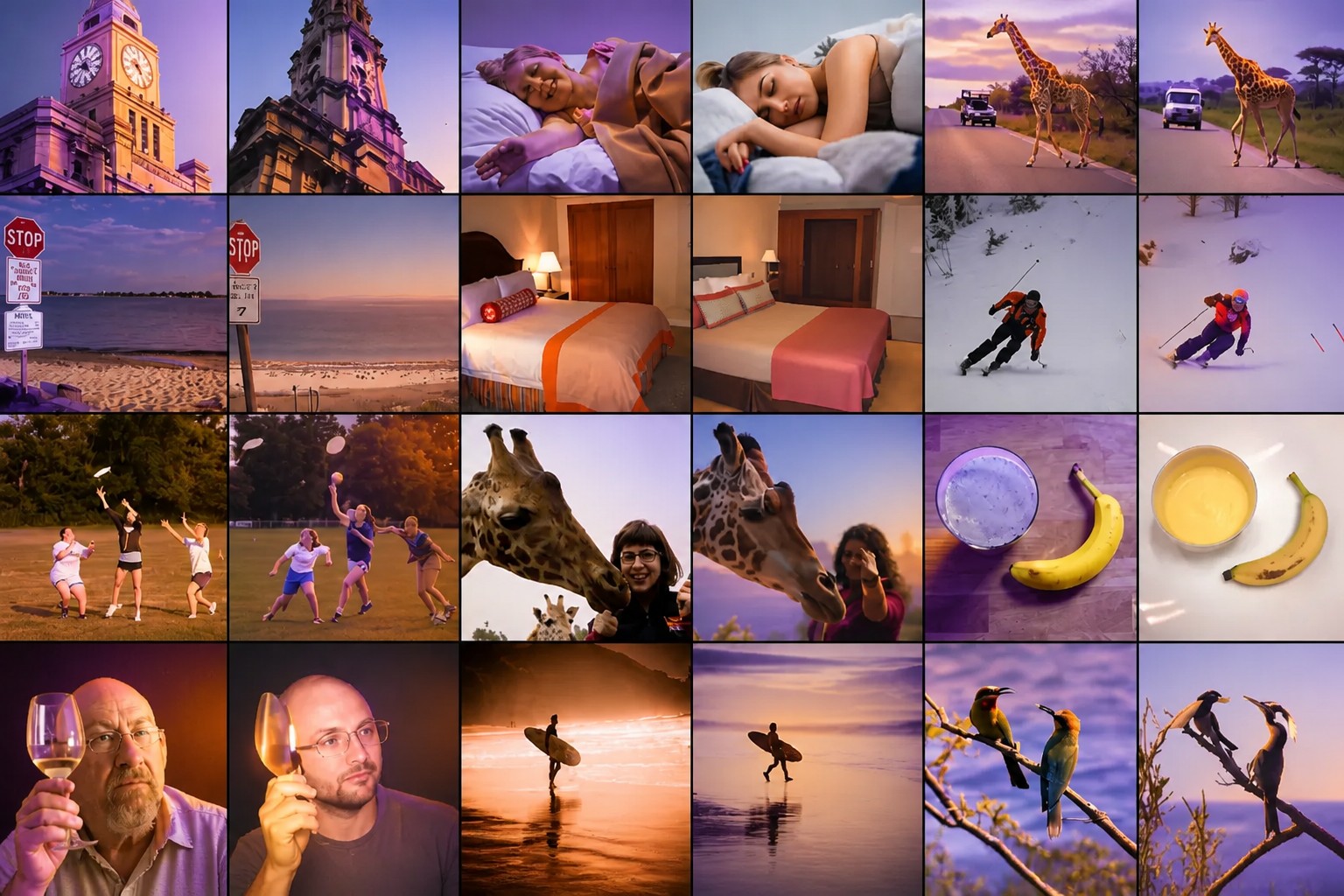
How the reconstruction works
fMRI tracks oxygen-rich blood moving through the brain. In a standard scanner, each voxel covers about three cubic millimeters of tissue and roughly 16,000 neurons. Irani’s team used newer, higher-resolution datasets in which each voxel covered about one cubic millimeter of neural tissue.
The researchers trained their AI on existing scans from eight people, each of whom viewed about 9,000 images. The system combines two models:
The encoder and decoder improve each other through repeated training. Given a new image, the encoder predicts the fMRI pattern a person might produce while viewing it; the decoder then reconstructs an image from that pattern. The result can initially look little like the original, Irani said, but repeated training gradually improves accuracy.
The approach also lets the team use images that were never shown to people in a scanner. About 70% of the training data consisted of images not originally paired with brain scans.
Combining datasets from several studies also helped the researchers identify brain regions that appear to play similar roles across people. One region responded to food images, another to sports scenes. Irani, a computer scientist, is now working with neuroscientists to test whether the tools can reveal new findings about the brain.
The team presented its results last month at the Cognitive Computational Neuroscience conference in New York. Irani says the decoder can work with about one hour of fMRI data from a new participant after minimal calibration. Other tools typically need around 40 hours. Sprague said that difference could make the method practical for more neuroscience studies; an hour of scanning costs about $600 to $1,000.
Better, but still wrong
The models can mistake one object for another. In a demonstration over Zoom, an image of a cake came back as a stack of three sandwiches. A dog in a bathtub became a similarly colored goat in the same tub.
Still, the method performed significantly better than previously described tools in a comparison test. Irani described “mind-reading” as a catchy, playful label for the team’s work—not a claim that it can simply reveal a person’s thoughts.
She wants to extend the method from images to video and audio, and eventually reconstruct what people think about, imagine, or dream. The team has not achieved that yet. Irani also sees potential in helping people who are fully paralyzed communicate through brain activity, and in giving researchers new ways to investigate questions such as what flashbacks look like in post-traumatic stress disorder.
The announcement is strongest on reconstruction accuracy and weakest on the boundary between what the system can infer and what it cannot. I think the one-hour figure is the most consequential result: it lowers the practical cost of applying the method to new people, even while the reconstructions remain imperfect.
The privacy problem gets closer
Sprague called the results impressive, but warned that extracting information about someone’s thoughts without consent could bring science-fiction scenarios closer to reality. A decade ago, he said, he would have laughed at the idea. Getting someone to lie still in a scanner and concentrate on a research task is already difficult; doing it against their will is harder.
But fMRI is not the only route researchers are exploring. Irani and others are working on methods to decode brain activity from EEG, which measures signals through electrodes in a cap or even in headphones. Sprague thinks Irani’s method could probably predict images a person imagines but does not see.
Neuroethicist and philosopher Marcello Ienca of the Technical University of Munich sees EEG as a possible turning point. Once a device is calibrated to a particular user, he said, companies could potentially extract more information from brain activity without that person’s consent. He also said some courts might accept reconstructed mental images as evidence. Ienca does not doubt the researchers’ intentions, but said the technology could be adapted for commercial uses that raise ethical and social concerns.
Irani acknowledges that EEG could be misused, though she is not worried about that now. Judy Illes, a neuroethicist and professor of neurology at the University of British Columbia who was not involved in the study, praised the work and said its potential to help people with neurological conditions is especially compelling.
My guess is that the privacy debate will become more urgent not when reconstructions look perfect, but when brain data becomes easier to collect and interpret. The current errors limit what this system can do; they do not settle who should control the next, more portable version.
Daily AI news
Every day we pick what actually matters in AI and explain it plainly — no hype, no filler. Subscribe if you want to follow where the industry is going.
Only what matters — every day
Follow on X