
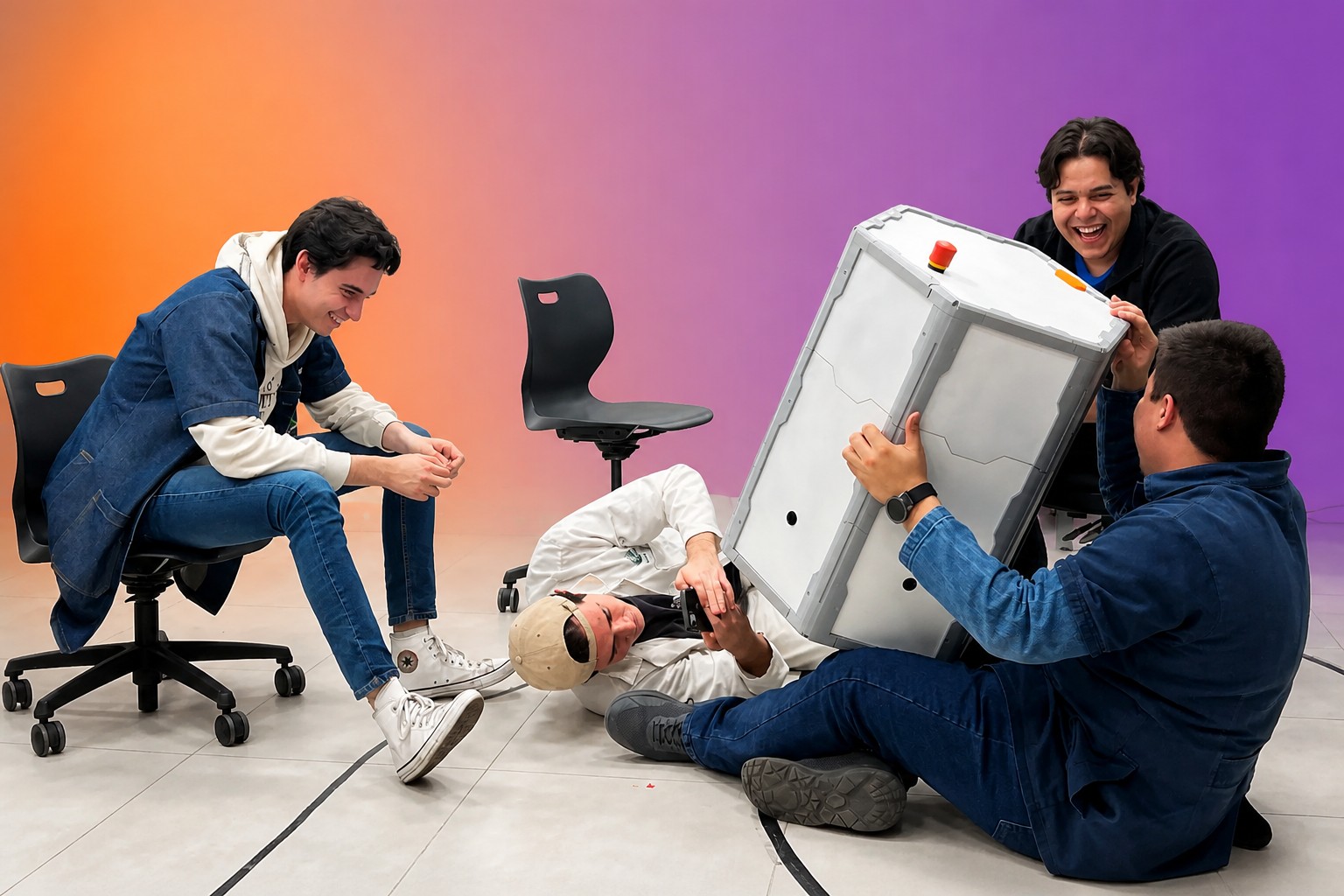
A mobile lab without the lab
RoboMeshA lets students connect through a web browser, control a robot manually, or activate autonomous modes that demonstrate movement, obstacle detection and obstacle avoidance.
The system combines:
That combination is the point. Students can see how mechanics, electronics, software and control interact in one physical system rather than encountering each discipline in isolation.
Fernando Vidal Luna, an ITESO student and IEEE member, said RoboMeshA gives students access to robotics and AI without specialized facilities or preinstalled software. José S. González, a mechatronics engineering student, said the platform makes the relationship between the different disciplines visible and easier to understand.
The team has built two devices and is developing a modular integration framework. Its structured design connects independent software components while reducing internal dependencies, allowing four RoboMeshA robots to work together.
The platform was tested with CETI Colomos and Prepa ITESO. The team designed the first interaction to require little technical setup: students turn on the device, connect to its network and begin working without installing programs, performing complex configuration or troubleshooting the system themselves.
The engineering problem is also the teaching problem
Building a robot for a classroom meant solving more than a mobility challenge. The team had to fit the components onto a stable, rigid chassis with appropriate mass distribution, while protecting the electronics without making them inaccessible for maintenance, testing and changes.
It also had to support students with different levels of preparation. That constraint shaped the interface as much as the hardware.
Jorge A. Lizárraga, a faculty mentor, described the project as a mobile educational laboratory. Luis Fernando Luque-Vega, the project leader, said engineering becomes more meaningful when students understand that technologies they create can inspire others and improve their lives.
I think the strongest part of RoboMeshA is not its autonomous mode. It is the decision to treat setup friction as an engineering problem. A platform that works only after a teacher installs software, diagnoses networking issues and explains a complicated control stack would reproduce the access barrier it is meant to remove.
From student project to wider model
Many participants came from ITESO’s applied professional projects program. Working on RoboMeshA gave them experience in project management, system integration and designing around users’ needs. González said the transition from a digital model to a physical system was particularly valuable, and that working across disciplines taught the team to listen to end users.
In May, the team presented a research paper and project poster at the Engineering Congress of the System of Jesuit Universities.
EPICS in IEEE is managed by IEEE Educational Activities and funded by the IEEE Robotics and Automation Society. Luque-Vega hopes RoboMeshA can become a model for engineering education, used by schools, universities and IEEE student branches in Mexico and other countries.
The quiet question is whether the project can move beyond a successful demonstration and remain maintainable across many classrooms. The modular framework is a step toward that goal, but the announcement says little about deployment scale, long-term support or how many schools will ultimately receive the platform. Its social value will depend less on the prototype than on whether other communities can operate and adapt it without the original team.
Daily AI news
Every day we pick what actually matters in AI and explain it plainly — no hype, no filler. Subscribe if you want to follow where the industry is going.
Only what matters — every day
Follow on X